





Struggling to scale your brand? Weak positioning could be the culprit. Growth-stage brands often face challenges like fluctuating revenue, inconsistent marketing results, and unclear differentiation. The solution? A strong positioning framework that aligns your team, clarifies your message, and helps you stand out in crowded markets.
Key takeaways from this guide include:
- Why positioning matters: Companies with solid positioning frameworks report up to 42% better marketing outcomes.
- Common challenges: Internal misalignment, diluted messaging, and competing on price instead of value.
- Proven frameworks: Use tools like Competitive Alternatives Analysis, the BCG Growth-Share Matrix, and Porter’s Five Forces to refine your strategy.
- Steps to success: Conduct a positioning audit, focus on customer needs, and create a clear Unique Selling Proposition (USP).
Positioning isn’t just a tagline – it’s the foundation for growth. This guide provides actionable steps to help your brand carve out a clear market space and build a scalable strategy.
Create A Competitive Positioning Strategy (Process Framework)
Common Positioning Challenges for Growth-Stage Brands
Growth-stage brands often grapple with unique hurdles when trying to carve out their place in the market. One major issue is internal misalignment – when team members have conflicting ideas about the brand’s market category. This disconnect leads to inconsistent messaging across marketing, sales, and product teams, which can erode customer trust over time.
Another frequent problem is positioning drift. Teams sometimes tweak messaging to make it sound more appealing, but this can unintentionally change the target audience or dilute the core value being communicated. This happens when positioning strategies remain buried in internal documents rather than being translated into clear, customer-friendly language.
"If the CEO is not the one driving the positioning, the strategy will fail."
– Anthony Pierri, Co-founder, FletchPMM
The consequences of poor positioning are serious. If prospects can’t easily understand what a product does or how it stands apart from competitors, it’s a red flag that the brand needs an immediate positioning overhaul. Misaligned messaging wastes time and resources, producing disjointed strategies that fail to reinforce the brand’s core identity. These internal missteps directly affect how the brand is perceived externally.
Standing Out in Crowded Markets
In today’s saturated markets, gaining "mind share" is a steep challenge, especially for brands with limited budgets. Without the resources to outspend competitors, many growth-stage companies end up mimicking their rivals’ messaging. This results in a lack of differentiation, which pushes prospects to focus solely on price. When price becomes the deciding factor, brands find themselves in a downward spiral of shrinking margins and tougher lead generation.
The numbers tell a clear story: brands with consistent positioning see revenue increases of 10% to 20%, while those with strong multi-channel messaging enjoy a 33% boost in customer retention. However, many brands fall into the trap of product-centric messaging. Highlighting features – like a "boxy shape" – instead of emotional drivers or practical benefits – such as "safety" – fails to create a meaningful connection with customers. In crowded markets, standing out requires more than just a good product; it demands a deep understanding of what truly resonates with your audience.
When Customers Don’t Understand Your Position
Unclear positioning doesn’t just confuse your team – it confuses your customers. If prospects can’t quickly grasp how your product fits into their lives or stacks up against alternatives, they’re unlikely to engage. Just as internal clarity is essential, your outward messaging must be equally straightforward.
Here’s a key insight: 87% of customers prefer brands that align with their beliefs. This underscores the importance of communicating values and purpose, not just features. Yet, many growth-stage brands fail to make their positioning visible across all customer touchpoints, keeping these strategies locked away in internal documents. Without a clear, customer-focused message, brands risk fading into obscurity, losing the chance to connect with their audience.
On the flip side, brands that prioritize customer needs in their positioning enjoy tangible benefits. Research shows that customer-centric companies achieve 21% higher profitability when their messaging directly addresses specific pain points and desires. To truly stand out, growth-stage brands must bridge the gap between internal alignment and external clarity.
Proven Positioning Frameworks for Growth-Stage Brands
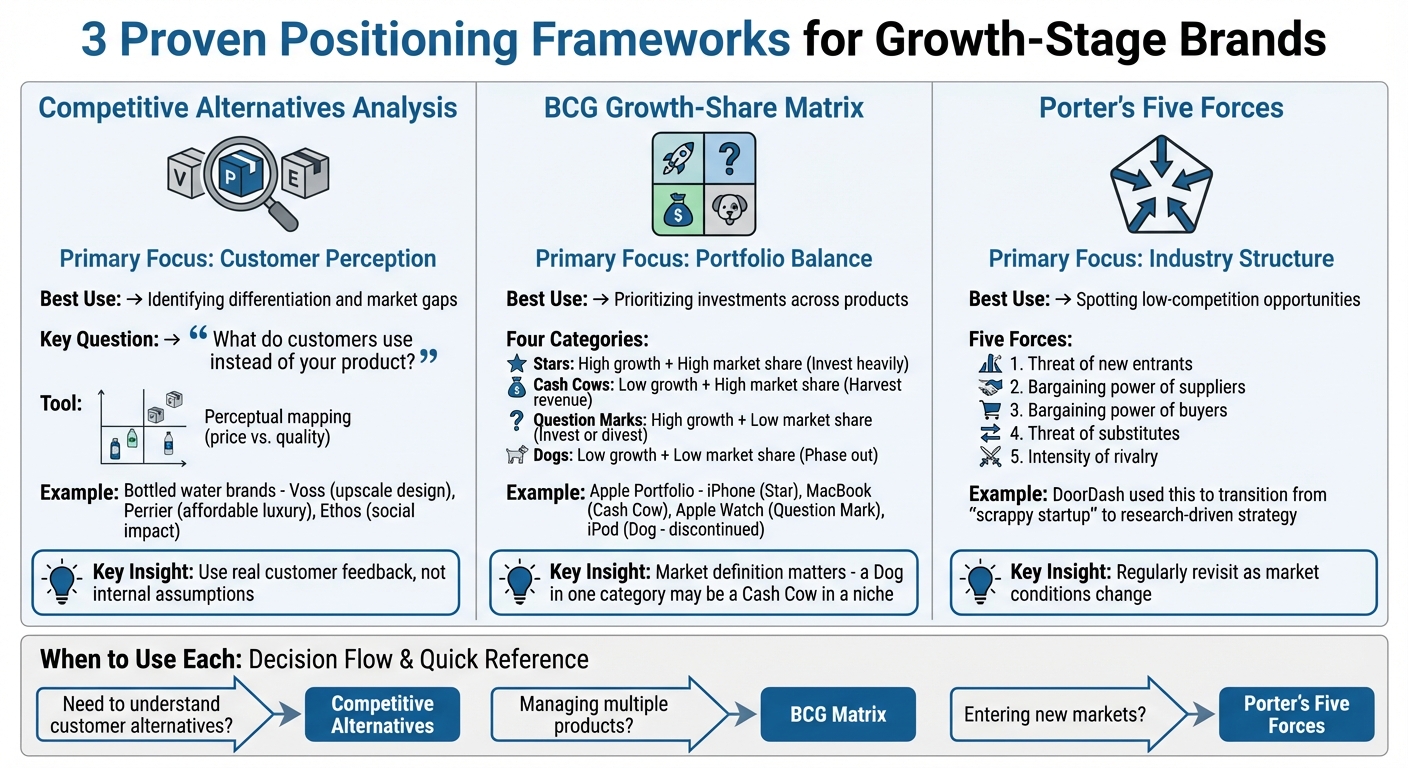
Positioning Frameworks Comparison: Competitive Alternatives vs BCG Matrix vs Porter’s Five Forces
Positioning frameworks help you uncover your edge in the market and guide strategic decisions. Building on earlier challenges, these tools offer practical ways to refine your brand’s place in the market. Each one tackles a different aspect of positioning – whether it’s understanding customer perceptions or deciding where to allocate resources.
Competitive Alternatives Analysis
Start by considering this question: What do customers use instead of your product? The answer goes beyond identifying your direct competitors. It sheds light on the shortcuts or alternative solutions customers turn to when addressing the problem your product solves.
A helpful tool here is perceptual mapping, where you plot brands on a two-axis grid (like price vs. quality) to visualize market opportunities. Take bottled water brands in 2024 as an example: Voss targeted upscale consumers with its sleek glass bottle, positioning itself as a "design statement." Perrier aimed for middle-class buyers, offering "affordable luxury" with naturally carbonated water and playful branding. Meanwhile, Ethos captured socially conscious millennials by donating to clean water initiatives.
The secret? Rely on real customer feedback – not assumptions from within your company – to create an accurate map.
BCG Growth-Share Matrix
The BCG Growth-Share Matrix is a classic framework for allocating resources across your product portfolio based on market share and growth. It divides your offerings into four categories:
- Stars: High-growth products with strong market share. These are your leaders and need substantial investment to stay on top.
- Cash Cows: Products in mature markets with steady revenue. They require minimal resources but fund other initiatives.
- Question Marks: Products in high-growth markets that haven’t yet captured significant share. They demand heavy investment but could evolve into Stars – or fail.
- Dogs: Low-growth, low-share products that often drain resources without meaningful returns.
For instance, Apple’s 2024–2025 portfolio demonstrates how this matrix works. The iPhone is a Star, driving over half of the company’s revenue in a growing market. The MacBook serves as a Cash Cow, generating stable income to support R&D. The Apple Watch, a Question Mark in the fast-growing wearables market (10%+ annual growth), requires significant investment to gain dominance. Meanwhile, the iPod was a Dog and was eventually discontinued as its market faded.
The takeaway? Invest in Stars, use Cash Cows to fund growth, transform Question Marks into Stars, and phase out Dogs. But remember, defining your market is critical – a product might be a Dog in a broad category but a Cash Cow in a niche.
Porter’s Five Forces Analysis
While the BCG Matrix focuses on your product portfolio, Porter’s Five Forces examines the structure of your industry. It highlights where competitive pressure is weakest, helping you position your brand more effectively.
This framework evaluates five forces:
- Threat of new entrants: How easy it is for competitors to enter your market.
- Bargaining power of suppliers: Whether suppliers can raise prices.
- Bargaining power of buyers: Whether customers can demand lower prices.
- Threat of substitutes: Alternative solutions that limit your pricing power.
- Intensity of rivalry: The level of competition.
These forces influence profitability and long-term growth. For example, in October 2023, Santiago Sanchez, General Manager at DoorDash, used this approach to transition the company from a "scrappy startup" mindset to a more disciplined, research-driven strategy. By analyzing competitive forces, DoorDash uncovered new growth opportunities and reduced risks in strategic planning.
"Research enables a much tighter focus to our strategy conversations, which ultimately gives us greater advantage."
– Santiago Sanchez, General Manager, DoorDash
Regularly revisiting these forces is crucial, as shifts like technological advances or regulatory changes can alter the balance of power. Focus on industries or segments where buyer or supplier power is weaker to maximize growth potential.
| Framework | Primary Focus | Best Use for Growth-Stage Brands |
|---|---|---|
| Competitive Alternatives | Customer Perception | Identifying differentiation and market gaps |
| BCG Matrix | Portfolio Balance | Prioritizing investments across products |
| Porter’s Five Forces | Industry Structure | Spotting low-competition opportunities |
sbb-itb-ad881f4
How to Build Your Unique Selling Proposition
Your Unique Selling Proposition (USP) is what ties your brand’s strengths to the challenges your customers care about most. It’s not just a catchy slogan – it’s a strategic choice that influences everything, from how products are developed to how they’re marketed and sold.
To get started, focus on understanding your customers. Dive into their needs by identifying the "Jobs to Be Done" – the functional, emotional, and aspirational challenges they face. This goes beyond basic demographics. For instance, brands that align their offerings with their audience’s values provide a stronger reason for customers to trust their promises, especially when targeting groups that make purchasing decisions based on personal beliefs.
Next, conduct a competitive SWOT analysis to assess market positioning. Study your top five competitors – both direct and indirect. Pay close attention to how they communicate their value in different spaces, like press releases versus their websites. This can uncover "brand whitespace", areas where customer needs are still unmet. Break down your product features into two categories: table stakes (the essentials everyone expects) and highlight features (the unique elements that solve customer pain points better than others).
Once you’ve gathered insights, craft your positioning statement. Use this simple formula:
"[Brand Name] is for [Target Audience] who [Need/Desire]. Unlike [Main Competitor], we [Key Differentiation] because [Reason to Believe]."
"Positioning defines how your product is a leader at delivering something that a well-defined set of customers cares a lot about." – April Dunford, Positioning Specialist
Your USP needs to be backed by solid proof. This could include data, customer testimonials, or proprietary technology. Without this kind of evidence, your USP might come across as just another empty marketing claim, which savvy customers will quickly see through.
If you’re looking for expert help to create a strong USP, check out Graystone Consulting. Their diagnostic audits and strategic insights are designed to help growth-stage brands uncover and articulate the unique advantages that fuel sustainable growth.
This strategic USP will lay the foundation for the step-by-step positioning audit covered in the next section.
Step-by-Step Implementation Plan
Running a Positioning Audit
Start by gathering insights from key stakeholders and reviewing all current marketing materials. The goal is to uncover any gaps between how your brand is perceived and how you want it to be positioned.
Take inventory of every unique attribute your brand offers – features, history, and team expertise included. At this stage, avoid judging their immediate relevance to customers. Instead, focus on documenting them. For each attribute, identify the specific capabilities and benefits it provides. For instance, if your company has a proprietary data integration process, explain how it empowers customers to achieve something they couldn’t before.
Next, zero in on your most engaged audience. Rather than trying to appeal to everyone, narrow your focus to the group that will deliver the highest return on investment. Evaluate your positioning across six key dimensions (Champion, Context, Task-at-hand, Current Way, Pain, and Capability) and assign a confidence rating from 1 to 5 for each. This exercise will highlight areas that need further validation before committing resources to execution.
Finally, map your product features against customer "Elements of Value" to identify untapped opportunities. Are customers relying on manual processes, sticking with the status quo, or choosing direct competitors? This analysis will reveal gaps in the market – areas where your competitors haven’t staked a claim.
Implementing Frameworks in Phases
Once you’ve completed the audit, transition to implementing a structured framework in phases. Break it down into four key steps: assess current assets, define aspirational brand territories, integrate customer feedback, and execute a tactical plan. Aim for quick wins within the first 30–60 days to build momentum and avoid the pitfall of spending months on strategy without visible progress.
Host a three-hour workshop to prioritize brand territories efficiently. Include cross-functional teams from Sales, Product, and Leadership to ensure alignment and smooth execution. Before rolling out the full strategy, validate 3–5 brand territories through customer interviews or surveys. This step ensures your new positioning resonates with your audience.
Once validated, craft a detailed communications plan. This should include guidelines for your brand voice, tailored strategies for different segments, and measurable KPIs. These steps will ensure your refined positioning aligns with your overall growth objectives. Remember, positioning isn’t static – it should evolve as market conditions change.
"Positioning is the act of designing the company’s offering and image to occupy a distinctive place in the mind of the target market." – Philip Kotler
For brands in the growth stage that lack the internal resources to manage this process, Graystone Consulting offers diagnostic sprints. These include full-funnel audits, KPI benchmarks, and growth roadmaps, providing the clarity needed to scale your positioning strategy effectively across all channels.
Conclusion
For brands in the growth stage, having a strong positioning strategy is the cornerstone of scalable success. The frameworks discussed in this guide – like Competitive Alternatives Analysis and Porter’s Five Forces – offer practical tools to uncover market opportunities, set your business apart, and craft a message that truly connects with your target audience.
Moving forward, embracing data-driven positioning represents the next step in refining market strategies. With AI-powered insights, traditional methods like occasional brainstorming or periodic updates are being replaced. These advanced tools analyze real-time market trends and customer feedback, turning static strategies into dynamic ones that adapt as the market evolves. In today’s fast-paced environment, your positioning can no longer be a “set it and forget it” approach – it needs to grow and shift alongside market changes.
But strategy alone isn’t enough. Execution demands strong leadership and expert guidance. The role of the CEO is pivotal – positioning must be championed from the top to ensure it influences every aspect of the business, from product development to sales, customer service, and beyond. When leadership takes ownership, the strategy becomes embedded in every interaction and decision.
For brands ready to put their positioning into action, Graystone Consulting offers diagnostic sprints. These are designed to transform your strategy into measurable, scalable systems, giving you the clarity and tools needed to execute effectively and drive growth.
FAQs
How can growth-stage businesses resolve internal misalignment in their brand positioning?
Growth-stage businesses often face challenges with internal misalignment, but a shared positioning framework can bring everyone together. This framework clarifies your brand’s purpose, target audience, and what sets it apart, ensuring that all teams are aligned and speaking the same language.
Start by developing a concise positioning statement. This statement should clearly define who your brand serves, what makes it different, and how it stands out in the market. When done right, it becomes the foundation for consistent messaging across the organization.
To keep everyone aligned as your business evolves, implement a structured brand positioning framework. This should include essential elements like your target market, brand promise, and competitive edge. Regular team workshops and check-ins are also key to refining this framework, ensuring it grows alongside your business. By building a shared understanding of your brand’s strategy, you can eliminate confusion and drive unified growth.
What is the CEO’s role in shaping a successful positioning strategy for a growth-stage business?
The CEO plays a key role in shaping and guiding a strong positioning strategy for a growth-stage business. As the company’s leader, they ensure that the positioning aligns seamlessly with the overall vision and growth goals, while encouraging collaboration across teams like marketing, sales, and product development.
By actively promoting the brand’s purpose, values, and unique strengths, the CEO helps establish a message that resonates both within the organization and with external audiences. Their leadership ensures the strategy evolves over time, adapting to market shifts and supporting continuous growth.
The CEO’s involvement is essential for keeping everyone aligned, building trust, and embedding the positioning strategy into the broader growth plan, ultimately driving competitive edge and long-term success.
How can frameworks like the BCG Matrix and Porter’s Five Forces help growth-stage brands succeed?
Frameworks like the BCG Matrix and Porter’s Five Forces offer growth-stage brands practical tools to navigate their competitive environment and make informed business decisions. These frameworks help pinpoint opportunities, assess potential risks, and allocate resources where they’ll make the biggest difference.
Take the BCG Matrix, for instance. It helps businesses categorize their products or services based on market growth and market share, making it easier to decide where to invest resources for maximum return. On the other hand, Porter’s Five Forces dives into the competitive dynamics of an industry – analyzing factors like rivalry among competitors, potential threats from new entrants, and customer influence. Together, these tools provide brands with a clearer picture of their market position and strategies to maintain or accelerate growth.



0 Comments