





A customer acquisition funnel is a step-by-step process that guides potential customers from discovering your business to becoming loyal, repeat buyers. It consists of four main stages: Awareness, Consideration, Conversion, and Retention. Each stage has specific goals, metrics, and strategies to help businesses attract, engage, and retain customers efficiently.
Here’s why it matters: businesses with structured funnels see higher revenue and better alignment across teams like marketing, sales, and customer success. For example, companies with strong sales and marketing alignment close 38% more deals and generate up to 208% more revenue.
Key takeaways:
- Awareness: Build visibility through content, ads, and events. Measure impressions, traffic, and lead conversions.
- Consideration: Nurture leads with case studies, demos, and follow-ups. Collaborate between marketing and sales.
- Conversion: Focus on closing deals. Track metrics like close rates, CAC (Customer Acquisition Cost), and LTV (Lifetime Value).
- Retention: Reduce churn and maximize customer value through onboarding, renewals, and upselling.
To implement a funnel, businesses need tools like CRMs, marketing automation, and analytics dashboards to track performance and make data-driven decisions. Regular testing and optimization ensure the funnel stays effective as market conditions and customer behaviors evolve.
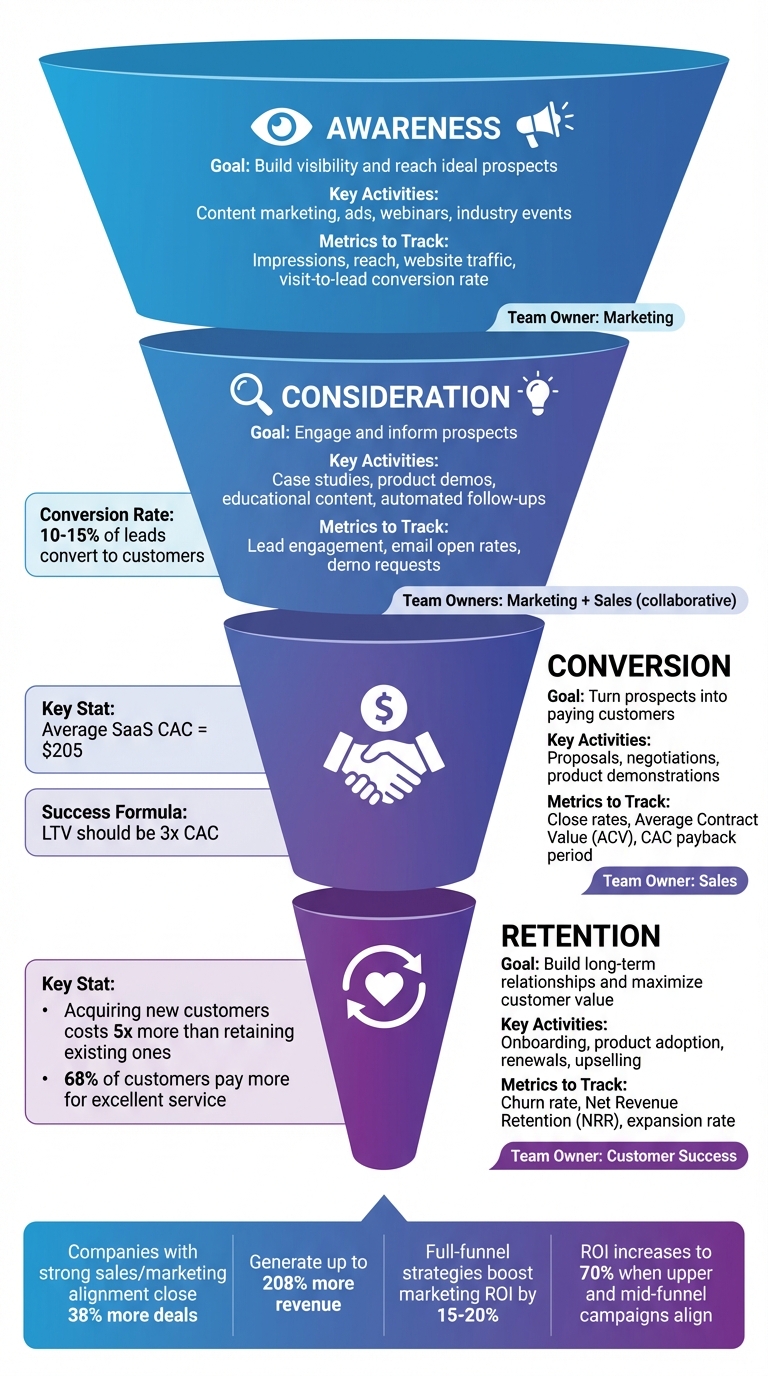
4 Stages of Customer Acquisition Funnel with Key Metrics
Is Your Customer Acquisition Funnel Ready to Scale? (4 Questions For You to Answer)
The 4 Stages of a Customer Acquisition Funnel
A customer acquisition funnel is made up of four distinct stages, each designed with specific goals and metrics in mind. Pinpointing where prospects drop off can help you make targeted adjustments. Here’s a closer look at what each stage entails.
Awareness: Reaching Potential Customers
The awareness stage is where potential customers first come across your brand while searching for solutions to their needs. Your primary objective here is to introduce your brand to as many ideal prospects as possible and leave a lasting impression. Marketing teams play a key role in this phase by boosting brand visibility and spreading awareness through tactics like content marketing, webinars, and participation in industry events. Metrics such as impressions, reach, website traffic, and visit-to-lead conversion rates help gauge whether you’re attracting the right audience.
Once you’ve captured their attention, the next step is to guide them toward evaluating your offering.
Consideration: Engaging and Informing Prospects
At the consideration stage, prospects are aware of your brand and begin exploring whether your solution fits their needs. This is your chance to provide them with the information they need to make an informed decision. Content like case studies, product demos, and detailed resources can answer their questions and move them closer to a purchase.
Marketing teams focus on nurturing these leads with educational content and automated follow-ups, while sales teams step in to qualify interested prospects. For context, only about 10 to 15% of leads typically convert into paying customers. By working together, marketing and sales can build on the initial interest and guide prospects toward the next phase.
Conversion: Turning Prospects into Customers
The conversion stage is all about sealing the deal. This is where qualified leads transition into paying customers through proposals, negotiations, and product demonstrations. Key metrics to track here include close rates, average contract value (ACV), and customer acquisition cost (CAC) payback periods. For example, the average CAC for SaaS companies is approximately $205. To ensure profitability, businesses often aim for a Customer Lifetime Value (LTV) that is at least three times their CAC.
Once a prospect becomes a customer, the focus shifts to keeping them engaged and maximizing their value over time.
Retention: Building Long-Term Relationships
In recurring revenue models, the funnel doesn’t end with conversion – it extends into retention. This stage emphasizes keeping customers satisfied and increasing their lifetime value through effective onboarding, product adoption, renewals, and upselling. Considering that acquiring a new customer can cost up to five times more than retaining an existing one, customer success teams work hard to minimize churn and drive expansion revenue.
Additionally, research shows that 68% of customers are willing to pay more for a product if it comes with excellent customer service. To optimize retention strategies, businesses often track metrics like churn rate, net revenue retention (NRR), and expansion rate. A strong retention strategy not only boosts profitability but also improves your overall LTV:CAC ratio.
How to Design Your Customer Acquisition Funnel
Building a successful acquisition funnel starts with knowing exactly who you’re targeting and understanding how they interact with your business. Without a clear plan, campaigns can fall flat, teams may work at cross-purposes, and budgets can be wasted. The goal is to craft a system where each stage has a specific role, designated ownership, and measurable outcomes tied to revenue.
Let’s break it down, starting with defining your audience.
Define Your Ideal Customer Profile and Personas
Your Ideal Customer Profile (ICP) and buyer personas are the backbone of your funnel. The ICP identifies the traits of companies that are most likely to benefit from your services, while personas focus on the motivations, challenges, and decision-making processes of individual buyers. To create these, start by digging into your existing customer data. Look for accounts with high lifetime value and efficient sales cycles – these often reveal patterns in what drives purchases.
For instance, studies show that 76% of consumers are more likely to buy from brands that offer a personalized experience. Use this insight to tailor your approach, but don’t rely on guesswork. Conduct surveys, interviews, and analyze behavioral data to develop personas that truly reflect your audience’s needs and preferences. This groundwork ensures your funnel resonates at every stage.
Map Your Customer Journey
Once you’ve defined your audience, it’s time to map out their journey. This involves outlining the key stages – Awareness, Consideration, Conversion, and Retention – and identifying the behaviors, questions, and challenges that arise at each step. For example, during the Awareness stage, prospects might be searching for solutions to a problem, while in the Consideration stage, they’re comparing options.
Assigning ownership to each stage is critical. Marketing teams might focus on driving traffic and capturing leads, sales teams handle the evaluation and closing stages, and customer success teams manage onboarding and retention. Each team should know their role and how their efforts connect to the broader funnel.
Set Goals and Track Performance
A well-designed funnel isn’t complete without clear goals and metrics. Start by setting revenue targets and breaking them down into actionable funnel metrics. This could include tracking visit-to-lead, lead-to-opportunity, close rates, and retention metrics. For example, understanding your conversion rates at each stage can help you pinpoint bottlenecks and optimize your strategy.
sbb-itb-ad881f4
Building Your Acquisition System With CRM, Automation, and Analytics
After mapping out your funnel and setting clear goals, the next step is to build and configure a unified acquisition system. This involves connecting your CRM, marketing automation tools, and analytics platforms to ensure every interaction is tracked seamlessly. By doing so, you can streamline processes across awareness, consideration, conversion, and retention stages. This setup eliminates the headaches of manual data entry and follow-ups while giving you the data needed to make smarter decisions. Here’s how to set up each component.
Set Up Your CRM as the Central Data Hub
Think of your CRM as the backbone of your acquisition system. It’s where every interaction – sales history, email exchanges, support tickets, and promotional touches – gets stored in one place. This centralization allows your team to see exactly where each lead is in the funnel and what action to take next. For instance, if a prospect downloads a whitepaper, your CRM should automatically log that activity and update their lead status.
To make this work, configure your CRM to track leads as they move through each stage of the funnel. Set up fields to capture details like lead source, engagement level, and deal stage. This way, your sales team can focus on high-priority leads without sifting through endless spreadsheets. Businesses that use data-driven marketing are 23 times more likely to outperform competitors, underscoring the importance of getting this right. Companies like Graystone Consulting can assist with CRM setup, ensuring your system captures essential data and integrates smoothly with your workflows.
Implement Marketing Automation
Marketing automation takes the manual effort out of lead nurturing. Instead of sending individual emails or manually updating lead statuses, you can create workflows that react to specific behaviors. For example, you might set up a welcome email series for new subscribers or a reminder for customers who abandon their shopping carts. These automated campaigns help keep your prospects engaged.
Another key feature is lead scoring. By tracking engagement signals – like email opens, content downloads, or demo requests – you can assign scores to leads. When a lead reaches a certain score, it can automatically move to your CRM for the sales team to act on. Businesses that use automation for lead nurturing often see a 10% or greater revenue boost within 6 to 9 months. The goal is to sync your automation platform with your CRM so lifecycle stages update in real time, giving your sales team a clear view of which leads are ready to convert and which need more attention.
Configure Analytics and Reporting Dashboards
Analytics tools tie everything together by integrating data from your CRM, marketing automation, and ad platforms. With the right setup, you can create dashboards that track conversion rates, channel attribution, and pipeline velocity, giving you a clear picture of what’s working and where adjustments are needed. For example, if your paid search campaigns drive plenty of traffic but aren’t converting, your dashboard should highlight this so you can tweak your targeting or landing pages.
Graystone Consulting specializes in building custom KPI dashboards that pull data from all your marketing channels. These dashboards should track metrics like Customer Acquisition Cost (CAC), Lead-to-SQL conversion rates, and LTV:CAC ratios, helping you measure profitability. Automating your reporting saves time and allows your team to focus on acting on insights rather than gathering data. This approach ensures your acquisition strategy is both effective and efficient.
How to Optimize and Manage Your Funnel Over Time
Building an acquisition system is just the beginning. To keep your funnel performing at its best, you need ongoing testing, smart prioritization, and clear leadership. Without regular updates, even the most effective funnel can lose its edge as customer behaviors shift and market dynamics change. Let’s dive into how experiments, focused improvements, and strong leadership can maintain your funnel’s performance.
Run Experiments to Test and Improve
Start by identifying a specific bottleneck in your funnel. Maybe your email open rates are lower than expected, or potential customers drop off after visiting your pricing page. Once you’ve pinpointed the issue, create a hypothesis and design a test. For instance, you could A/B test different email subject lines or try simplifying your pricing structure. Compare your results to a baseline, and when you find a winning strategy, scale it quickly to maximize its impact.
Focus on testing one variable at a time. Back in 2025, Livestorm used a data-driven approach to fine-tune their top-of-funnel marketing. The result? A threefold increase in ROAS (Return on Ad Spend) and a similar boost in their LTV:CAC ratio – all within a year. Achieving this kind of success depends on having reliable data from your CRM and analytics tools, which is why the foundational setup discussed earlier is so critical.
Prioritize High-Impact Changes
Not every tweak to your funnel will be worth the effort. After testing, focus on changes that deliver the biggest revenue gains. Use an impact-versus-effort framework to decide where to direct your resources. For example, if you notice that 40% of leads drop off between the consideration and conversion stages, addressing that issue should take precedence over refining ad copy that only affects a small percentage of visitors.
A great example of this approach is Fatty15, which in 2025 adopted a process of continuous improvement focused on high-impact fixes. By prioritizing effectively, they saved over $200,000 annually and doubled their marketing budget – proving that smart decisions can free up resources for growth. Regularly review your funnel data to identify the areas with the most potential for revenue growth, and allocate your team’s efforts where they’ll make the biggest difference.
Establish Leadership and Accountability
Optimization doesn’t happen on its own – it requires clear ownership and consistent oversight. Assign someone, such as a Fractional CMO, to take charge of funnel performance and ensure alignment across marketing, sales, and service teams.
To keep everyone on track, use leadership retainers for strategic guidance, and hold regular KPI review sessions – weekly or biweekly – to monitor progress. These meetings should focus on the metrics that matter most and ensure accountability for hitting key targets. Additionally, schedule monthly or quarterly funnel audits to evaluate KPIs, identify bottlenecks, and prioritize impactful fixes. This routine keeps your acquisition system sharp and ready to adapt to changing conditions.
Conclusion: Build a Funnel That Drives Predictable Growth
A well-structured, data-driven acquisition funnel is a game-changer for growth-stage businesses. It replaces guesswork with a clear, measurable path, turning the customer journey into a series of repeatable, trackable steps. By mapping out the entire process, it becomes much easier to pinpoint where prospects drop off and make targeted adjustments that deliver real results.
According to McKinsey, businesses using full-funnel strategies see a 15–20% boost in marketing ROI, with results climbing to 70% when upper-funnel efforts are aligned with mid-funnel campaigns. This comprehensive view – spanning awareness to retention – empowers teams to make smarter, data-backed decisions that consistently drive growth. But achieving these outcomes depends on having a unified, data-driven system in place.
The foundation of such a system includes tools like a CRM, marketing automation platforms, and detailed dashboards to track every customer interaction. These tools tie together every touchpoint, ensuring that each step in the funnel aligns with your strategic goals. To keep things running smoothly, regular audits, thoughtful experimentation, and strong leadership are key to maintaining and improving performance over time.
FAQs
How do I find and fix problems in my customer acquisition funnel?
To figure out what’s causing problems in your customer acquisition funnel, start by examining where potential customers tend to drop off at each stage. Tools like analytics software or CRM platforms can help you identify these sticking points.
Once you’ve pinpointed the trouble areas, work on fixing them. This might involve fine-tuning your messaging, making processes simpler, or enhancing the overall user experience. For instance, you could shorten your checkout process, tailor your content to better resonate with your audience, or eliminate unnecessary steps that slow things down. Even small, focused changes can make a big difference in how well your funnel performs.
What are the key tools needed to build an effective customer acquisition funnel?
Creating an effective customer acquisition funnel means having the right tools to simplify and fine-tune each step. Here’s a breakdown of some tools that can make a big difference:
- CRM platforms: Tools like Salesforce or Zoho help you manage customer relationships and keep track of every interaction, ensuring nothing falls through the cracks.
- Analytics tools: Platforms like Google Analytics let you monitor performance, spot trends, and pinpoint areas that need improvement.
- Marketing automation tools: Services such as HubSpot streamline tasks like email campaigns and lead nurturing, saving time while keeping your efforts consistent.
- Session replay and heatmap tools: Tools like Hotjar give you a window into user behavior, showing how visitors interact with your site.
- AI-driven personalization tools: These tools boost engagement by delivering tailored experiences that resonate with individual users.
When used together, these tools create a smooth, efficient system that supports your business objectives and helps you connect with customers more effectively.
How can I align marketing, sales, and customer success teams within the acquisition funnel?
To get your teams working in sync, start by establishing a clear and shared understanding of the customer acquisition funnel and each of its stages. Define unified goals and set measurable KPIs that everyone can rally around. Leverage integrated tools like CRM platforms and analytics software to make sure data flows smoothly between departments and remains accessible to everyone.
Promote teamwork by setting up regular feedback sessions, maintaining open communication channels, and aligning incentives across teams. Use data-driven lead scoring to focus on high-value prospects, ensuring that all teams are aligned on priorities. When you build a culture rooted in collaboration and transparency, your funnel process becomes not only smoother but far more effective.



0 Comments