





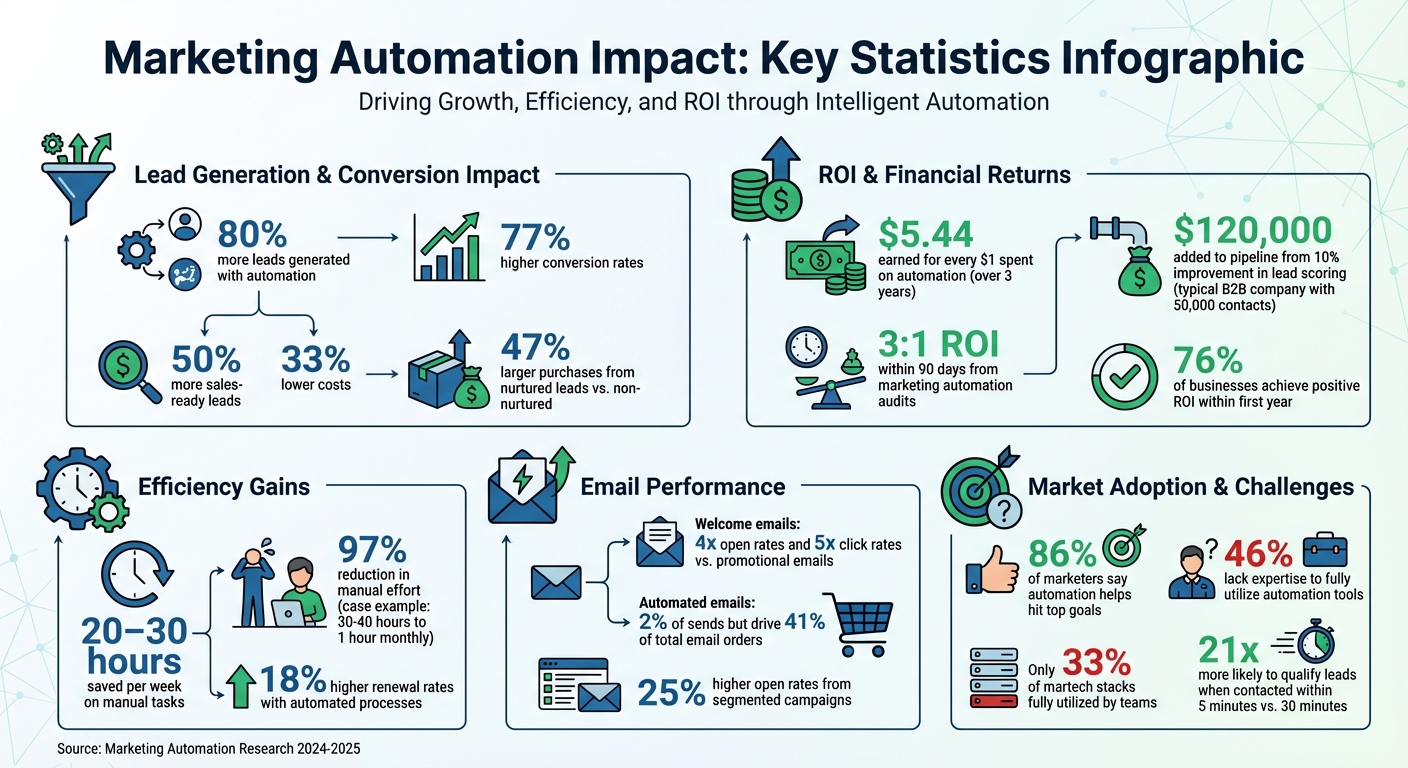
Automation in marketing is about simplifying repetitive tasks like sending emails, updating CRM records, and tracking metrics. It helps businesses save time, reduce errors, and focus on strategy. Companies using automation see up to 80% more leads and 77% higher conversions. Here’s how you can get started:
- Clean Your Data: Ensure databases are accurate and free of duplicates.
- Document Workflows: Map out processes and identify areas for automation.
- Set Clear Goals: Use measurable targets like improving lead conversion rates.
- Leverage Tools: Integrate CRMs like HubSpot or Salesforce with other platforms.
- Build Nurturing Campaigns: Automate personalized emails to guide leads through the funnel.
- Segment Audiences: Use behavioral data to group contacts for targeted messaging.
- Automate Reporting: Create real-time dashboards to track performance and ROI.
Automation isn’t just about saving time – it can drive growth without increasing headcount. Start small, test workflows, and scale as you see results.
Marketing Automation ROI Statistics and Key Performance Metrics
How to Implement Marketing Automation: A Step-by-Step Guide for Beginners
Evaluating Your Business for Automation
Before diving into automation, it’s crucial to assess whether your business is ready. Jumping into new platforms without addressing foundational issues can lead to wasted resources. A proper evaluation should focus on three key areas: data quality, documented processes, and baseline metrics.
Start with Your Data
Quality data is the backbone of any automation effort. If your database contains more than 5% duplicate contacts, it’s a red flag that you’re not ready to automate. Issues like outdated lists, inconsistent formats, or missing fields can derail automated workflows. As Tina Sang, Growth Lead at Artisan, puts it:
"The CRM is where every signal, conversation, and conversion lives. Without it as the single source of truth, our GTM engine would just be a tangle of disconnected tools".
Ensuring your CRM is clean and reliable is non-negotiable. Without it, automation efforts will struggle to deliver value.
Document Your Processes
Automation thrives on clarity. Before implementing it, make sure your workflows are well-documented. This includes having clear buyer personas and mapping out the customer journey. A simple three-column audit can help: list each workflow, identify the owner, and note the pain points. For instance, if you find that "Manual list pulls eat 90 minutes weekly", you’ve identified a clear opportunity for automation.
If you can’t easily pinpoint repetitive tasks – like lead follow-ups or data entry – it’s a sign that your business isn’t ready to automate yet.
Track the Right Metrics
Baseline metrics are essential for measuring automation’s success. Monitor key performance indicators (KPIs) like lead-to-opportunity conversion rates and cost per lead on a weekly basis. For example, if your lead scoring accuracy is below 70% when compared to closed-won deals, it’s time to recalibrate before automating. Businesses that identify specific funnel weaknesses tend to see the most benefit from automation.
Once you’ve addressed these three areas – data quality, processes, and metrics – you’re ready to evaluate your current tools.
Review Your Current Marketing Tools
Take stock of all your marketing platforms – CRM, email, analytics tools, and more – and map out how data flows between them. Research from Gartner reveals that only 33% of martech stacks are fully utilized by teams, meaning many tools often go unused.
Pay attention to potential bottlenecks like sync errors, API rate limits, or integration gaps that create data silos. For instance, broken attribution tracking can misallocate up to 20–30% of paid media budgets. Ask questions like: Does your CRM sync with your email platform in real time? Are you still manually exporting and importing lists between systems? These friction points are prime candidates for automation.
To clean up your data, use diagnostic tools that detect duplicates, null fields, and inconsistent formats. Fuzzy matching algorithms can standardize fields like job titles or geographic data. Before automating personalization, ensure your data is accurate and complete. Keep in mind that 46% of professionals report lacking the expertise to fully utilize automation tools. If your team isn’t equipped to handle the platforms, include training in your readiness plan.
Once you’ve mapped your tools and addressed issues, it’s time to set clear automation goals.
Set Clear Goals and Metrics
A strong foundation enables precise goal-setting. Replace vague objectives with measurable targets. For example, instead of saying "generate more leads", aim for something like "Increase MQL-to-SQL conversion from 12% to 20% within 90 days". This SMART-goal approach provides a clear benchmark to measure automation’s impact.
Document your baseline metrics before making any changes. Track numbers like lead-to-opportunity rates, email open rates, click-throughs, and unsubscribes. These figures will serve as a reference point to demonstrate ROI later.
Finally, calculate the potential return on investment (ROI). For instance, a 10% improvement in lead scoring accuracy can add $120,000 to the pipeline for a typical B2B company with 50,000 contacts. Marketing automation audits often deliver a 3:1 ROI within 90 days, and businesses generally earn $5.44 for every dollar spent on automation over three years. These benchmarks can help you justify the investment to stakeholders and secure executive buy-in, which is critical for success.
How to Automate Marketing Workflows
Once your processes are organized, it’s time to automate key marketing workflows to help your business grow. Start small – focus on one workflow at a time and gradually expand. For instance, you might dedicate 30 days to data cleaning, 60 days to nurturing workflows, and 90 days to optimizing re-engagement campaigns.
Set Up and Integrate a CRM
A well-integrated CRM is the backbone of marketing automation. Select a platform like HubSpot, Salesforce, or Zoho based on factors such as cost, scalability, user interface, and integration capabilities.
Next, connect your CRM with tools like your website, calendar, analytics platform, and ad accounts. Tools like Zapier can help seamlessly sync data between apps.
Automation relies on triggers and actions. A trigger (e.g., a form submission or page view) sets off an action, such as sending an email or updating a contact record. For example, you can configure your pipeline to move leads from "New" to "Attempting" when a sales rep logs a call or receives an email reply. Automation can also save time by keeping your database clean, like copying company-level details to individual contact records.
"AI-powered marketing is leading to easier, breezier growth. AI tools and unified tech stacks are a major differentiator in helping marketers connect with their audiences."
– Kipp Bodnar, CMO, HubSpot
Before launching any workflow, test thoroughly. Send test emails to check links, personalization tokens, and mobile responsiveness. Document workflows in a standard operating procedure (SOP) to ensure consistency as your team scales.
Once your CRM is set up and triggers are in place, move on to building lead nurturing workflows to maximize efficiency.
Create Lead Nurturing Automations
Lead nurturing workflows are essential for converting prospects efficiently. These workflows can generate 50% more sales-ready leads at 33% lower costs. Plus, nurtured leads tend to make 47% larger purchases compared to non-nurtured ones.
Every workflow should include three key components: triggers (starting events), actions (tasks the software performs), and time controls (delays or scheduling). A strategic nurturing workflow typically follows five stages: Welcome (first impressions), Segmentation (identifying interests), Nurturing (adding value), Conversion (offers), and Extraction (feedback or final value from cold leads).
Welcome emails are among the most effective tools in your arsenal. They achieve 4x the open rates and 5x the click rates of standard promotional emails. Stick to plain-text email templates rather than heavy HTML designs – A/B testing consistently shows better results with simpler formats.
Integrate your automations with your CRM to notify sales reps when leads show high-intent behaviors, like visiting a pricing page multiple times. Use lead scoring workflows to assign points based on engagement – opening an email adds points, while unsubscribing deducts them. "If/then" branches can route leads to specific sales teams based on the interests they indicate in forms.
For workflows where customers may repeat actions (e.g., downloading resources), set re-enrollment triggers. If leads don’t convert after 90 days, activate an extraction workflow to request feedback or testimonials, which can provide valuable market insights.
| Workflow Type | Primary Trigger | Best Use Case |
|---|---|---|
| Event-based | Customer actions (e.g., form fill) | Welcome series, instant responses |
| Time-based | Calendar intervals | Onboarding, renewal reminders |
| Behavioral | Engagement patterns | Re-engagement, upsell signals |
| Cross-channel | Multiple touchpoints | Product launches, ABM |
Implement Customer Segmentation
Segmenting your audience allows for more targeted and effective messaging. Start with 3–5 broad categories, such as prospects, leads, opportunities, customers, and loyal advocates. Segmented campaigns tend to perform better – achieving 25% higher open rates than generic ones.
Instead of relying purely on static demographics, use behavioral data like website visits, content downloads, or abandoned carts to automate segmentation. For example, if someone visits your pricing page three times in one week, move them into a "high-intent" segment and notify your sales team.
Ensure your CRM, website, and ad platforms are connected so your segments reflect the entire customer journey. Modern tools like HubSpot and monday.com even use AI to create segmentation workflows and analyze lead intent, making it easier to assign scores and route leads automatically.
To maintain a human touch, set "quiet hours" to avoid sending emails during non-business hours (e.g., 8 PM to 8 AM). Review workflows monthly to identify underperforming campaigns and refresh outdated content.
Effective segmentation not only improves campaign performance but also makes reporting more streamlined.
Automate Reporting and Dashboards
Real-time reporting is crucial for making informed decisions. Set up dashboards to track metrics at three levels: operational (e.g., time saved, workflow completion rates), performance (e.g., open rates, conversion rates), and business outcomes (e.g., revenue attribution, customer lifetime value).
Connect your CRM, website, and analytics tools to ensure reporting covers the full customer journey. Platforms like Zapier can sync data across systems and even send conversion events back to ad platforms like Google, LinkedIn, and Facebook, helping you optimize ad spend in real time.
Tailor dashboards to different audiences – executives need insights into revenue impact, while practitioners benefit from campaign-level metrics. Automation can also streamline lead handoffs by instantly notifying sales reps when a lead reaches a "hot" score or visits a pricing page.
Companies with automated renewal processes see 18% higher renewal rates, and 76% of businesses using automation achieve a positive ROI within their first year. By tracking these metrics, you can clearly demonstrate the value of your automation efforts to stakeholders.
sbb-itb-ad881f4
Testing, Optimizing, and Scaling Your Workflows
Designing workflows is just the beginning – you need to test, fine-tune, and scale them to see meaningful results. Before rolling out a workflow fully, test it with a sample group to ensure triggers, data flow, conditional splits, and email rendering work as intended.
Once the basics are in place, use A/B testing to refine your workflows further.
Conduct A/B Testing
After launching your workflows, A/B testing is essential to maximize their impact. Try out different subject lines, creative elements, and send times to determine what resonates most with your audience. Let these tests run for several weeks to gather data on open rates, click-through rates (CTR), and conversions. Even small adjustments can lead to big results – automated emails, for instance, make up just 2% of all email sends but drive 41% of total email orders.
Take Kayo Sports in Australia as an example. In 2025, they used Braze and BrazeAI Decisioning Studio to scale personalized messaging, increasing daily personalized emails from 300 to 1.2 million. This effort boosted reactivated customers by 14% within a year of churning and increased cross-selling to their sister service, BINGE, by 105%. Similarly, Outcomes Rocket implemented AI-driven content personalization for email campaigns, achieving a 65% jump in engagement and a 28% rise in conversions.
Once you’ve optimized your workflows through testing, keep an eye on performance metrics to ensure sustained success.
Monitor Performance Metrics
Tracking key performance metrics is crucial to maintaining workflow efficiency. Focus on three main areas: operational metrics (like time saved and error rates), performance metrics (such as open rates and CTR), and business metrics (including revenue attribution and customer lifetime value). Set up automatic alerts for significant dips – like a 20% week-over-week drop in CTR – and use holdout groups (keeping 5–10% of users out of a program) to measure the incremental lift of your workflows compared to organic behavior. Collaborate with your sales team to regularly revisit and refine lead-scoring models, ensuring the "MQL" (Marketing Qualified Lead) threshold remains accurate. Also, monitor funnel speed to identify where leads may be stalling and adjust workflows to address those bottlenecks.
Scale Workflows for Growth
Once your workflows are performing well, it’s time to scale. Instead of building new workflows from scratch, replicate successful ones for different markets or products. Before scaling, stress-test your systems at 2× to 5× their usual volume, ensure your architecture is modular, and clean your data to avoid issues that could disrupt automation.
For example, Adore Me automated its product description workflow, cutting down a monthly 30–40-hour bottleneck to just one hour – a 97% reduction in manual effort. Likewise, Eco Grant UK worked with Acuto to create a custom chatbot for lead generation, resulting in a 312% increase in eligible leads while freeing up team resources to nurture prospects.
As you scale, establish a center of excellence to document workflow ownership and provide guidance as your business evolves. And remember, speed is critical: companies that contact leads within five minutes are 21 times more likely to qualify them than those waiting 30 minutes.
Working with Graystone Consulting for Automation
Automating workflows isn’t just about efficiency – it’s about identifying where revenue is slipping through the cracks and bringing disconnected tools together. That’s where Graystone Consulting (https://graystonellc.net) steps in. They specialize in diagnosing, implementing, and fine-tuning scalable marketing systems tailored for founder-led and growth-stage businesses. The goal? To move from scattered, one-off tactics to reliable, data-driven growth.
Graystone’s strategy revolves around three main services: a Diagnostic Sprint to pinpoint inefficiencies, a Growth System Installation to build a cohesive infrastructure, and a Leadership Retainer to ensure long-term success as your business evolves. Let’s break down how their process starts with identifying revenue gaps.
Diagnostic Sprint for Revenue Leak Identification
Before diving into automation, it’s critical to understand where potential customers are dropping off in your sales funnel. Graystone’s Diagnostic Sprint takes a detailed look at every stage – from lead capture to pipeline management – to uncover specific areas where prospects are being lost. This includes analyzing lead capture processes, nurture email sequences, data syncing, reporting, and compliance issues.
Their process involves a thorough review of your CRM, funnel definitions, and existing reporting systems to create a prioritized list of fixes with the highest impact. They also identify critical data gaps, such as inaccessible subscriber information, which can derail automation efforts if ignored. By the end of the sprint, you’ll have a clear roadmap highlighting where automation can make the biggest difference.
Once the leaks are identified, the next step is to build a system that ensures no lead is left behind.
Growth System Installation for Connected Infrastructure
After diagnosing the problem areas, it’s time to create a system that works seamlessly. Graystone’s Growth System Installation is a 90-day process designed to unify fragmented marketing tools into one cohesive workflow. This includes deploying funnels, setting up automation for lead capture and follow-ups, and integrating tools across platforms like your website, forms, email, SMS, and CRM. They also provide revenue intelligence dashboards to track ROI and pipeline performance in real time.
The aim is to build a system where every lead is captured, properly tagged, and followed up with – without requiring manual effort. Businesses that adopt this connected infrastructure often see an 80% increase in lead generation and a 77% boost in conversion rates. Graystone even backs their work with a guarantee of a 15–20% improvement in funnel performance by addressing gaps that cause leads to slip through unnoticed.
Leadership Retainer for Continued Optimization
Automation isn’t a one-and-done process – it requires regular oversight. Graystone’s Leadership Retainer provides fractional CMO services, offering weekly or biweekly strategy sessions, KPI monitoring, and optimization sprints. A fractional CMO ensures that your automated workflows align with broader business objectives rather than just executing isolated tasks. Unified dashboards keep tabs on metrics like lead response time, pipeline conversions, and stage velocity in real time.
This flexible model allows businesses to scale expert resources – such as marketing operations experts, data analysts, and automation specialists – up or down as needed. By adopting this approach, companies save 20–30 hours per week on manual tasks and achieve an average return of $5.44 for every $1 invested in marketing automation.
Conclusion
Setting up automated marketing workflows isn’t just about flipping a switch – it takes thoughtful planning, consistent testing, and regular fine-tuning. It all starts with a solid foundation: clean data, well-defined buyer personas, and SMART goals tied to revenue outcomes . From there, workflows should align with every stage of the customer journey – from the first spark of interest to the point where customers become loyal advocates. A trigger–action framework is a great way to keep everything running smoothly .
The results can be game-changing. Companies have reported generating 80% more leads and boosting conversion rates by 77%. Some have even seen a 451% increase in leads – clear proof of what targeted automation can achieve . However, these results don’t happen overnight. Success often begins with small, high-impact processes like welcome sequences and gradually expands to more complex, cross-channel campaigns . Regular audits every 4–6 weeks are essential to keep workflows aligned with shifting customer behaviors and business goals.
"Skip that cycle and automation becomes ‘set it and forget it,’ which might lead to a system that stagnates in the long run."
- Logic
For growing businesses wrestling with automation challenges, teaming up with Graystone Consulting can be a game-changer. Nearly half of professionals admit they lack the expertise to fully utilize automation tools. Graystone’s process – identifying revenue leaks, building connected systems, and offering fractional CMO oversight – helps businesses scale their automation without piling on extra work or staff. With 86% of marketers saying automation has helped them hit their top goals, the secret lies in crafting a system that’s both strategic and built to last.
FAQs
How can I tell if my business is ready for marketing automation?
Before diving into marketing automation, it’s important to assess whether your business is truly ready. Start by checking a few essential boxes: clean, organized data, detailed buyer personas, clear operational processes, and support from leadership. These components are the backbone of a system that runs efficiently and can scale as needed.
If your contact lists are outdated, buyer personas remain untested, or you lack clear, measurable goals, it’s worth addressing these gaps first. Marketing automation thrives on accurate data, well-defined manual tasks, and a strong foundation. Once these pieces are in place, your business will be set to leverage automation for streamlined operations, tailored customer experiences, and steady growth.
What mistakes should I avoid when automating marketing workflows?
When setting up marketing automation workflows, a frequent misstep is not aligning the tools with your team, processes, and overall business goals. Without proper integration or well-defined objectives, automation can quickly spiral into ineffective campaigns, wasted resources, and unnecessary rework.
Another major issue is relying on outdated or inaccurate data. Poor data quality can derail personalization efforts, leading to irrelevant messaging that misses the mark. To avoid this, ensure your workflows are built around a clear process, covering critical steps like lead capture, nurturing, and conversion. A disorganized setup can create inefficiencies and even result in lost leads.
Lastly, failing to establish measurable KPIs or regularly monitor performance can hold you back from refining and improving your workflows. By keeping your data clean, aligning tools with your goals, and consistently tracking results, you’ll set yourself up to get the most out of your marketing automation efforts.
How can I track the success of my marketing automation efforts?
To measure how effective your marketing automation efforts are, keep your focus on key performance metrics that tie directly to your goals. Start by analyzing engagement metrics, such as email open rates, click-through rates, and conversion rates. These numbers give you a clear picture of how well your automated campaigns are connecting with your audience.
Then, shift your attention to the bigger picture – your business outcomes. Check metrics like the number of qualified leads your campaigns are generating, the revenue directly tied to automation, and your overall cost per acquisition. Comparing these figures to your pre-automation benchmarks will show you how much progress you’ve made and where efficiency has improved.
Lastly, don’t overlook operational benefits. Track how much time your team is saving by automating repetitive tasks. This helps ensure that the value of automation goes beyond revenue and includes smoother workflows. Setting clear benchmarks and regularly reviewing your performance will keep your strategies sharp and your growth steady.



0 Comments