





Want to grow your SaaS business without relying on paid ads? Organic search can deliver consistent, long-term growth at a fraction of the cost. Here’s what you need to know:
- SEO ROI: SaaS companies see an average ROI of 702% from SEO, breaking even in just 7 months.
- Better Conversions: Leads from SEO convert at 14.6%, compared to 1.7% for outbound strategies.
- Key Metrics to Track: Focus on organic traffic quality (non-branded traffic, keyword rankings) and conversion rates (trial sign-ups, demo requests).
- Benchmarks: Aim for 41% annual traffic growth and a 4.1% median conversion rate (top performers hit 8–12%).
- Actionable Tips: Target high-intent keywords, optimize page speed, and align content with the buyer’s journey.
Organic search doesn’t just reduce costs – it builds a scalable growth engine. Keep reading to learn how to measure and improve both traffic and conversions effectively.
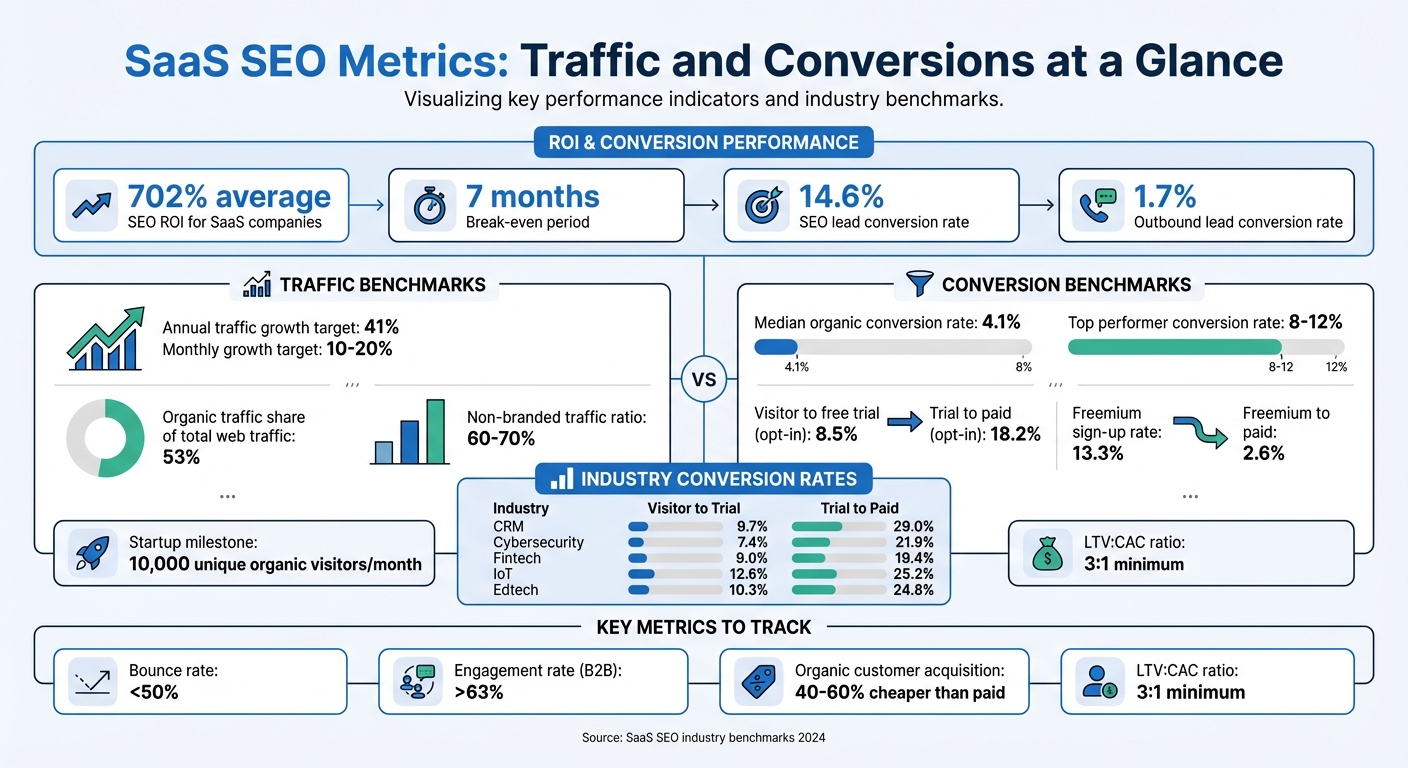
SaaS SEO Performance Metrics and Conversion Benchmarks
SaaS SEO: Why Your Traffic is Dropping (How to Fix It)
Core SEO Metrics Every SaaS Company Should Track
Measuring the right metrics is what sets growing SaaS companies apart from those that struggle to scale. In the SaaS world, it’s not just about counting visitors – it’s about understanding how those visitors convert into meaningful outcomes. To get a clear picture, you need to focus on two key areas: traffic measurement and conversion measurement. Each provides a unique perspective on your growth journey, and both are essential for building a strong acquisition strategy.
Organic Traffic Metrics
Start with total organic sessions – this gives you a snapshot of your overall reach. To get a clearer picture of growth, compare these numbers year-over-year to filter out seasonal fluctuations. For SaaS companies, aiming for 41% year-over-year growth in organic search traffic is a good benchmark.
Next, break down traffic by page type. For example:
- Blog posts: Top-of-funnel content that attracts new visitors.
- Product pages: Mid-funnel content that addresses specific needs.
- Pricing pages: Bottom-of-funnel content aimed at conversions.
Another critical metric is the branded versus non-branded traffic split. Branded traffic comes from people already familiar with your company, while non-branded traffic reflects the discovery of new customers through solution or category keywords. A healthy SaaS business typically sees 60-70% of its traffic coming from non-branded searches. If branded traffic dominates, it’s a sign that you’re not reaching enough new audiences.
Keep an eye on keyword rankings, especially the number of terms in the Top 3 and Page 1 positions. Here’s why this matters: the first position in search results attracts 3.8 times more backlinks than other positions, and it captures 27.6% of clicks compared to just 0.63% for second-page results. Also, track search impressions, which show how often your pages appear in search results. This metric helps you understand your overall visibility in the market.
While traffic metrics highlight your reach, the real story unfolds when you dive into conversions.
Conversion Metrics
Once you’ve measured your organic traffic, the next step is to determine how well that traffic translates into meaningful actions.
Traffic without conversions is just noise. The organic conversion rate tells you what percentage of your organic visitors take a desired action, such as signing up for a trial or requesting a demo. This metric shows whether you’re attracting the right audience and if your website is effectively guiding them toward a decision.
It’s also important to track specific conversion actions separately, such as:
- Trial sign-ups
- Demo requests
- Newsletter subscriptions
Each action reflects a different level of intent. For reference, the average conversion rate for turning website visitors into free trial users is 8.5%, while the conversion rate from free trial to paying customer is 18.2%.
Another useful metric is the content-to-signup ratio, which measures how many signups you generate per 1,000 sessions on specific content pages. This helps you identify which content drives the most engagement.
Don’t overlook CTA click-through rates, which measure how effectively your calls-to-action encourage visitors to take the next step. URLs with target keywords see a 45% higher click-through rate, underscoring the importance of optimization. To tie it all together, connect these metrics to your CRM to track Marketing Qualified Leads (MQLs) and Sales Qualified Leads (SQLs) generated from organic search. This creates a clear link between your SEO efforts and their contribution to your sales pipeline.
As Ricardo Rodriguez, a SaaS SEO expert, explains:
SaaS SEO metrics aren’t just about rankings and clicks anymore. They’re about understanding the complete journey from organic visitor to profitable, retained customer and everything that happens in between.
How to Track Organic Traffic for SaaS Growth
To effectively track organic traffic for SaaS growth, you need to connect search visibility, user behavior, and revenue. The best way to do this is by using three key tools: Google Analytics 4 for understanding user behavior, Google Search Console for insights into search intent and visibility, and your CRM (like HubSpot or Salesforce) to attribute revenue. Together, these tools provide a full view of the customer journey – from discovering your site in search results to converting into a paying customer. This comprehensive data is essential for proper segmentation.
A crucial step is segmenting your traffic data. Start by distinguishing between branded traffic (users searching for your company by name) and non-branded traffic (users searching for solutions or services you offer). Why does this matter? Branded traffic reflects existing brand awareness, while non-branded traffic highlights your ability to attract new audiences. You can also segment by search intent, separating informational queries (research-focused) from transactional ones (purchase-focused). These distinctions help fine-tune strategies to improve organic conversions.
Another metric to monitor is your content efficiency ratio – organic sessions per indexed page. This can help you identify content bloat. Additionally, use the PPC equivalency method to assign a dollar value to your organic traffic, giving stakeholders a clear understanding of your SEO’s impact.
Traffic Volume Benchmarks
Organic search is expected to drive about 53% of total web traffic. If your share is lower, it could signal missed opportunities for growth. For SaaS websites, monthly organic sessions should ideally grow by 10% to 20%. On a year-over-year basis, aim for 41% to 47% growth to remain competitive.
For startups, a good early milestone is 10,000 unique organic visitors per month, which signals growing brand awareness. As your business scales, focus more on the quality of traffic rather than just the volume. High traffic numbers are only valuable if they lead to meaningful engagement and conversions.
Traffic Quality Indicators
Once you’ve established traffic volume benchmarks, shift your attention to traffic quality. Start by evaluating user engagement and technical performance. A key metric to watch is your bounce rate, which should stay under 50% for SaaS websites. While the average bounce rate for B2B sites falls between 25% and 55%, anything higher suggests your content isn’t meeting user expectations. With Google Analytics 4, bounce rate is now part of the engagement rate metric. Aim for an engagement rate above 63% for B2B sites and above 71% for B2C sites.
Also, check your branded vs. non-branded traffic ratio. Ideally, 60-70% of your traffic should come from non-branded searches. If this isn’t the case, adjust your content strategy to target category keywords and problem-aware searches to attract a broader audience.
Technical performance is another critical factor in traffic quality. Core Web Vitals measure user experience across three metrics:
- Largest Contentful Paint (LCP): Should be under 2.5 seconds.
- Interaction to Next Paint (INP): Should be under 200ms.
- Cumulative Layout Shift (CLS): Should be under 0.1.
Currently, only 33% of websites meet these standards, which means improving Core Web Vitals can give you a serious edge. Poor performance in these areas doesn’t just hurt your rankings – it drives users away before they even engage with your content or value proposition.
sbb-itb-ad881f4
How to Improve Conversions from Organic Traffic
Once you’ve established steady organic traffic, the next step is turning those visitors into paying customers. Combining SEO with Conversion Rate Optimization (CRO) can increase conversion rates from organic traffic by 30-50%. This strategy builds on earlier traffic and conversion metrics and completes the framework for scalable SEO growth.
To maximize conversions, align your content with the buyer’s journey. Top-of-funnel (ToFu) content raises awareness, middle-of-funnel (MoFu) content fosters consideration, and bottom-of-funnel (BoFu) content drives decisions. A common pitfall for SaaS companies is creating educational content without naturally showcasing their product as the solution. Using product-led content, where your SaaS tool is seamlessly integrated into the material, can encourage sign-ups without feeling overly salesy.
Page speed is another critical factor – optimize for load times under two seconds and meet Core Web Vitals standards. A delay of even a second can reduce conversions by 7%. Simplify your sign-up process with progressive profiling, which collects user information gradually. For example, Groove simplified its sign-up process in 2025 by requiring only an email address initially and gamified the onboarding process. This boosted setup completion rates from 70% to 89% and increased trial-to-paid conversions by 31%.
Organic Conversion Rate Benchmarks
The median organic conversion rate for SaaS companies is 4.1%, with top performers reaching 8-12%. Your actual rate depends on your business model and the friction in your sign-up process. For instance, opt-in free trials convert at 8.5%, while opt-out trials convert at only 2.5% but lead to higher trial-to-paid conversion rates – 48.8% compared to 18.2% for opt-in trials.
Freemium models tend to attract more sign-ups, with 13.3% of organic visitors signing up, but only 2.6% of those users convert to paid subscriptions. Conversion rates also vary by industry, as shown below:
| Industry | Visitor to Trial | Trial to Paid |
|---|---|---|
| CRM | 9.7% | 29.0% |
| Cybersecurity | 7.4% | 21.9% |
| Fintech | 9.0% | 19.4% |
| IoT | 12.6% | 25.2% |
| Edtech | 10.3% | 24.8% |
Landing page design also plays a huge role in conversions. Use the 5-second test: visitors should instantly understand what your product is, its main benefit, what sets it apart, trust signals, and the next action to take. Simplicity matters – landing pages written at a 5th-to-7th grade reading level convert 514% better than those with overly complex language. Placing social proof near CTAs can further boost conversions by up to 270%.
Revenue Attribution Models
To measure the full value of your organic traffic, tie it directly to revenue metrics like Monthly Recurring Revenue (MRR) and Customer Lifetime Value (CLV). This requires selecting the right attribution model.
- First-touch attribution gives credit to the first interaction, often organic search.
- Last-touch attribution focuses on the final interaction, such as a demo or sales call.
- Multi-touch attribution spreads credit across all touchpoints.
For SaaS businesses, multi-touch attribution is the most accurate since organic search often acts as an "assist" in long sales cycles, typically lasting 30-90 days for B2B SaaS. Companies using multi-touch attribution see 15-25% better conversion optimization than those relying on single-touch models. To implement this, connect Google Analytics 4 to your CRM (e.g., HubSpot or Salesforce) and tag organic traffic as a source when leads enter the pipeline. This enables you to track closed-won revenue and MRR generated through SEO.
"The biggest mistake is not tracking micro and macro conversions to see the full journey. Key-term signups are important, but they need to connect to revenue." – Jason Smit, CEO, Contentellect
A healthy SaaS business should aim for a Customer Lifetime Value (LTV) to Customer Acquisition Cost (CAC) ratio of at least 3:1. Organic customers are typically 40-60% cheaper to acquire than paid customers and tend to have a higher lifetime value. In fact, organic search delivers an average ROI of 702% for B2B SaaS companies. By aligning revenue attribution with conversion strategies, you can clearly demonstrate the impact of SEO on growth and justify further investment in it.
Practical Steps to Improve Traffic and Conversions
If you want to boost traffic and conversions, focus on high-intent keywords rather than high-volume ones. Instead of going after broad terms like "human resource management", aim for more specific phrases like "HR software for enterprise" or "time tracking software for construction sites." These long-tail keywords tend to drive better results because they attract users who already know what they need and are closer to making a decision. This approach sets the stage for measurable improvements.
Here’s how you can implement this strategy: Start by talking to your sales and customer success teams. They can help you uncover the exact language your customers use to describe their challenges. From these conversations, you’ll identify three key types of keywords:
- Category variations (e.g., "CRM for real estate")
- Competitor comparisons (e.g., "[Competitor] alternatives")
- Jobs-to-be-done phrases (e.g., "how to automate time-off requests")
Don’t shy away from targeting keywords with 20 or fewer monthly searches. SEO tools often underestimate traffic for these terms, but their high intent makes them incredibly profitable.
For each specific long-tail keyword, create a dedicated page instead of trying to target multiple keywords on one page. This approach works. For example, Circuit grew its organic traffic from 920 to 14,577 sessions in just six months by publishing six competitor comparison articles. Over two years, these articles generated 149 organic signups, even though SEO tools estimated almost no search volume. Similarly, Geekbot discovered that 22 bottom-of-funnel articles delivered 1,348 conversions at a 4.78% conversion rate, while 42 top-of-funnel articles brought in just 397 conversions at a meager 0.19% – despite having 10 times more traffic.
To improve conversion rates further, integrate your product directly into your content. Use product screenshots, feature walkthroughs, and real-world use cases to show how your solution addresses the searcher’s specific problem. Before you start writing, review the top 10 Google results for your target keyword. If the results are mostly academic or encyclopedic, it’s a sign the keyword lacks buying intent. Pages designed to meet commercial intent often convert 3x better than those chasing general traffic.
Finally, don’t let technical issues hold you back. Make sure your site loads in under 2 seconds and meets Core Web Vitals standards to boost both visibility and conversions. Also, ensure that your most important content and calls-to-action are visible above the fold so users don’t have to scroll to find them. These small technical tweaks can make a big difference.
Conclusion
Keeping a close eye on organic traffic and conversions is key to driving long-term growth. For instance, B2B SaaS companies see an average ROI of 702% through SEO, with a break-even period of just seven months. Even more striking, leads from SEO convert at 14.6%, compared to a mere 1.7% for traditional outbound strategies. These numbers highlight how SEO directly supports sustained revenue growth.
The gap between a basic content strategy and a data-driven one is massive. Companies that publish 8 or more thought leadership posts per month achieve a 748% ROI, while those sticking to just 4 posts per month barely hit 16% ROI. What sets high performers apart is their ability to track key metrics – like Net New MRR and non-branded traffic growth – and adapt their strategy based on actionable insights.
Organic search offers unmatched long-term benefits. Unlike paid ads, which stop delivering as soon as the budget dries up, organic search works like a growth engine that compounds over time. Well-crafted content continues to bring in qualified leads for years – provided you measure more than just traffic and focus on how that traffic converts into paying customers.
To make the most of this, integrate your SEO data with your CRM and segment traffic by intent. Prioritize pages that drive conversions. This approach transforms organic search from a simple marketing cost into your most profitable growth channel.
FAQs
What are the 3 most important SEO metrics for SaaS growth?
When it comes to driving SaaS growth, some SEO metrics stand out as key indicators of success. These include organic traffic, conversions, and revenue-centered KPIs like Net New MRR (Monthly Recurring Revenue) and Customer Lifetime Value (CLV).
Why are these metrics so important? They provide a clear picture of how well your SEO efforts are fueling lead generation, customer acquisition, and revenue expansion. By keeping a close eye on these numbers, SaaS companies can make smarter decisions to scale their business efficiently.
How do I separate branded vs. non-branded organic traffic?
To differentiate between branded and non-branded organic traffic, start by categorizing search queries based on whether they mention your brand name. Branded keywords show that users are already familiar with your brand, and they often lead to higher conversion rates. On the other hand, non-branded keywords help you reach new audiences who may not know about your brand yet.
You can use tools like Google Search Console to filter branded queries easily. Alternatively, Google Analytics allows you to apply regex filters to separate branded and non-branded traffic. This approach helps you gain clearer insights into how different types of traffic contribute to your overall performance.
How can I attribute SEO conversions to MRR in my CRM?
To tie SEO conversions to Monthly Recurring Revenue (MRR), start by tracking how organic traffic leads to critical actions, like signups or purchases. Use your CRM to tag traffic from organic search and monitor leads as they progress through the sales funnel. Once a lead converts into a paying customer, trace the revenue back to its original source. This approach helps you clearly measure how SEO contributes to MRR growth.



0 Comments