





Want to grow your business without wasting resources? Prioritizing your marketing budget is the key. Companies that allocate funds based on data see faster growth and higher returns. Here’s how to make every dollar count:
- Set SMART Goals: Align your marketing spend with specific, measurable revenue targets.
- Tailor Budgets by Growth Stage: Startups may spend 12–20% of revenue, while mature businesses often stick to 5–7%.
- Focus on ROI-Driven Channels: Channels like email marketing ($42 ROI per $1 spent) and SEO (5:1 to 10:1 ROI) deliver measurable results.
- Use the 70-20-10 Rule: Dedicate 70% of your budget to proven strategies, 20% to emerging opportunities, and 10% to experiments.
- Track Performance: Monitor metrics like ROI, CAC, and LTV:CAC ratios to identify and scale high-performing efforts.
Key takeaway: Treat your marketing budget like an investment portfolio. Regularly review and adjust based on performance to drive sustainable growth.
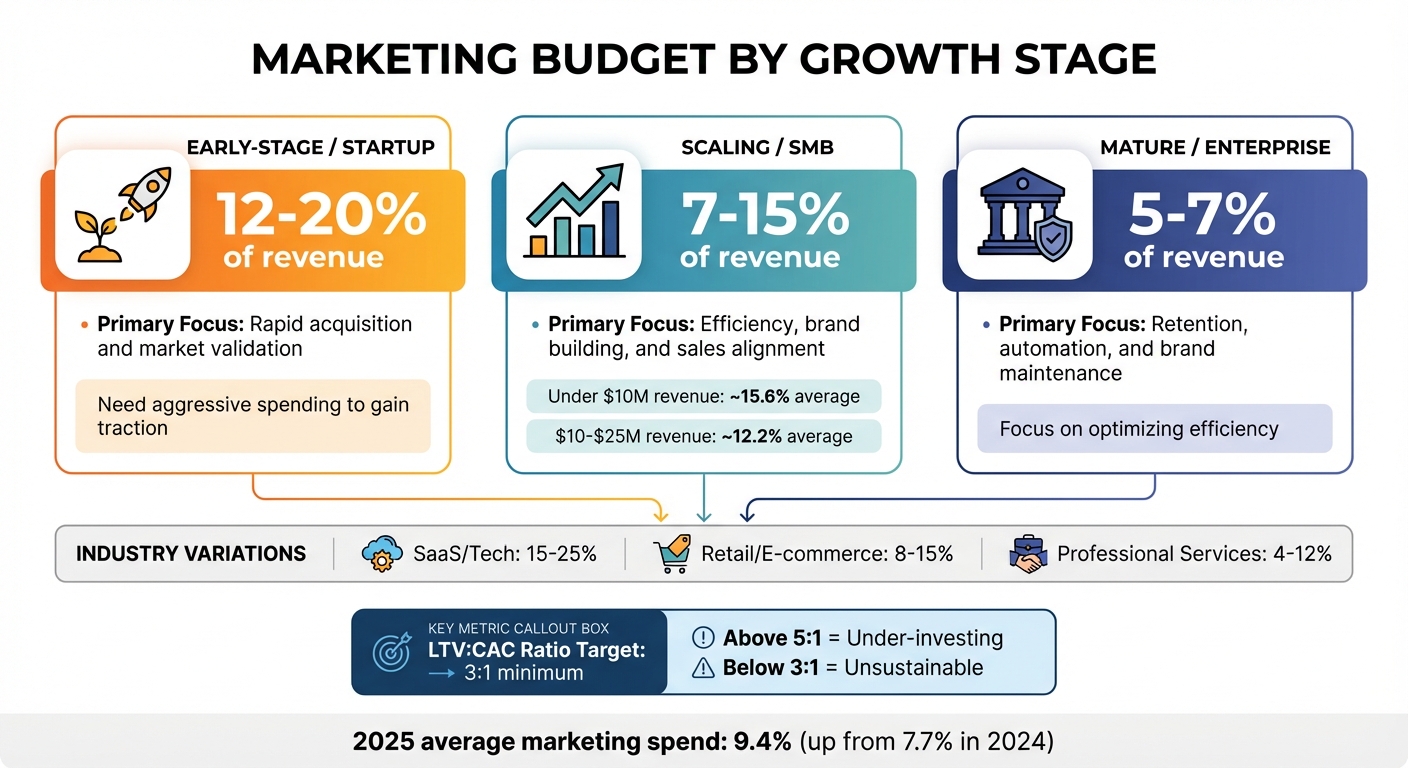
Marketing Budget Allocation by Business Growth Stage
How to Set a Realistic Marketing Budget For 2026
1. Review Your Goals and Growth Stage
Before diving into marketing spend, it’s crucial to define your goals. Without a clear direction, your budget could end up wasted. Start by assessing where your business stands today and where you want it to go. From there, work backward to determine the investment needed to bridge the gap.
Set SMART Marketing Goals
Your goals should be Specific, Measurable, Achievable, Relevant, and Time-bound (SMART) – and they must connect directly to revenue. For instance, instead of saying "grow our email list", aim for something like: "Increase qualified email subscribers by 2,000 by September 30, 2026, to support a $150,000 revenue target from email campaigns."
"A SMART goal like ‘increase website traffic by 50% by Q3 2025’ will [guide spending effectively]. This specificity ensures every dollar you spend is aligned with your objectives." – Kelsey Parks, Founder, Psyche Digital
By treating marketing as a revenue driver rather than a cost, you can align spending with measurable outcomes. Start with your revenue goals, average deal size, and conversion rates to calculate how many leads you need – and how much you’ll need to spend to generate them. For example, if you aim for 100 new customers with a $3,000 average deal value and a 10% close rate, you’ll need 1,000 qualified leads. At a target customer acquisition cost (CAC) of $300, that translates to a $30,000 marketing budget.
Consider this real-world example: In 2025, a Boise-based business coach helped a client redirect their marketing focus. The client had been spending 5% of revenue on untargeted digital ads. By reallocating that same 5% toward targeted email funnels and retargeting, the company saw a 32% revenue boost in just 10 months. The budget didn’t change – the strategy did.
Determine Your Marketing Budget by Growth Stage
The percentage of revenue you should dedicate to marketing depends on your business’s growth stage. Startups typically need to spend more aggressively to gain traction, while established companies focus on optimizing efficiency and retaining customers.
Here’s a general breakdown of marketing budgets by growth stage:
| Growth Stage | % of Revenue | Primary Focus |
|---|---|---|
| Early-Stage / Startup | 12–20% | Rapid acquisition and market validation |
| Scaling / SMB | 7–15% | Efficiency, brand building, and sales alignment |
| Mature / Enterprise | 5–7% | Retention, automation, and brand maintenance |
Smaller businesses (under $10 million in revenue) typically allocate around 15.6% of their budget to marketing, while mid-sized businesses ($10–$25 million) spend closer to 12.2%. Across industries, the average marketing spend increased to 9.4% in 2025, up from 7.7% in 2024.
Industry differences also matter. SaaS and tech companies often spend 15–25% of revenue on marketing due to fierce competition and longer sales cycles. Retail and e-commerce businesses allocate around 8–15%, while professional services firms typically spend 4–12% .
"Your marketing budget needs anywhere from 5% to 20% of your revenue to thrive. Generally, 5%-10% is enough to sustain, but you’ll need 11%-20% in data-driven marketing campaigns to grow." – Sam Yadegar, CEO and co-founder, HawkSEM
A good rule of thumb is to maintain a healthy LTV:CAC ratio – aim for at least 3:1. This means each customer should generate three times what it cost to acquire them. If your ratio climbs above 5:1, you’re likely under-investing and missing out on growth opportunities. On the flip side, a ratio below 3:1 indicates your acquisition strategy isn’t sustainable.
At Graystone Consulting, we help businesses at various growth stages identify the right budget allocation. Through diagnostic audits, we uncover revenue leaks and untapped opportunities. The goal isn’t to spend more – it’s to spend smarter, aligning your budget with your actual needs instead of wishful projections.
Once you’ve set clear goals and established a tailored budget, the next step is to evaluate your current marketing performance.
2. Review Current Marketing Performance
Once your budget is set, the next move is figuring out what’s actually delivering results. This means diving into your data to separate the strategies that work from those that waste resources. A clear focus on key metrics will help you measure and understand performance.
Measure Key Metrics
Start by focusing on the numbers that directly tie to profitability. One of the most critical metrics is Customer Acquisition Cost (CAC). This tells you how much it costs to bring in a new customer. To calculate CAC, divide your total marketing and sales expenses (think ad spend, salaries, agency fees, software costs, etc.) by the number of new customers acquired. Including all costs ensures you get the full picture.
Another crucial metric is Customer Lifetime Value (LTV), which estimates how much revenue a customer generates over their time with your business. The LTV:CAC ratio is a solid indicator of how sustainable your strategy is. A ratio of 3:1 is considered healthy – meaning every dollar spent on acquisition brings in three dollars in revenue. If your ratio climbs above 5:1, you might not be investing enough in growth. On the flip side, if it’s below 2:1, your approach likely needs a rethink.
Also, keep an eye on the CAC Payback Period, which measures how long it takes to recoup your acquisition costs. For most businesses, a payback period of 12–24 months is acceptable.
Return on Investment (ROI) is another must-watch metric. A 5:1 ROI (earning $5 for every $1 spent) is strong across most industries, while 10:1 is considered outstanding. Anything below 2:1 often means you’re losing money once production and distribution costs are factored in. Interestingly, email marketing tends to deliver the highest ROI, averaging $42 for every $1 spent.
Lastly, analyze conversion rates at every stage of your funnel. Track how prospects move from visitor to lead, lead to opportunity, and opportunity to customer. This will help you spot where potential customers are dropping off. Keeping tabs on Return on Ad Spend (ROAS) for paid channels and retention rates by acquisition channel can also give you insight into long-term value.
With these metrics in hand, it’s time to dig deeper into your funnel to identify high-performing channels and uncover hidden revenue leaks.
Find High-ROI Channels and Revenue Leaks
Armed with your key metrics, conduct a thorough audit of your marketing funnel. Break down performance by segment – not just by channel, but also by persona, geography, creative, and campaign type. Blended averages can mask important insights. For instance, one segment might show a 6:1 LTV:CAC ratio, while another struggles at 1.5:1.
A great example of this approach comes from Directive Consulting’s partnership with New Relic in October 2025. Mark Selcow, VP of Marketing at New Relic, and his team shifted their focus from lead volume to a revenue-first analysis. By identifying the keywords and audiences that converted into pipeline opportunities, they reallocated their budget away from underperforming efforts. This pivot led to a 57% increase in revenue from paid media within just 12 months.
"Directive helped us change our paid media strategy by focusing on what really makes money, not just leads. Their analysis and optimizations had a direct effect on our pipeline and sales results." – Mark Selcow, VP of Marketing, New Relic
To further refine your strategy, use incrementality testing to determine whether a channel is driving new demand or simply capturing existing intent. For example, running a two-week holdout test in a specific region can reveal the channel’s true impact on organic sales.
Identify your “red zones” – segments where the LTV:CAC ratio falls below 2:1 or where the CAC Payback Period exceeds acceptable limits. These areas may require you to pause campaigns or rethink your strategy. Automated guardrails can be a lifesaver here, pausing campaigns automatically if performance dips below your thresholds for two consecutive weeks.
At Graystone Consulting, we tackle this kind of analysis through our Diagnostic Sprint service. By consolidating fragmented data from platforms like Meta, Google, and your CRM into a single source of truth, we eliminate platform bias and ensure accurate comparisons. This process helps identify revenue leaks across every segment and creates a growth blueprint to show where to cut, where to double down, and where to experiment with new strategies.
The goal isn’t just to highlight what’s working – it’s about uncovering the inefficiencies that quietly drain your budget. By plugging these leaks and reallocating resources toward high-performing channels, you can maximize your marketing impact and accelerate growth.
3. Distribute Budget Across Channels
Once you’ve reviewed your performance, the next step is to allocate your budget wisely to achieve both immediate results and sustained growth. Instead of dividing funds equally across all channels, focus on areas that promise the best returns and growth potential.
Apply the 70-20-10 Rule
Think of your marketing budget like an investment portfolio, and use the 70-20-10 approach to manage it effectively:
- 70% for proven channels: Dedicate the majority of your budget to strategies that have consistently delivered results over time. These include SEO, email marketing, and high-intent PPC campaigns, which are known for generating strong ROI.
- 20% for emerging opportunities: Set aside funds for newer tactics showing potential, such as AI-driven search optimization (AEO), influencer partnerships, or niche video platforms. These channels typically need 3–6 months to demonstrate their effectiveness.
- 10% for experimentation: Reserve a small portion of your budget for high-risk, high-reward ideas, like AR experiences, Web3 marketing, or AI-powered personalization. Limiting these experiments to 10% ensures minimal risk if they don’t yield results.
Interestingly, companies that follow this model have been found to deliver 2.7x higher shareholder returns over a decade compared to those with static budget strategies. Elena, a Senior Marketing Director at Google, shared her perspective:
"You know the 70/20/10 principle that guided Google’s product development? We apply the same thinking to our marketing budget".
However, these percentages aren’t set in stone. Adjust them based on unit economics. For instance, if a channel’s Customer Acquisition Cost (CAC) is less than one-third of its Lifetime Value (LTV) and pays back within 12 months, consider scaling it. Also, monitor performance monthly instead of waiting for quarterly reviews. This allows you to reallocate funds quickly from underperforming campaigns to those driving results.
After allocating across channels, the next step is balancing investments between brand, performance, and retention strategies.
Split Investments Between Brand, Performance, and Retention
Your budget distribution between brand building, performance marketing, and retention efforts will vary depending on your company’s growth stage. Startups often allocate 12–20% of revenue to marketing, prioritizing customer acquisition, while established companies usually spend 5–7%, focusing more on retention and efficiency.
- Brand building: Early-stage companies might allocate 5–10% of their budget to brand efforts, increasing to 30–35% as they grow. If your Marketing Efficiency Ratio (MER) looks solid but growth is slowing, consider boosting brand spending by 10–20% to drive long-term gains.
- Performance marketing: This typically takes the largest share – 60–70% for businesses in growth phases. Key channels include paid search (roughly 9.8% of total budgets), social media (about 11.3%), and content marketing (around 10.2%). For B2B brands, websites, blogs, and SEO often deliver the best ROI, while B2C brands may see stronger returns from email campaigns and social shopping tools.
- Retention: Allocate 15–20% to retention strategies. Channels like email marketing are particularly effective, offering returns of $36–$42 for every $1 spent. For e-commerce brands, retaining existing customers is far more cost-effective than acquiring new ones.
Another trend among leading brands is prioritizing "owned" channels, such as email lists, private communities, and first-party data systems. These channels now account for up to 40% of their efforts. This shift reduces reliance on unpredictable ad platform algorithms, protecting performance from sudden disruptions.
sbb-itb-ad881f4
4. Track Performance and Plan for Changes
Once your budget is allocated, the next step is keeping a close eye on how your marketing efforts are performing – and being ready to adjust as needed. Marketing isn’t static; it demands ongoing attention. Markets shift, algorithms evolve, and customer habits change. Without consistent tracking and the ability to adapt, you could waste resources on strategies that no longer deliver results.
Set Up Key Performance Indicators (KPIs)
Start by identifying metrics that directly impact your business growth, such as revenue, lead generation, and net profit, instead of getting distracted by vanity metrics like follower counts. A practical way to do this is to work backward from your revenue goals. Figure out the revenue gap, estimate how many new customers you need to close that gap, calculate the lead volume required, and determine your acceptable cost per lead (CPL).
At different stages of the customer journey, focus on specific metrics:
- Awareness: Impressions, reach, and click-through rate (CTR)
- Engagement: Time on page, social media interactions, email open rates (a strong email CTR is above 4%)
- Conversion: Conversion rate, cost per acquisition (CPA), and return on ad spend (ROAS)
Here’s a quick reference for essential KPIs and their formulas:
| KPI | Formula | Purpose |
|---|---|---|
| Return on Investment (ROI) | (Revenue – Marketing Costs) ÷ Marketing Costs | Evaluates financial return on marketing efforts |
| Customer Acquisition Cost (CAC) | Marketing Costs ÷ Number of New Customers | Determines the cost of acquiring a single customer |
| Customer Lifetime Value (CLV) | Avg. Purchase Value × Purchases Per Year × Avg. Lifespan | Estimates total revenue from a single customer |
| Cost Per Lead (CPL) | Marketing Costs ÷ Number of Leads | Tracks the efficiency of lead generation |
Rather than reacting to daily fluctuations, focus on trends over weeks or months to get a clearer picture of what’s working. As Peter Drucker once said, "If you can’t measure it, you can’t improve it".
Once your KPIs are in place, prepare for unexpected changes by setting aside funds for flexibility.
Set Aside Contingency Funds
It’s smart to reserve 10–15% of your annual marketing budget for unforeseen opportunities or challenges. Why? A competitor might launch a surprise campaign, a new platform could suddenly gain traction, or algorithm updates might disrupt your top-performing channel.
Think of this reserve as your "Marketing R&D" fund. It’s there to help you experiment with new platforms or jump on seasonal trends without derailing your main strategy. This buffer ensures you’re ready to pivot when data signals a shift.
Use Real-Time Tracking Tools
To stay on top of your performance, review your metrics weekly using integrated dashboards. Combining your KPIs with real-time data helps you directly connect marketing efforts to revenue outcomes. Tools like HubSpot, Salesforce, and Google Analytics can centralize your data, making it easier to track cross-channel impacts.
For fast-moving platforms like Meta and Google Ads, weekly reviews allow you to quickly shift your budget toward campaigns that are performing well. Companies that align marketing, sales, and revenue data see 1.8 times faster lead growth compared to their peers. As Dan V., Head of Client Strategy at WebFX, puts it:
"A lot of teams come to us because they don’t actually know whether their existing marketing is working. They see activity and leads, but they can’t connect any of it back to revenue".
Real-time tracking also enables closed-loop marketing, where you tie marketing activities directly to sales and revenue. This approach shows which campaigns are driving actual profit, not just leads. Brands that embrace data-driven tracking and smart budget adjustments can reduce customer acquisition costs by as much as 25–40%.
5. Review and Adjust Regularly
After setting up performance tracking, it’s important to regularly revisit and refine your strategy. By reviewing your efforts consistently, you can adapt to market changes and ensure your approach stays effective. Leading brands often reassess their budgets monthly or quarterly to stay flexible. This process helps you quickly identify underperforming areas and focus more on strategies that are delivering results.
Run Quarterly Performance Reviews
Evaluate your marketing efforts every 90 days. Quarterly reviews provide enough data to spot meaningful patterns without being overwhelmed by day-to-day fluctuations. Begin by comparing your revenue and KPI metrics against your quarterly goals and the previous year’s performance to identify any gaps. Next, analyze each channel – paid search, social media, email, and organic traffic – and assess metrics like Customer Acquisition Cost (CAC) and Return on Ad Spend (ROAS).
During these reviews, prioritize the following areas:
| Review Category | What to Audit | Action to Take |
|---|---|---|
| Proven Channels (70%) | ROAS, CAC, Revenue Attribution | Scale successful campaigns; cut bottom 20% |
| Emerging Channels (20%) | Assisted Conversions, Branded Search Lift | Promote to "Proven" if ROI is strong; otherwise, reclassify as "Experimental" |
| Experimental Channels (10%) | Engagement Depth, Reach Efficiency | Evaluate within 30 days; cut if no results |
Apply a "Graduate or Die" rule: emerging channels must demonstrate ROI each quarter or be eliminated. This approach ensures you avoid wasting resources on underperforming experiments. As Steven Morey, Technology Marketing Specialist at Opollo, explains:
"Adjusting your 2025 digital marketing budget in Q2 isn’t a sign of poor planning – it’s a mark of smart, responsive leadership".
From your review, identify 3–5 key objectives to focus on for the next quarter. For instance, if paid search CPCs rose by 15% year-over-year (as they did in late 2025), you may need to reallocate your budget to maintain traffic levels. Companies that adapt their budgets based on real-time data often achieve a 20% higher marketing ROI.
Keep Marketing Aligned with Business Goals
Consistent tracking and adjustments are essential for efficiency, but aligning your strategy with broader business goals is what drives sustained success. As your business evolves, so should your marketing approach. For example, seed-stage companies should focus on channels with proven ROI, while growth-stage businesses can afford to explore new opportunities while maintaining efficiency. Marketing budgets typically range from 5% to 12% of total revenue, with 5% supporting stability and 10–12% enabling aggressive growth.
To maintain alignment, create shared reporting dashboards for marketing, finance, and leadership teams. This ensures everyone has access to the same data and prevents decisions based on intuition instead of facts. Weekly check-ins between marketing, sales, and finance teams can further strengthen trust in the data and keep everyone aligned on priorities. This collaboration is crucial, as marketing directly influences the sales pipeline, cash flow, and overall business growth.
Keep a reserve budget for unexpected opportunities, whether it’s countering a competitor’s aggressive campaign or capitalizing on a new platform’s rise. As GMS Media Group emphasizes:
"Marketing for the next financial year isn’t about guessing. It’s about engineering growth through smart, agile decision-making".
Conclusion
Smart marketing spend isn’t about sticking to a rigid formula – it’s about treating your budget like a flexible investment portfolio. The most successful growth-stage businesses evaluate every dollar based on current performance rather than relying on past results. By setting clear goals tied to your growth stage, conducting in-depth performance audits, and using frameworks like the 70/20/10 rule, you can create a foundation for consistent growth.
These principles help refine how you allocate resources strategically. The companies that scale efficiently are often the ones with strong data accuracy and a willingness to reallocate budgets decisively. As Trackier points out:
"The brands that will win in 2026 are not the ones with the biggest budgets. They are the ones that treat their marketing spend like an investment they actively manage, test, and refine."
This mindset aligns perfectly with the 70/20/10 framework, emphasizing the importance of constant reassessment. It also involves measuring incrementality – ensuring your campaigns generate new demand instead of simply capturing existing interest.
Regular quarterly reviews allow you to pivot quickly when market dynamics shift. Whether it’s a spike in CPCs, a competitor’s aggressive move, or a new platform opportunity, having a 10–15% contingency fund gives you the flexibility to adapt .
Long-term growth also depends on building your own infrastructure – things like email lists, original content, and private communities. These assets grow over time and reduce reliance on third-party platforms for visibility . Transparent reporting across marketing, finance, and leadership ensures your entire team works from the same playbook. By combining clear goal setting, regular performance reviews, smart budget distribution, and agile tracking, you can turn strategic planning into measurable profit.
If you’re ready to turn your marketing budget into a true growth engine, Graystone Consulting can help you design a scalable, data-focused marketing system tailored to your business needs.
FAQs
How do I calculate a realistic marketing budget from my revenue goal?
To figure out a marketing budget, begin by identifying your revenue target and then decide on a percentage to allocate, depending on how aggressively you want to grow. Most businesses usually set aside 7–10% of their revenue for marketing.
For instance, if your revenue goal is $1 million and you decide on 8%, your marketing budget would be $80,000. This method helps ensure that your marketing investment is directly tied to your objectives and supports steady progress.
Which metrics matter most to decide what to cut or scale?
To connect marketing efforts with actual business results, focus on metrics like lead quality, conversion rates, and pipeline velocity. These indicators provide a clear picture of how effectively your strategies are driving outcomes. Watch out for signs of inefficiency, such as poorly qualified leads, deals that stall in the pipeline, or a lack of coordination between marketing and sales teams.
Additionally, keeping a close eye on the ROI of your channels and campaigns can reveal which investments deliver the most revenue. This insight makes it easier to pinpoint areas where spending adjustments could improve overall performance.
How do I tell if a channel is truly incremental growth?
To figure out if a channel is genuinely contributing to growth, ask yourself this: would the sales or conversions still happen without spending on that channel? The best way to find out is by running controlled tests or experiments. Compare the actual results with what happens when the channel is inactive. If the boost in sales or conversions can’t be attributed to other factors and holds up under testing, then you’ve got proof that the channel is driving real, incremental results.



0 Comments