





Inbound lead generation is the backbone of modern B2B marketing. Why? It’s cost-effective, scalable, and aligns with how today’s buyers make decisions. Inbound leads cost 61% less than outbound ones and deliver 3x more leads per dollar spent. These strategies attract prospects who are already searching for solutions, making them more likely to convert.
Here’s a quick rundown of the top strategies covered in this article:
- Content Marketing & SEO: Create targeted, high-quality content to rank for buyer-intent keywords and build long-term traffic.
- Gated Content: Offer valuable resources like whitepapers or webinars in exchange for contact details.
- Email Nurturing: Use segmentation and automation to move leads through the sales funnel effectively.
- Social Media Engagement: Leverage platforms like LinkedIn for precise targeting and personal connections.
- Paid Search Advertising: Gain instant visibility for high-intent keywords with Google Ads or LinkedIn campaigns.
- Lead Scoring: Prioritize leads based on engagement and intent signals to focus on the most promising prospects.
- Webinars: Host live virtual events to engage and educate decision-makers.
- Landing Pages: Design focused pages that convert visitors into leads with clear calls-to-action.
- Sales Enablement Content: Use case studies, ROI calculators, and comparison guides to help buyers make informed decisions.
- Fast Lead Follow-Up: Respond to inquiries quickly to capitalize on peak interest.
These strategies work best when integrated into a marketing operating system that aligns marketing and sales efforts, uses automation, and tracks performance metrics. Businesses that adopt these methods see shorter sales cycles, higher conversion rates, and better ROI.
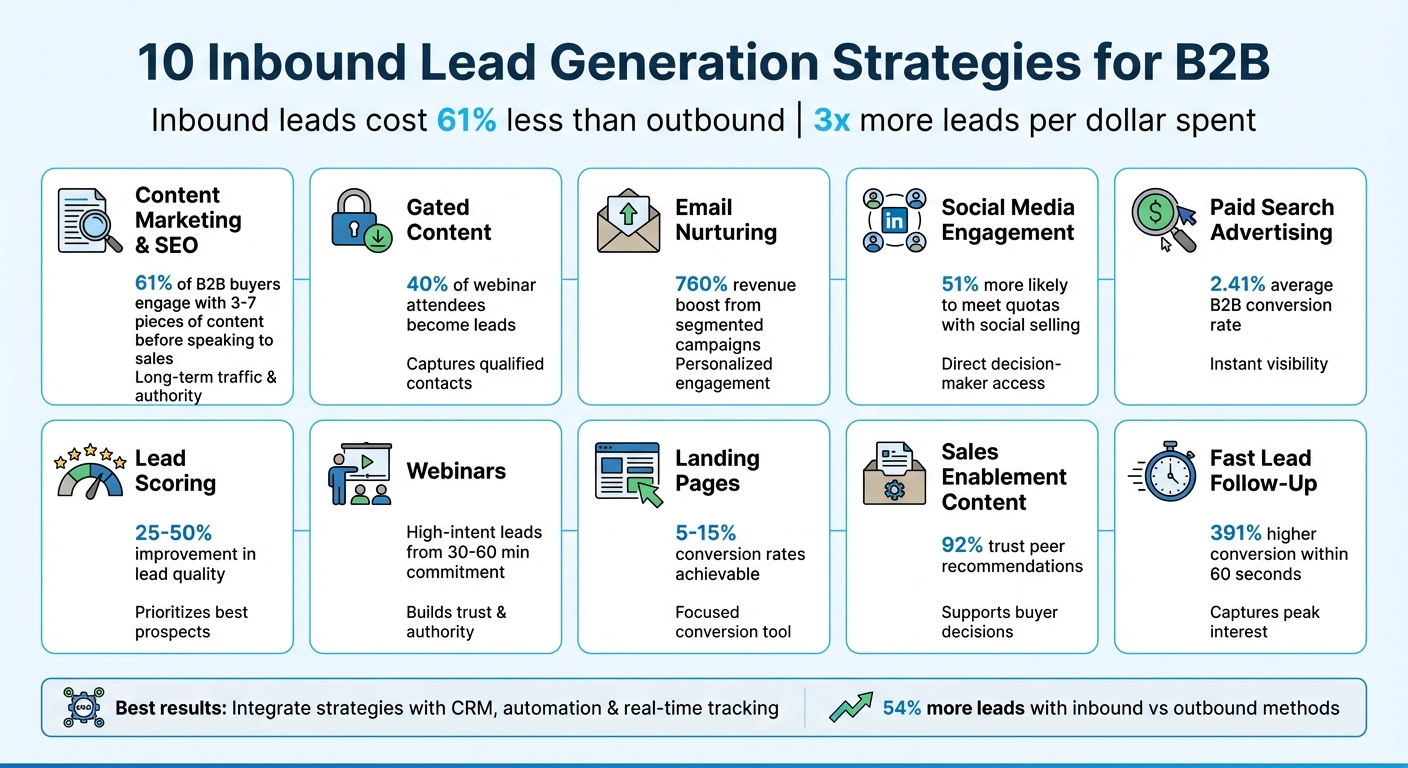
10 B2B Inbound Lead Generation Strategies Comparison
The Best Lead Generation Strategy For 2026 (Tutorial)
sbb-itb-ad881f4
1. Content Marketing and SEO
Content marketing and SEO are cornerstones of any B2B inbound strategy. Together, they don’t just attract potential clients – they create a solid foundation for broader, more integrated marketing efforts. Here’s a telling statistic: 61% of B2B buyers engage with 3–7 pieces of content before even speaking to a salesperson. This makes aligning your content with search intent absolutely essential.
Attracting Qualified Leads
Unlike cold outreach, content marketing attracts leads who are already invested in solving a problem – they’re actively seeking answers. This makes them more likely to convert and speeds up the sales process. To align with their search intent, tailor your content to their stage in the buying journey:
- Early research: Offer guides or educational resources.
- Evaluation stage: Use comparison articles and case studies.
- Decision-ready prospects: Provide pricing pages or ROI calculators.
Businesses that rank on the first page for buyer-intent keywords can experience a 40%+ boost in qualified inbound leads. Focusing on keywords like "comparison", "pricing", "reviews", and "alternatives" ensures you capture prospects who are ready to make a purchasing decision.
Scalability for Growing Businesses
One of the biggest advantages of content marketing is its long-term impact. A well-optimized blog post or whitepaper can continue driving traffic for months – or even years. B2B companies that prioritize blogging see 67% more leads per month than those that don’t.
To scale effectively, focus on building topical authority. This involves creating pillar pages – comprehensive guides on core topics – supported by related blog posts that dive deeper into specific subtopics. This cluster approach doesn’t just help you rank for individual keywords; it positions you as a trusted resource across an entire subject area.
Supporting the B2B Buyer Journey
It’s worth noting that 69% of decision-makers only reach out to sales teams after they’ve already made their purchase decision. This means your content must address every stage of the buyer journey:
- Awareness stage: Blog posts, infographics, and other educational content to help prospects identify their problem.
- Consideration stage: Webinars, case studies, and comparison articles to assist in evaluating solutions.
- Decision stage: Demos, pricing pages, and testimonials to solidify their choice.
"Content isn’t just about attracting clicks, it’s about guiding potential customers through a decision-making process. If your content doesn’t match their stage in the journey, you’ll either overwhelm them with too much information too soon or leave them hanging."
- Colleen Barry, Head of Marketing, Ketch
Seamless Integration with Marketing Systems
Content marketing doesn’t operate in a vacuum. When paired with tools like CRMs and marketing automation platforms, it becomes even more powerful. For example, tracking actions like downloading a pricing guide can help score leads and prioritize those most likely to convert. Surprisingly, 79% of B2B marketers haven’t implemented a formal lead scoring strategy yet, leaving plenty of room for gaining a competitive edge.
This integrated, content-driven strategy works hand-in-hand with the lead capture tactics covered in the next sections.
2. Gated Content and Lead Capture
Gated content works by offering valuable insights in exchange for contact information, creating a win-win situation. Unlike casual blog posts, gated resources like whitepapers, webinars, and ROI calculators attract individuals who are actively seeking solutions to specific challenges. These aren’t just casual visitors – they’re people signaling genuine interest. For example, someone downloading an in-depth industry report or dedicating time to a webinar is far more likely to be a qualified lead than someone simply skimming a blog post.
Effectiveness in Attracting Qualified Leads
Here’s a telling statistic: 96% of B2B customers look for content from industry thought leaders before making a purchase decision. And the numbers don’t stop there – up to 40% of webinar attendees become leads, while well-optimized gated landing pages can push conversion rates from around 25% to over 31%.
The secret lies in matching the content to where the prospect is in their buyer journey. For early-stage awareness, ebooks and industry reports work wonders. Prospects in the consideration phase respond better to case studies and comparison guides. And when someone is ready to make a decision? Offer gated demos, free trials, or ROI calculators. This approach ensures you’re capturing details from individuals who are actively moving closer to a purchase.
Scalability for Growth-Stage Businesses
One of the best things about gated content is how it scales. A single high-value resource can keep generating leads for months, even years. To make the process even smoother, use progressive profiling. Start small – just ask for an email address on the first interaction. Then, as they engage further, collect more details with dynamic form fields. This way, you build a full profile over time without overwhelming new visitors.
Another major advantage? You can repurpose one gated asset across multiple platforms. For instance, take key insights from a whitepaper or webinar and turn them into blog posts, social media content, or email snippets. This not only extends your reach but ensures the original resource keeps working behind the scenes to capture leads.
Seamless Integration with Marketing Systems
Gated content truly shines when integrated with your CRM and marketing automation tools. By syncing fields like "Recent Conversion" and "Recent Conversion Date", you can automatically assign lead scores and trigger follow-up sequences based on the asset they downloaded.
Automation takes it a step further by smoothly transitioning contacts through the lifecycle – from "Subscriber" to "Lead" – without manual effort. Plus, exclusion lists can prevent current customers or active opportunities from receiving entry-level gated offers, keeping your sales process focused and efficient. When done right, gated content becomes a seamless part of your inbound strategy, feeding high-quality leads directly into your marketing funnel.
3. Email Nurturing and Segmentation
Email nurturing takes inbound strategies like content marketing and gated lead capture to the next level by maintaining a steady, personalized connection with prospects. This approach helps transform cold contacts into qualified leads throughout the buyer’s journey. Here’s a striking fact: roughly 80% of new leads won’t convert without proper nurturing, and only 27% of B2B leads are ready for sales when they first enter the pipeline. That leaves 73% requiring follow-up efforts to move forward. These numbers underscore how crucial segmentation and automation are for successful email nurturing.
How It Attracts Qualified Leads
When you segment your audience based on factors like job title, company size, funnel stage, or challenges they face, engagement rates soar. For instance, marketers have seen a 760% revenue boost from segmented campaigns. Personalized emails also perform significantly better, with click-through rates 2.5 times higher than generic ones, and lead nurturing emails yielding response rates 4 to 10 times greater than standalone email blasts.
Trigger-based workflows are another game-changer. These workflows automatically send relevant follow-up content when a prospect takes a specific action – like downloading a whitepaper or visiting a pricing page. Pair this with lead scoring, where you assign points for actions (e.g., +20 for downloading a case study or +50 for visiting a pricing page), and your sales team can zero in on high-priority leads. It’s worth noting that 68% of B2B buyers are more likely to engage with a vendor that consistently delivers relevant content, even if they initially ignored earlier outreach efforts.
Aligning with the B2B Buyer Journey
Segmentation is just the start – aligning emails with each stage of the buyer’s journey takes engagement to the next level. Tailor your content to match where prospects are in their journey: share educational resources during the awareness stage, case studies and ROI calculators during consideration, and demos or testimonials during decision-making.
The results speak volumes. Nurtured leads tend to make purchases that are 47% larger than those who aren’t nurtured. Plus, companies that invest in lead nurturing see 50% more sales-ready leads while cutting costs by 33%. Start with a welcome series to set expectations and deliver immediate value. From there, create branching sequences based on user behavior. For example, if someone registers for a webinar, follow up with a related case study two days later. If they visit your pricing page multiple times, alert your sales team to prioritize that lead.
Seamless Integration with Marketing Systems
To get the most out of email nurturing, integrate these efforts with your CRM and automation tools. A well-integrated system captures engagement data and lead scores in real time, allowing you to build dynamic lists that sort leads into workflows automatically. This eliminates the need for manual sorting and ensures scalability, especially for growing businesses. Modern AI-powered tools can even handle prospecting and follow-ups without requiring additional staff.
Bidirectional syncing is key – make sure engagement data, such as email opens, clicks, and downloads, flows back into your CRM. This gives your sales team a complete view of each lead’s journey. Integration also extends beyond email, enabling LinkedIn outreach and retargeting ads that maintain a consistent message across all channels. Regularly clean your contact lists to maintain high deliverability rates, and aim for a frequency of 1–2 emails per week for most B2B campaigns. With the right systems in place, email nurturing becomes a seamless process, delivering qualified leads straight to your sales team with minimal friction.
4. Social Media Engagement and Content Distribution
Social media provides a powerful way to connect with decision-makers and nurture those relationships. Among the platforms, LinkedIn stands out as a leading choice for B2B marketers, offering precise targeting options based on job title, industry, and company size. Despite 85% of B2B marketers prioritizing lead generation, 44% still find their efforts only moderately effective. The key to success lies in aligning your social media strategy with the buyer’s journey and seamlessly integrating it with your existing marketing systems. Social platforms bring a human element to your brand, building trust in ways that corporate messaging alone cannot. This trust becomes the foundation for leveraging personal branding and employee advocacy.
Effectiveness in Attracting Qualified Leads
A reliable method for generating B2B leads combines founder-led content with employee advocacy. When founders and sales teams post regularly – around 3 to 5 times per week – with meaningful insights, the compounded effect drives inbound messages and demo requests. People prefer buying from other people, which is why personal LinkedIn profiles often see higher engagement and credibility compared to corporate pages. This personal approach complements your broader marketing systems.
Social selling leaders are 51% more likely to meet sales quotas, and 61% of B2B buyers consume 3 to 7 pieces of content before ever speaking to a salesperson. To maximize engagement with organic posts, follow a simple structure: "Hook + Value + CTA". For paid campaigns, LinkedIn Lead Gen Forms can provide high-quality leads at costs up to 78% lower than other formats, thanks to pre-filled user data from profiles.
Alignment with B2B Buyer Journeys
To make your efforts more effective, align your content distribution with each stage of the buyer’s journey. In the Awareness stage, focus on sharing educational blogs, industry reports, and thought leadership articles. For the Consideration stage, offer case studies, comparison guides, and webinars to help prospects evaluate options. Finally, during the Decision stage, provide tools like ROI calculators, implementation guides, and customer testimonials. Data shows that prospects who engage with three or more pieces of content before converting are 2–3 times more likely to close.
Repurposing content for different platforms can also extend your reach. Instead of simply reposting links, tailor your message – turn a whitepaper into an engaging LinkedIn carousel or transform a blog post into a thread on X (formerly Twitter). Since 72% of prospects prefer watching videos over reading about a product, short-form videos can be a great way to simplify complex B2B topics.
Ability to Integrate with Marketing Systems
Social media becomes even more impactful when integrated with your CRM and marketing automation tools. Platforms like LinkedIn and Facebook connect directly with systems like Salesforce and HubSpot, automatically syncing lead data to ensure smooth handoffs to sales teams. Adding tracking pixels, such as the LinkedIn Insight Tag, enables you to retarget website visitors by linking their web activity to social ad delivery.
Modern sales engagement tools take this a step further by orchestrating multi-channel outreach. These platforms combine LinkedIn messaging with email and phone campaigns, allowing growth-stage businesses to scale personalized interactions. Social engagement signals – like likes, clicks, and form submissions – can feed into CRM-based lead scoring systems, helping prioritize high-intent prospects for immediate follow-up. With LinkedIn boasting connection acceptance rates between 40% and 60% and message response rates of 10% to 20%, integrating social media with marketing systems ensures you capture and engage high-intent leads efficiently. This integration empowers businesses to adopt more dynamic and responsive marketing strategies tailored to B2B lead generation.
5. Paid Search Advertising
Paid search offers something that most inbound strategies can’t: instant visibility. While SEO takes time to gain traction, paid search puts your business right at the top for high-intent keywords – immediately. As Cleverly puts it:
"Paid ads give you instant visibility while your SEO compounds".
This quick visibility works hand-in-hand with the long-term benefits of inbound strategies, creating opportunities for highly targeted campaigns that bring in qualified leads.
Effectiveness in Attracting Qualified Leads
The real power of paid search lies in its ability to target bottom-of-funnel (BOFU) keywords. These are keywords that often include terms like "pricing", "alternatives", "reviews", or "vs" – signals that a prospect is actively researching and ready to make a decision. For example, Constellix adjusted its ad copy to highlight the benefits of switching, which immediately boosted click-through rates and improved its Quality Score.
For service-based B2B companies, Google Local Services Ads (LSAs) are particularly effective. They focus on trust-building elements like verification and customer reviews, making them a strong fit for businesses that rely on credibility.
Scalability for Growth-Stage Businesses
Paid search isn’t just about quick wins – it’s also highly scalable, making it ideal for businesses in growth mode. With full control over budgets, audiences, and keywords, you can fine-tune your spending to meet pipeline goals and forecast revenue more accurately. For instance, B2B companies using Google Ads see an average conversion rate of 2.41%, giving you a reliable framework for scaling efforts.
Take Netguru’s example: a targeted LinkedIn Lead Gen Ad campaign helped them generate over 240 high-quality leads while slashing acquisition costs by 78%. This kind of precision and scalability makes paid search a dependable tool for driving growth.
Alignment with B2B Buyer Journeys
Paid search aligns seamlessly with every stage of the buyer’s journey. In the awareness phase, broad educational keywords help attract prospects just starting their research. In the decision phase, BOFU keywords capture buyers who are ready to take action.
For example, creating dedicated landing pages for comparison queries like "[Your Product] vs [Competitor]" gives you control over the narrative when prospects are weighing their options. It’s important to avoid sending paid traffic to your homepage; instead, use focused landing pages with a single call-to-action and minimal distractions. Retargeting campaigns can then re-engage visitors who showed intent – like those who viewed pricing or demo pages but didn’t convert.
Ability to Integrate with Marketing Systems
Paid search becomes even more powerful when integrated with your marketing systems. By connecting your campaigns to a CRM like HubSpot or monday CRM, you can automate lead routing and scoring. This setup enables a speed-to-lead of under five minutes, which has been shown to significantly boost conversion rates.
Modern tools also allow you to sync CRM contacts with platforms like LinkedIn Matched Audiences or Google Customer Match, ensuring your ad content aligns with where prospects are in their buying journey. Advanced configurations can even filter out low-intent leads or mismatched industries, helping your sales team focus on high-priority opportunities. This integration not only optimizes your campaigns but also strengthens your overall lead generation strategy.
6. Lead Scoring and Qualification
Once you’ve captured leads through gated content and nurtured them, the next step is figuring out which ones are ready for sales attention. That’s where lead scoring comes in. It helps you prioritize your pipeline by focusing on the most engaged prospects who are showing real interest.
Lead scoring works by assigning numerical values to prospects based on their demographics and behaviors. This process helps differentiate between Marketing Qualified Leads (MQLs) – those who are interested but not quite ready to buy – and Sales Qualified Leads (SQLs), who are primed for direct sales engagement. By analyzing these intent signals, sales and marketing teams can work together more effectively, boosting conversion rates and speeding up the sales process. As HubSpot explains:
"Lead scoring is a way to qualify leads quantitatively… to determine where they fall on the scale from ‘interested’ to ‘ready for a sale.’"
How Lead Scoring Improves Lead Quality
Lead scoring doesn’t just identify qualified leads – it makes them better. By combining first-party data (like activity on your site) with third-party intent data (such as external research behavior), you can pinpoint active buyers more accurately. This approach can improve lead quality by 25-50% and increase conversion rates by 15-30%.
A strong scoring system tracks actions across different stages of the sales funnel. For example:
- Low scores: Assigned to top-of-funnel activities like reading blog posts.
- Moderate scores: Given to middle-of-funnel behaviors like downloading whitepapers.
- High scores: Reserved for bottom-of-funnel actions, such as multiple visits to pricing pages.
This kind of system can drive a 3-5% MQL-to-SQL conversion rate.
Scaling for Growing Businesses
For businesses in growth mode, lead scoring is a game-changer. It automates the qualification process, allowing your team to focus on building relationships with high-value prospects instead of manually sorting through leads. As Scalelist puts it:
"The goal of automation is not to replace human interaction but to make it more timely and relevant."
To make this work, marketing and sales teams should collaborate to define the "MQL threshold" – the score that signals when a lead is ready for sales. Once a lead hits that score, the system can automatically update their status, assign them to a sales rep, and trigger a follow-up task.
Seamless Integration with Marketing Tools
Lead scoring becomes even more effective when paired with tools like CRMs and marketing automation platforms. Systems such as HubSpot and Salesforce can automatically notify sales teams via Slack or create tasks as soon as a lead meets the threshold score. You can also set up workflows that skip standard nurturing steps for high-intent actions, sending these leads straight to sales.
To avoid redundant communication, create a Global Exclusion List. This ensures that leads already in negotiations or existing customers don’t receive introductory content. Advanced setups can even sync scored leads with LinkedIn Matched Audiences or Google Customer Match, so your ads align perfectly with where those leads are in their buying journey.
7. Webinars and Virtual Events
Webinars, much like content and email campaigns, are a highly engaging inbound marketing tool. They act as strong lead magnets, especially because of the time commitment they require. When someone sets aside 30–60 minutes to attend a webinar, it shows a much deeper level of interest compared to simply downloading a PDF. This makes webinar attendees more likely to be qualified leads right from the start.
Why Webinars Attract Qualified Leads
Webinars offer a unique opportunity to showcase your product or service in real time while addressing questions and concerns on the spot through Q&A sessions. This builds trust much faster than static content ever could. Educational webinars also position your brand as a knowledgeable and reliable resource, helping you establish a connection with potential customers even before sales discussions begin.
Statistics back this up – 61% of B2B marketers highlight that finding high-quality leads is their biggest challenge. Webinars tackle this head-on by drawing in prospects who are actively looking for solutions. The interactive nature of webinars aligns perfectly with different stages of the buyer journey, making it easier to guide prospects toward conversion.
Matching Webinar Topics to Buyer Stages
The success of a webinar often depends on how well the topic aligns with where your audience is in their buyer journey. For early-stage prospects, sessions on industry trends or emerging challenges are a great fit. Mid-stage leads might benefit from case study breakdowns or comparisons of different solutions. For those nearing a purchase decision, live product demos and ROI-focused discussions can seal the deal. Tailoring your webinar content to meet these needs ensures you’re connecting with your audience at the right time.
This multi-touchpoint engagement strategy can significantly boost conversion rates.
Seamless Integration with Marketing Tools
Modern webinar platforms make it easier than ever to integrate with your existing marketing systems. They sync directly with CRMs and marketing automation tools, allowing you to track attendance, measure engagement, and score leads accordingly. For example, active participation – like asking questions or staying for the entire session – can automatically increase a lead’s score and alert your sales team.
To maximize your efforts, set up automated workflows for both attendees and no-shows. Send attendees follow-ups with recordings, slides, and clear next steps, while no-shows can receive a "sorry you missed it" email along with access to the session recording. Recorded webinars can also be repurposed as on-demand content, extending their value.
8. Landing Pages and Conversion Optimization
Landing pages are all about one thing: turning visitors into leads. Unlike a traditional website loaded with navigation options, a landing page is laser-focused. Its purpose is clear – guide visitors toward a specific action or let them leave. By stripping away distractions, you create a space where prospects either engage or move on.
Effectiveness in Attracting Qualified Leads
On average, landing page conversion rates range between 3% and 5.5%. But with thoughtful tweaks, B2B landing pages can hit much higher rates – think 5–15% or even more. A standout example is Articulate Marketing, which fine-tuned its landing page forms to achieve an impressive 31.09% conversion rate. The key? Tailoring each page to match where the buyer is in their journey. Early-stage buyers might respond best to educational resources like ebooks or industry reports. Mid-funnel prospects? They’re likely interested in comparison guides or case studies. And when someone’s ready to make a decision, demos or pricing details can seal the deal.
Building trust is another game-changer. Adding elements like client logos, testimonials, or snippets from case studies can help hesitant buyers feel more confident. Visuals also play a big role – content paired with images gets up to 94% more views than text alone. And here’s a striking stat: 96% of B2B buyers look for insights from industry experts before committing. The takeaway? Show value upfront, even before asking for contact details.
Alignment with B2B Buyer Journeys
Getting the message right is crucial. Your landing page headline and design should match the ad or link that brought the visitor there – it’s all about consistency. For leads in the awareness stage, keep things simple: just ask for an email address. This lowers barriers and encourages sign-ups. As prospects move further along, you can use progressive profiling to gather more details without scaring them off during their first interaction. This approach not only boosts conversions but also sets the stage for seamless CRM integration.
Ability to Integrate with Marketing Systems
Your landing pages shouldn’t exist in isolation – they need to work hand-in-hand with your marketing systems. For instance, when someone downloads a whitepaper, your CRM should automatically score the lead, update their stage in the buyer’s journey, and trigger a follow-up sequence tailored to their interest. To keep things organized, use standardized data fields to prevent clutter in your database. And for high-intent actions, like visits to your pricing page, set up immediate calls-to-action to capture that interest while it’s hot.
9. Sales Enablement Content
Sales enablement content plays a crucial role in helping buyers make informed decisions. Resources like comparison guides, case studies, and ROI calculators give potential customers the tools they need to evaluate options and justify their choices internally with tailored consulting solutions. While landing pages are great for grabbing attention, enablement content helps prospects dive deeper into why your solution is the right fit. This is particularly important because modern B2B buyers complete 67% of their purchase journey before ever reaching out to a sales representative. They’re doing their homework – researching, comparing, and building business cases independently. This makes it easier to measure lead quality through actionable metrics.
Effectiveness in Attracting Qualified Leads
Content aimed at the bottom of the funnel, such as pages targeting high-intent keywords like "pricing" or "alternatives", tends to attract the most qualified leads. Social proof is also a game-changer – 92% of B2B buyers trust peer recommendations, and case studies showcasing real results can boost conversion rates by up to 20%. When prospects engage with multiple pieces of content – three or more – they’re 2-3x more likely to convert into customers. Creating comparison pages (e.g., “Your Product vs. Competitor”) is particularly effective. These pages allow you to guide the narrative and address concerns directly during the evaluation process.
Alignment with B2B Buyer Journeys
Sales enablement content shines during the Consideration and Decision stages. At these points, prospects aren’t debating whether they need a solution – they’re figuring out which vendor to choose and how to justify the investment to decision-makers. With most B2B purchases involving 6–10 stakeholders, it’s essential to provide tools like business case templates and evaluation guides. These resources empower internal champions to advocate for your solution effectively.
Integration with Marketing Systems
To maximize the impact of sales enablement content, integrate it seamlessly with your marketing systems. Configure your CRM to flag high-value prospects who engage with these assets, ensuring your sales team is notified immediately. Streamline workflows to prioritize high-intent actions, skipping standard nurturing steps. Additionally, use progressive profiling to collect lead information over time, reducing form friction while building a complete profile of each prospect. Companies that align their sales and marketing teams see 208% higher marketing revenue compared to those that don’t.
10. Fast Lead Follow-Up and Engagement
Once you’ve established strong inbound strategies, the next step is acting quickly on new leads. When someone fills out a form or requests a demo, they’re showing peak interest in your business. Reaching out within the first 60 seconds can boost your chances of conversion by a staggering 391%. As Sanjana Murali, Content Marketing Manager at Dealfront, explains:
"Once you qualify a lead, it’s crucial that you contact them fast before they lose interest in your business. It’s a classic case of striking while the iron is hot."
Why Quick Follow-Up Works
Speed matters. Behavioral trigger automation has been shown to increase conversion rates by 84%. The logic is straightforward: inbound leads are already interested – they’ve taken the first step. Unlike cold outreach, where you’re interrupting someone’s day, a fast response meets these prospects when they’re ready to engage. By prioritizing speed and personalization, advanced lead generation strategies can deliver 65% more qualified opportunities. And when you combine efforts across multiple channels – like LinkedIn, email, and phone – you can see response rates improve by 40% or more compared to relying on a single method.
Scaling for Growth Without Adding Staff
For businesses handling a growing number of leads, scaling doesn’t have to mean hiring more sales reps. AI-powered tools can automate lead prioritization and distribution, ensuring no opportunity slips through the cracks. Round Robin lead routing, for example, can instantly assign leads to the right team member, avoiding delays. To stay accountable, establish clear Service Level Agreements (SLAs) between marketing and sales – like committing to follow up with high-priority leads within two hours.
Aligning with the B2B Buyer’s Journey
Fast follow-up fits perfectly into the B2B buyer’s journey, engaging prospects as they transition from research to evaluation. Acting quickly can also shorten the traditionally long B2B sales cycle. Some companies have reported a 42% reduction in cycle length by optimizing their response processes. Using behavioral "jump" logic in workflows lets high-intent leads – such as those visiting pricing pages – skip nurturing steps and head straight to a sales conversation.
Seamless Integration with Marketing Systems
To ensure no lead is left behind, integration between your CRM and prospecting tools is essential. Centralized systems allow for real-time lead routing, notifying the right sales rep immediately. Automate alerts – via Slack or email – when a lead’s score reaches a certain threshold. AI-powered lead scoring can flag "hot" leads for instant attention. Additionally, live chat on high-intent pages, like pricing or demo sections, can capture details and provide immediate answers. Companies with advanced lead generation systems can even forecast revenue with 10-15% accuracy. This kind of immediate engagement ties everything together, ensuring a seamless and effective inbound strategy.
How to Implement Inbound Lead Generation
Inbound lead generation follows a clear, four-stage process designed to guide prospects from being strangers to becoming loyal customers: Attract, Engage, Close, and Delight. This approach is not just effective – it’s efficient, delivering three times more leads per dollar spent compared to traditional outbound methods. Each stage builds on the one before, creating a seamless system for generating and nurturing leads.
The Attract stage is all about drawing in the right audience. This starts with creating valuable, educational content tailored to your ideal customers. Think SEO-optimized blog posts, social media updates, and targeted ads that answer your audience’s questions. With 68% of online customer experiences starting with a search engine, it’s crucial for your content to appear when potential customers are searching for solutions – even if they’re not yet aware of your product or service.
Once you’ve attracted visitors, the next step is the Engage stage. Here, the goal is to convert those visitors into leads by offering something of value in exchange for their contact information. Tools like landing pages, calls-to-action, and lead magnets are essential. Since most leads aren’t ready to buy immediately, nurturing becomes key. Personalized email campaigns, retargeting ads, and educational content help build trust and guide leads through the decision-making process.
The Close stage focuses on turning engaged leads into paying customers. This involves strategies like email nurturing, product demonstrations, and lead scoring to identify prospects who are ready to buy. For those still on the fence, continued nurturing pays off – companies that invest in lead nurturing see 50% more leads at 33% lower costs and enjoy 47% larger purchases. Once a lead converts, the work doesn’t stop there; keeping customers satisfied is just as important.
Finally, the Delight stage is all about creating loyal promoters. This is achieved through proactive support, Net Promoter Score (NPS) surveys, and personalized follow-up content. Why does this matter? Because 92% of consumers trust referrals from people they know. By consistently delivering value, you can turn happy customers into enthusiastic advocates, extending your marketing reach organically.
How Graystone Consulting Can Help
Graystone Consulting takes the inbound lead generation strategies mentioned earlier and transforms them into a complete system designed to scale your marketing efforts. For businesses led by founders or in their growth stages (typically generating $1M–$10M in revenue), they specialize in turning scattered marketing efforts into measurable growth.
Start with their Diagnostic Sprint, a comprehensive audit of your entire funnel. This process uncovers revenue leaks and tracks deal progression in real time. It helps identify your Ideal Customer Profile and highlights key challenges by addressing major pain points. The deliverables include a baseline for KPIs, a revenue leak analysis, and a clear blueprint for growth – providing actionable insights before scaling begins.
From there, the Growth System Installation addresses any gaps by implementing essential tools like CRMs, marketing automation, ad connectivity, and real-time KPI dashboards. This setup ensures that every action is tied to measurable outcomes. Graystone promises a 15–20% boost in funnel efficiency through this structured approach, ensuring your investment yields real results.
Their Leadership Retainer provides fractional CMO services for ongoing strategic guidance. This service bridges the gap between marketing and sales, ensuring resources are focused on high-potential leads instead of wasted on unqualified ones. With regular strategy sessions – either weekly or biweekly – and KPI oversight, you’ll have executive-level support to keep your growth aligned and on track.
Graystone’s approach centers on driving measurable, long-term results. By building systems around real-time KPIs, attribution, and funnel optimization, they ensure every dollar you spend is working toward maximum return.
Conclusion
Inbound lead generation is a cornerstone for consistent B2B growth. Businesses using inbound strategies generate 54% more leads compared to those relying on outbound methods. Plus, these leads tend to close faster because they’ve already taken the time to research and understand their needs. By leveraging tools like content marketing, SEO, email nurturing, and conversion optimization, you’re establishing trust long before a sales conversation even begins.
These approaches align perfectly with how today’s B2B buyers operate. They prefer to research independently, engage with multiple pieces of content, and opt for permission-based interactions rather than intrusive marketing. In fact, multi-touch engagement can increase conversion rates by 2 to 3 times. That’s the strength of educating your audience over relying on pushy sales tactics.
However, success in inbound lead generation isn’t just about implementing these strategies – it’s about connecting them. A well-structured system that includes lead scoring, qualification processes, and alignment between marketing and sales is critical. Without real-time performance metrics, effective attribution tracking, and automated nurturing, even the best content can fail to deliver its full potential. A data-driven, integrated marketing system ensures all these pieces work together to capture and convert high-intent leads efficiently.
If your business earns between $1 million and $10 million annually and struggles with fragmented marketing efforts, Graystone Consulting can help. Their Diagnostic Sprint identifies where leads are slipping through the cracks, while their Growth System Installation builds the infrastructure needed to capture and convert leads seamlessly.
Start small – implement a few strategies, analyze the results, and then scale what works. By 2026, the businesses leading the way won’t necessarily have the largest ad budgets. Instead, they’ll be the ones with a systematic, data-backed approach to attracting and converting high-intent leads. Let that be your edge.
FAQs
What’s the best way to combine content marketing and SEO to generate more B2B leads?
To successfully merge content marketing with SEO for B2B lead generation, the first step is understanding your target audience. Pinpoint their main challenges and needs, then use this knowledge to identify keywords that match their search intent. This ensures your content is both helpful and easy to find.
Focus on creating well-crafted, engaging content that incorporates these keywords to boost your search engine rankings and attract organic traffic. Share your content widely through channels like email campaigns and social media to expand its reach. Continuously monitor performance metrics to fine-tune your strategy and ensure your content stays relevant. By blending SEO with content marketing, you can establish authority, maintain steady traffic, and turn visitors into qualified leads.
What are the best ways to use gated content to generate high-quality B2B leads?
To make gated content work effectively for generating qualified B2B leads, focus on crafting resources that your audience can’t resist. Think whitepapers, eBooks, case studies, or webinars that tackle specific industry challenges or common pain points. The content should directly address their needs and provide practical insights that genuinely help in their decision-making process.
To maximize success, keep things simple. Use clear and compelling calls-to-action and limit form fields to the essentials – this reduces friction and makes it easier for users to engage. Once you’ve captured a lead, follow up with personalized outreach and tailored content to nurture the relationship. This approach helps guide prospects through the buyer’s journey while building trust. By consistently delivering top-notch resources, you position your business as a dependable partner, paving the way for converting leads into loyal clients.
What is lead scoring, and how does it make B2B sales more efficient?
Lead scoring is a system that helps rank potential customers based on how likely they are to make a purchase. By assigning scores to leads – using factors like their level of engagement, behaviors, and how well they match your target demographics – sales teams can zero in on the prospects with the most promise.
This method makes the sales process more efficient by cutting down on time spent chasing leads that are less likely to convert. It ensures resources are used wisely, helping businesses close deals faster and boost revenue.


0 Comments