




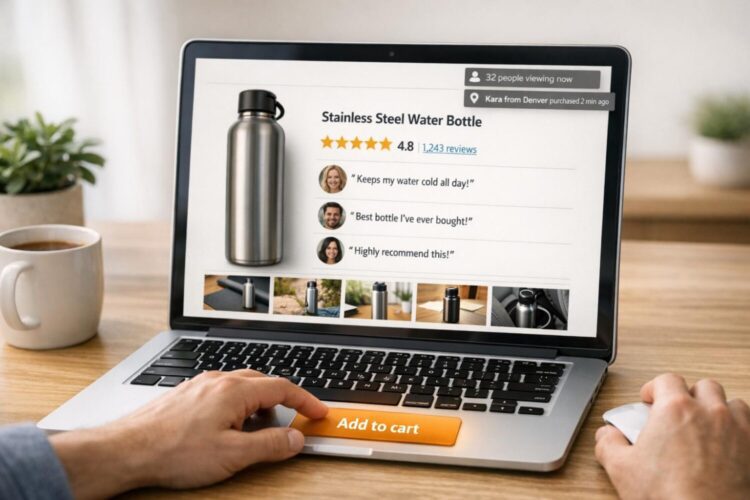
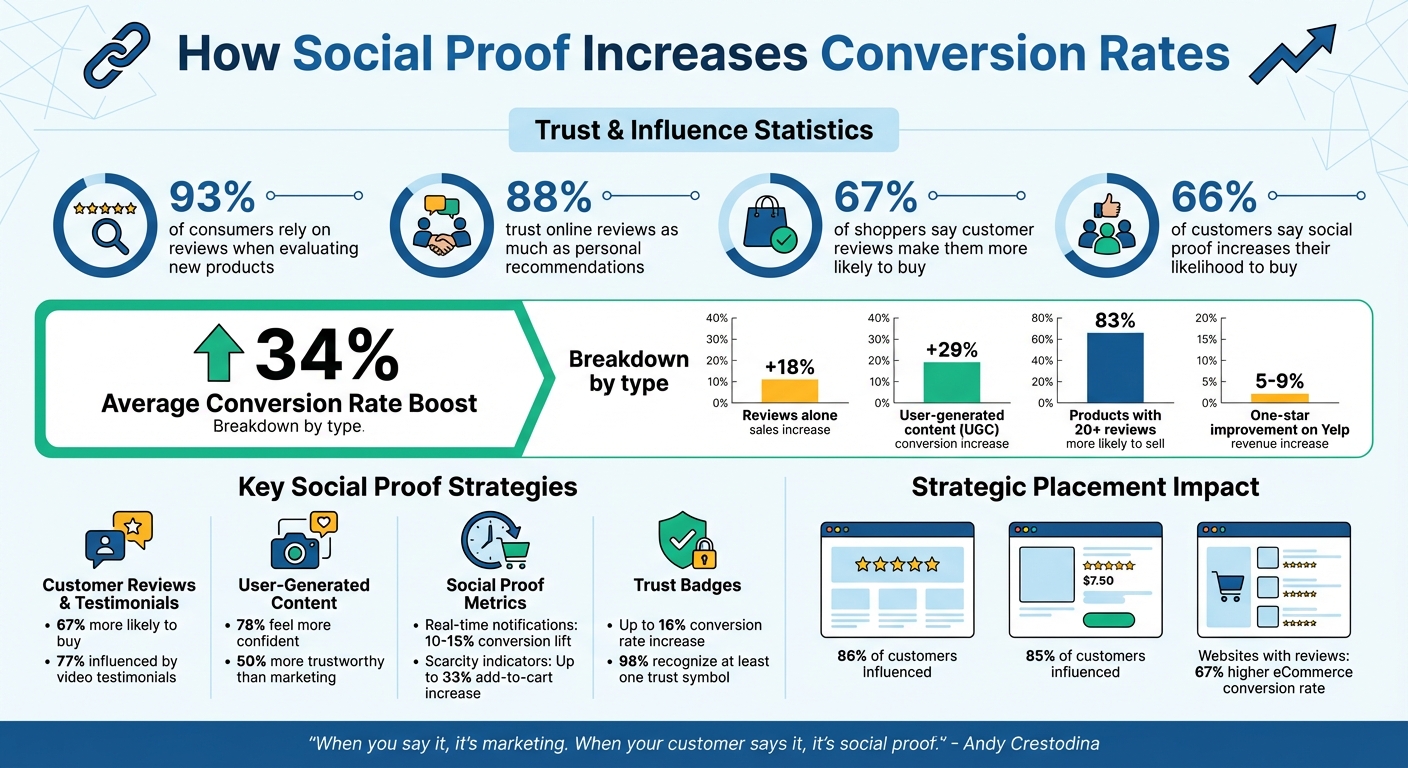
Social proof works because people trust what others say and do. It’s a psychological phenomenon that reduces uncertainty, builds trust, and makes decisions feel safer. For example, 93% of consumers rely on reviews when evaluating new products, and 88% trust those reviews as much as personal recommendations.
Websites that use social proof – like reviews, testimonials, or real-time purchase notifications – see an average conversion rate boost of 34%. Key strategies include:
- Customer reviews and testimonials: 67% of shoppers say these make them more likely to buy.
- Case studies and success stories: Detailed narratives with tailored consulting solutions and measurable results resonate strongly.
- User-generated content (UGC): Photos and videos from real customers can increase conversions by 29%.
- Social proof metrics: Stats like "10,000+ customers" or scarcity indicators like "Only 2 left" create urgency.
Placing these elements strategically – near CTAs, product pages, or checkout areas – can address hesitation and drive sales. However, low numbers or outdated reviews can backfire, so it’s essential to use social proof wisely and keep it updated. Testing different formats and placements ensures maximum impact. Social proof isn’t just about showing popularity; it’s about building trust and reducing risk for your audience.
Social Proof Impact on Conversion Rates: Key Statistics and Strategies
How To Increase Your Conversions with Social Proof Marketing
Social proof is a critical component of a scalable marketing operating system that drives predictable revenue.
sbb-itb-ad881f4
What Social Proof Is and How It Works
Social proof, or informational social influence, is a psychological concept where people look to others’ actions and feedback to guide their own decisions. When potential customers see others buying and endorsing a product, it feels more trustworthy – like a genuine recommendation rather than just a marketing tactic. This helps reduce uncertainty and makes the buying process feel less risky.
For example, 66% of customers say social proof increases their likelihood to buy, and 98% can identify at least one trust symbol that influences their decision. Products with at least 20 reviews are 83% more likely to sell compared to those without any.
The Psychology of Social Proof
Several psychological factors explain why social proof is so effective at driving decisions. One key factor is uncertainty. When people are unsure, they naturally turn to others for guidance. Reviews and Q&A sections help answer the critical question on buyers’ minds: "Is this legitimate?"
Similarity is another powerful driver. Feedback from someone who shares a buyer’s background or challenges is far more persuasive than a generic endorsement. In fact, 67% of shoppers trust user-generated content over branded marketing when making decisions.
Then there’s the bandwagon effect – the idea that if many people are doing something, it must be the right choice. Phrases like "Join 50,000+ users" or "Best Seller" trigger this instinct, making high numbers feel like validation. Additionally, endorsements from experts or trusted media outlets can lend even more credibility.
"We view a behavior as more correct in a given situation to the degree that we see others performing it."
- Robert Cialdini, Ph.D., Author of Influence: The Psychology of Persuasion
Generational differences also play a role. For instance, 72% of Gen Z consumers are influenced by social proof, compared to 63% of Baby Boomers. These psychological principles explain why social proof has such a strong impact on conversions.
How Social Proof Affects Conversion Metrics
The psychological triggers behind social proof directly translate into improved conversion rates. Websites leveraging social proof see average conversion rate increases of 34%. Reviews alone can boost sales by 18%, and 78% of shoppers feel more confident when they see user-generated content like reviews, photos, or Q&As.
Social proof also impacts revenue. For instance, a one-star improvement on Yelp can increase a business’s revenue by 5% to 9%. On the flip side, 94% of people admit poor reviews have convinced them to avoid a business.
Where you place social proof matters. Positive star ratings and reviews on a homepage influence 86% of customers, while 85% are swayed by reviews on product pages. Adding social proof at critical friction points – like the checkout page or near call-to-action buttons – can help ease hesitation.
Real-time social proof adds another layer of urgency. Notifications like "27 people bought this in the last 24 hours" tap into FOMO (fear of missing out) and signal high demand. This trend is growing as brands recognize that showcasing current activity makes social proof feel more immediate and relevant.
"When you say it, it’s marketing. When your customer says it, it’s social proof."
- Andy Crestodina, Strategic Director, Orbit Media
However, there’s a catch: using social proof when the numbers are low can backfire. If you display zero reviews or single-digit social shares, it can create "negative social proof", which may discourage buyers. If you’re just starting out, it’s better to wait until you’ve built up enough validation before showcasing social proof. Knowing how to navigate these nuances will help you use social proof more effectively on your site.
Types of Social Proof You Can Use
Social proof is a powerful tool for building confidence and addressing a marketing system leaking revenue by encouraging conversions. From testimonials to real-time metrics, each format offers a unique way to establish trust and inspire action. However, not all types of social proof work the same way. The effectiveness often depends on your audience and their stage in the buying process. Let’s break down the main types and when to use them.
Customer Testimonials and Reviews
Customer testimonials and reviews are some of the most straightforward forms of social proof. They show that real people have used your product or service and were happy enough to share their experiences. The most impactful testimonials go beyond generic praise to detail specific challenges and measurable results.
For instance, WikiJobs saw a 34% increase in conversions simply by adding customer testimonials to a sales page. Plus, 88% of consumers trust online reviews as much as personal recommendations. This makes them especially influential when buyers are comparing options.
Video testimonials can take this to another level. A whopping 77% of viewers say testimonial videos helped convince them to make a purchase. To make testimonials feel genuine, include real photos, full names, and company logos. Interestingly, including a mix of positive and negative reviews can actually enhance credibility, as it shows balanced, honest feedback.
Case Studies and Success Stories
Case studies are perfect for showcasing success through a detailed, data-driven narrative. They’re especially effective for B2B companies and high-value products or services. A good case study doesn’t just claim results – it demonstrates them with real challenges and measurable outcomes.
For example, Voices.com increased its conversion rate by 400% by displaying logos of well-known clients on its site. Similarly, Invesp boosted conversions by 190% by prominently listing client names and logos. Buyers tend to connect more with case studies that mirror their own challenges, making these stories relatable and impactful.
User-Generated Content
User-generated content (UGC) adds an authentic, unpolished voice to your brand. This includes photos, videos, and social media posts created by your customers. Because UGC comes from unbiased peers, it feels more genuine than traditional marketing materials. In fact, 78% of shoppers feel more confident about a purchase when they see UGC, which is considered 50% more trustworthy than standard marketing.
UGC works by showing your product in real-life situations, reducing uncertainty and encouraging purchases. For example, featuring user-generated photos has been shown to boost conversion rates by up to 29%. You can encourage UGC by creating branded hashtags or offering incentives and then showcasing this content on product pages, social media, and email campaigns.
Social Proof Numbers and Metrics
Numbers are a great way to tap into the bandwagon effect. Phrases like “Join 124,500 students” or “Trusted by 10,000+ customers” signal that your product or service is popular and reliable. Specific numbers – such as “4,127 customers” – tend to feel more credible than rounded figures.
| Metric Type | Example | Psychological Trigger | Impact |
|---|---|---|---|
| Activity | "Sarah from Chicago just bought this" | Bandwagon Effect | 10–15% conversion lift |
| Scarcity | "Only 2 items left at this price" | Loss Aversion / FOMO | Up to 33% add-to-cart increase |
| Popularity | "Join 124,500 students enrolled" | Safety in Numbers | Builds authority and trust |
| Urgency | "34 people are looking at this property" | Competition | Faster decision-making |
Real-time activity feeds showing recent purchases or sign-ups can increase conversions by 10–15%. However, be cautious with low numbers – like only a handful of subscribers or no reviews – as this can have the opposite effect. It’s best to use this approach once you’ve built a solid base.
Trust badges and certifications are another powerful tool. Seals like SSL certificates, industry awards, or “As Seen On” logos help reduce perceived risks, especially during checkout. In fact, trust badges can increase conversion rates by up to 16%, and 98% of consumers recognize at least one trust symbol that makes them more likely to buy.
Each of these types of social proof plays a role in easing buyer hesitation and driving conversions.
Where to Place Social Proof on Your Site
Strategically placing social proof at key moments can reassure visitors and nudge them toward making decisions. Let’s break down the best spots to showcase it.
Product and Landing Pages
Your product and landing pages are often the first impression for visitors, particularly those arriving via search engines. With 91% of shoppers reading online reviews before purchasing, this is where social proof can shine.
The hero section – the area at the top of the page visible without scrolling – is prime real estate. Use this space to feature client logos, star ratings, or endorsements from experts. If not here, position these elements just below the fold to ensure they grab attention.
Another key spot? Right next to call-to-action (CTA) buttons like "Sign Up" or "Add to Cart." Adding subscriber counts, testimonials, or phrases such as "Join 37,238 marketers" can reduce hesitation and drive action. Websites with customer reviews see a 67% higher eCommerce conversion rate.
Here’s how you can align social proof with placement:
| Placement Area | Recommended Social Proof Type | Primary Benefit |
|---|---|---|
| Hero Section | Client logos, star ratings, expert endorsements | Builds trust and credibility instantly |
| Near CTA/Form | Testimonials, subscriber counts, short quotes | Reduces hesitation, boosts conversions |
| Product Gallery | User-generated photos or videos (UGC) | Highlights real-world product use |
| Sidebar | Rotating quotes, social media follower counts | Reinforces authority while browsing |
As visitors move further into the buying process, the role of social proof becomes even more critical.
Checkout and Pricing Pages
The checkout and pricing pages are where doubts and hesitation are most likely to surface. Smartly placed social proof here can ease concerns and encourage completion.
Trust badges – like SSL certificates, PayPal or Mastercard logos, and industry certifications – placed near payment fields can alleviate security worries. These badges can increase conversion rates by up to 16%, with trust logos alone boosting them by 5% to 7%.
Position star ratings close to the price or "Add to Cart" button to quickly convey quality. Additionally, testimonials that address specific concerns – like price or value – can help overcome objections.
Live activity notifications, such as "3 people just bought this" or scarcity indicators like "Only 2 left", tap into the "wisdom of the crowd" and create urgency. With 69% of shoppers reporting a fear of missing out (FOMO), these tactics can significantly influence decisions.
"When we are uncertain, we are willing to place an enormous amount of trust in the collective knowledge of the crowd."
– Robert Cialdini, Author of Influence
Highlighting features like money-back guarantees or customer service availability can reduce perceived risk. However, if a product has limited or no reviews, it’s better to avoid displaying social proof counters entirely – low numbers can discourage buyers.
Email Campaigns and Retargeting Ads
Social proof isn’t just for your site – it’s equally effective in email campaigns and retargeting ads. These tools help re-engage hesitant buyers and extend the influence of social proof beyond your website.
In emails, using social proof in subject lines (e.g., "95% of users recommend this!") can boost open rates. Inside, include visual elements like screenshots of reviews or user-generated content to make the proof feel authentic and relatable.
Abandoned cart emails are especially effective when they address common objections. For instance, if you sell protein powder, a testimonial about its great taste might help overcome doubts.
In retargeting ads, customer quotes and media mentions can transform your ads into trusted recommendations. Featuring "As seen in" logos or awards builds credibility quickly, with 88% of consumers trusting online reviews as much as personal recommendations.
Here’s some eye-opening data: Figleaves.com saw a 37.5% increase in conversions after adding product reviews to their campaigns. Similarly, Revolut achieved a 700% boost in customer acquisition by introducing a referral program.
Personalization is key here. Segment your audience based on their browsing behavior or abandoned products, and use automation to deliver targeted testimonials or case studies.
"Use social proof to answer major objections. For instance, if you sell protein powder, then taste is going to be a big objection. This is when you use social proof that directly answers that objection."
– Danavir Sarria, Founder, Supply Drop
Lastly, steer clear of negative social proof. Instead of emphasizing inaction, focus on showcasing the majority taking the desired action. Keep your social proof fresh by rotating testimonials regularly, as outdated reviews can lose their impact.
How to Test and Improve Social Proof Performance
After adding social proof to your site, the next step is figuring out what works best. Testing different strategies helps you fine-tune your approach and boost conversions.
A/B Testing Different Types of Social Proof
A/B testing is a straightforward way to compare a baseline version of your site (without social proof) to versions featuring different types of social proof. This process helps you pinpoint which elements are most effective at driving conversions.
Start by experimenting with different formats. For instance, compare text-based testimonials to video testimonials or expert endorsements. Research indicates that testimonials with photos are far more memorable than plain text, and high-profile client logos tend to leave a stronger impression than lesser-known ones.
You can also test placement and specificity. Try positioning social proof near your call-to-action button and compare it to placing it in less prominent areas, like the footer. Experiment with specific figures like "4,127 customers" versus rounded numbers like "4,000+ customers" to see which builds more trust. Real-time notifications – such as "3 people are viewing this page right now" – can also be tested to determine if creating urgency improves conversions compared to static proof.
Before running these tests, map out your ideas and decide on the metrics you’ll track. Tools like Google Optimize, Convertize, and WiserNotify can simplify the process.
Once you’ve tested your variations, measure their effectiveness using targeted metrics.
Metrics to Track
As you run A/B tests, focus on metrics that reveal how well your social proof is performing. The conversion rate – the percentage of visitors who take action after seeing social proof – is the most important metric to track.
Other key metrics include:
- Click-through rate (CTR): This measures how often users interact with specific social proof elements, helping you gauge their relevance and appeal.
- Time on page: A longer time spent on a page can indicate that your social proof is keeping visitors engaged.
- Bounce rate: A lower bounce rate suggests that your trust signals are encouraging visitors to stick around rather than leaving immediately.
For user-generated content (UGC), you can calculate conversion uplift by comparing the conversion rates of visitors who interact with UGC against those who don’t. On average, e-commerce sites see a 161% increase in conversions when using UGC, with the apparel industry experiencing even higher gains at 207%.
| Metric | What It Measures | Why It Matters |
|---|---|---|
| Conversion Rate | Percentage of visitors taking action | Reflects direct impact on business goals |
| Click-Through Rate | Engagement with social proof elements | Shows interest and relevance |
| Time on Page | How long users stay engaged | Suggests credibility and trust |
| Bounce Rate | Visitors leaving immediately | Highlights trust or relevance issues |
Additionally, keep an eye on Customer Acquisition Cost (CAC). Since social proof often requires a one-time setup, it can reduce your long-term cost per lead. Comparing the conversion rates of customers who interact with social proof to those who don’t can help you calculate the ROI of each element.
Tools for Tracking and Improving Results
The right tools can make testing and optimization much easier. Platforms like Trustmary, WiserNotify, and OptinMonster simplify A/B testing without requiring technical expertise. Meanwhile, VWO’s visual editor and Kameleoon’s AI insights can provide deeper analysis.
For real-time notifications, tools like TrustPulse (starting at $5/month), Proof ($29/month), and Fomo ($19/month) offer affordable options with customizable event tracking and quick setup.
When it comes to analytics and ROI tracking, tools like Yotpo Analytics and Senja deliver dashboards that show the dollar value and conversion uplift generated by your social proof. Heatmapping tools like Hotjar or Inspectlet can also reveal whether visitors are paying attention to your social proof elements or scrolling past them.
To maximize impact, segment your data. For example, show shoe reviews to visitors browsing footwear. Analyze the percentage of visitors engaging with a widget versus the percentage of sales from those visitors. If the sales percentage is higher, your widget is delivering a positive ROI.
How to Collect and Display Social Proof
Gathering social proof from your customers doesn’t have to be complicated. The trick is to ask at the right moment and make the process as effortless as possible for them.
How to Request Testimonials from Customers
Timing is everything when it comes to asking for feedback. Reach out during key moments, like after a customer achieves a milestone, completes a successful support interaction, or shares something positive about your product on social media. Automated follow-up emails or personalized messages right after these interactions can help you collect more detailed testimonials.
Instead of vague questions, guide your customers with prompts like, "What problem were you trying to solve before using our product?" or "What results have you seen since using it?" These types of questions make it easier for customers to structure their responses. Streamline the process even further by offering one-click ratings, short forms, or even drafting a testimonial for their approval. If you don’t get a response, a single follow-up after a week is enough. Always make sure to get their permission before sharing their feedback and avoid including any sensitive information.
Once you’ve gathered testimonials, focus on selecting the ones that will resonate most with your audience.
Selecting the Right Social Proof to Show
Not all testimonials are equally persuasive. Choose ones that highlight specific features, solve common problems, or include measurable outcomes. For example, a comment like "Great product!" is less impactful than one that shares specific results, such as improved efficiency or cost savings.
Tailor your social proof to different stages of the customer journey. For your homepage, use broad indicators like total user numbers or media coverage to build credibility quickly. On product pages, detailed testimonials featuring customer photos can address specific concerns. For pricing and checkout pages, risk-reduction tools like trust badges, security seals, or real-time purchase notifications help reassure buyers.
Whenever possible, include exact figures to make testimonials more credible. Rotating your social proof regularly keeps it fresh and prevents your brand from seeming outdated.
After selecting the best testimonials, focus on maintaining their authenticity to build trust.
Keeping Social Proof Honest and Transparent
Trust is built on authenticity, and customers can easily spot fake reviews. To make testimonials more believable, include details like the customer’s full name, a real photo, and their job title. Video testimonials are even more effective, as they capture emotions and body language that written reviews simply can’t convey.
Another way to boost credibility is by showcasing reviews on trusted third-party platforms like Trustpilot or G2 instead of relying solely on your own website. Shoppers tend to trust these independent sources more – after all, 92% of consumers read online reviews before making a purchase.
"Using a closed platform is like asking your own mother if you’re handsome."
- Peter Mühlmann, CEO, Trustpilot
Don’t shy away from negative reviews. Displaying a mix of feedback, including constructive criticism, shows transparency and gives you the opportunity to respond publicly in a helpful way. If you incentivize reviews, offer small tokens of appreciation – like discounts – for honest feedback, not just positive comments. This approach helps you maintain trust and ethical standards.
Conclusion
Social proof is a powerful psychological tool that helps customers feel more confident in their decisions by observing the actions of others. With 67% higher conversion rates reported on websites displaying customer reviews, it’s clear that people trust the opinions of other customers far more than brand messaging.
Using strategies like testimonials, case studies, or real-time stats, you can turn hesitation into action. Place testimonials strategically, such as near CTAs, product pages, or checkout areas, to address doubts at key moments. Be specific with numbers – like "4,127 members" instead of rounded figures – to boost credibility. Real-time activity, like showing recent purchases, adds urgency, while rotating testimonials regularly keeps your content relevant. These tactics not only reassure buyers but also strengthen trust in your brand.
"When you say it it’s marketing. When they say it it’s social proof." – Andy Crestodina, Co-founder, Orbit Media
For maximum impact, include customer names, photos, and measurable results in your testimonials. Highlight reviews from trusted platforms like Trustpilot or G2 to add credibility, and don’t shy away from negative feedback – being transparent builds trust. Interestingly, while 42% of consumers now trust online reviews as much as personal recommendations (a drop from 79% in 2020), reviews remain a critical factor in decision-making.
Start by auditing your current social proof, such as customer emails, social media shoutouts, or client logos. Continuously test and refine your approach using A/B testing to discover what resonates most with your audience. Social proof alleviates perceived risks and encourages conversions without overshadowing your core message. When thoughtfully implemented and consistently optimized, it becomes one of your most effective tools for building trust and driving results.
For more tips on crafting a persuasive online strategy, explore additional resources on the Graystone Consulting blog.
FAQs
How many reviews do I need before showing social proof?
Products with at least five reviews tend to perform much better in terms of sales. In fact, research indicates that having five or more reviews can boost purchase likelihood by as much as 270%. Reaching this review count is key to building trust and credibility, both of which play a major role in converting potential buyers into customers.
What’s the best place to add social proof on my site?
The most effective spots to showcase social proof are near calls-to-action (CTAs) or key decision points, like purchase buttons or sign-up forms. Placing it here can help ease doubts and build trust at the moment people are deciding.
You can also sprinkle testimonials, reviews, or trust signals across your landing pages. Focus especially on areas where visitors are likely to weigh their options – this can add credibility and encourage them to take the next step.
How do I test which social proof increases conversions?
A/B testing is a smart way to figure out which type of social proof resonates most with your audience. Here’s how it works: create multiple versions of your webpage or marketing materials, each showcasing different types or placements of social proof – like testimonials, reviews, or case studies. Then, measure how each version performs by tracking key metrics such as click-through rates, form submissions, or sales.
By analyzing the results, you’ll gain insights into what drives your audience to take action. It’s a straightforward, data-driven way to refine your approach and make sure you’re using the kind of social proof that truly connects with your target audience.



0 Comments