





Hiring a marketing team during your company’s growth stage can directly impact revenue and scalability. The key? A structured process that aligns hiring decisions with your business goals. Here’s a quick overview of the steps:
- Assess Your Needs: Identify gaps in your marketing strategy. Focus on roles like Growth Leaders, CRO Specialists, or SEO experts depending on your priorities (e.g., paid acquisition, retention, or organic traffic).
- Write Clear Role Profiles: Define measurable goals, required skills, and tools (e.g., HubSpot, Salesforce). Avoid vague job descriptions and emphasize specific outcomes.
- Evaluate Candidates: Use niche platforms like AngelList for sourcing. Conduct scenario-based interviews and reference checks to find candidates who align with your objectives.
- Onboard Effectively: Provide access to tools, set 30/60/90-day goals, and schedule regular check-ins to ensure new hires can contribute quickly.
A structured hiring approach ensures your team delivers measurable results, like increasing qualified leads by 40% or doubling website traffic within a year. Ready to scale? Start by pinpointing your biggest growth challenges.
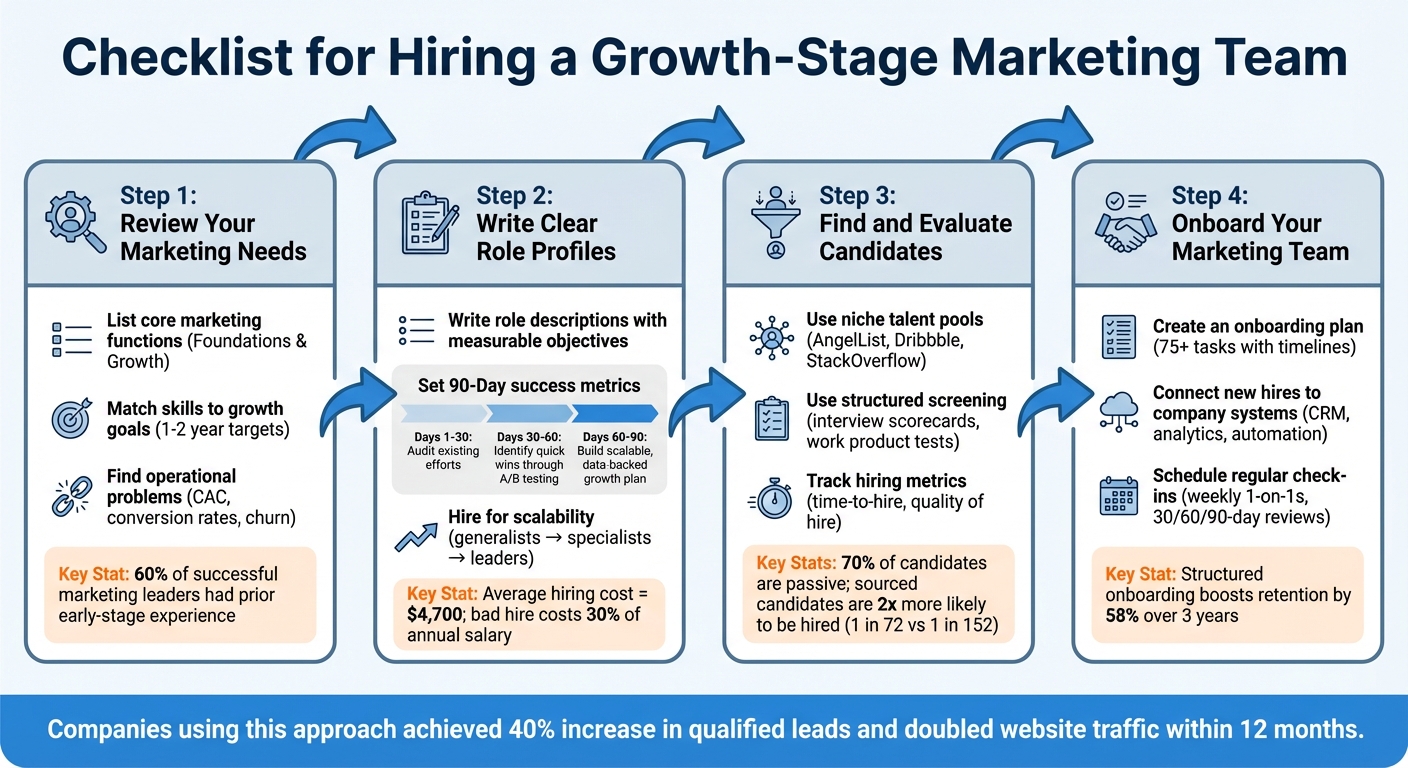
4-Step Process for Hiring a Growth-Stage Marketing Team
Best Marketing Team Structure (& What To Look For When Hiring)
Step 1: Review Your Marketing Needs
Before diving into job descriptions, take a step back and evaluate the gaps in your marketing strategy that might be holding back revenue growth.
List Core Marketing Functions
Start by outlining the key marketing functions your business needs. These typically fall into two categories:
- Foundations: Think product positioning, brand strategy, organic social media, community engagement, and research.
- Growth: Includes performance marketing, lead generation, conversion rate optimization (CRO), analytics, and event marketing.
For companies in the growth stage, essential hires often include a Growth Leader to oversee campaigns, a Growth Marketer to manage specific channels, a Video Content Specialist, a Designer, a Developer, and a CRO Specialist. Once your team exceeds 10 members, you may need additional roles like Growth Product Managers, Marketing Operations experts, Data Scientists, and specialized Designers.
Your hiring priorities will depend on your business model. For example, product-led growth (PLG) companies should focus on marketing talent to drive digital demand and optimize the website. On the other hand, sales-led enterprise companies should prioritize sales hires to build client relationships, with marketing playing a supporting role.
"In my experience, it is quite inefficient for one growth marketer to manage more than three paid acquisition channels or two growth pillars simultaneously." – Jonathan Martinez, Contributor, TechCrunch
Once you’ve mapped out these functions, align them with your specific growth objectives.
Match Skills to Growth Goals
Align your hiring with your short-term revenue targets (1–2 years). Focus on roles that address your immediate needs.
For example:
- If scaling paid acquisition is a priority, hire someone skilled in platforms like Facebook, Google, or LinkedIn.
- For retention, look for expertise in lifecycle marketing and CRM tools.
- If organic traffic is underperforming, bring in an SEO specialist or a content strategist.
Target candidates with 6–8 years of experience. These professionals typically have the expertise to lead while still being hands-on. It’s also worth noting that 60% of successful marketing leaders at top startups had prior experience in early-stage environments, which means they’re familiar with the fast-paced challenges of growth.
Before committing to a full-time hire, test the waters. Use agencies or contractors to validate new channels like TikTok or podcasts. If a channel shows potential for scalable growth, then bring that function in-house. For instance, in February 2023, Jonathan Martinez shared how Postmates transitioned from generalists to hiring dedicated channel managers for platforms like Snapchat, Facebook, and Google after their $300 million Series E round. This shift allowed them to ramp up testing and acquisition efforts.
Next, identify the operational challenges these hires will help you solve.
Find Operational Problems
Pinpoint specific bottlenecks in your operations. Common issues include high customer acquisition costs (CAC), low conversion rates, underutilized marketing channels, high churn rates, or inefficient workflows that bog your team down with manual tasks.
Look for data-driven red flags, such as:
- Difficulty analyzing trends in CAC, lifetime value (LTV), or conversion rates.
- Lack of technical expertise with tools like tracking pixels, web analytics, or CRMs (e.g., HubSpot, Salesforce).
- Inability to run structured A/B tests or multivariate experiments.
To dig deeper, map out your customer journey using the AARRR funnel (Acquisition, Activation, Retention, Referral, Revenue). This will help you identify where customers are dropping off. For instance:
- Losing leads at the top of the funnel? You need acquisition expertise.
- Struggling to convert sign-ups into paying customers? Focus on activation and CRO.
- High churn rates? Invest in retention and lifecycle marketing.
"Think of a growth marketer as fuel for a fire – not the spark. They scale what’s working, but they can’t build a viable business model from scratch." – Rana Bano, Growth Marketing Specialist, MarketerHire
Consider hiring when marketing tasks start pulling founders away from core product development, when growth stalls despite ongoing efforts, or when your customer base expands beyond personal networks.
Step 2: Write Clear Role Profiles
Once you’ve outlined your marketing needs, the next move is to translate those insights into role profiles that attract the right talent and set clear expectations from the start.
Write Role Descriptions
Begin with a concise summary of the role. Explain why the position exists and how it ties into your company’s overall vision and goals. Focus on measurable objectives instead of vague responsibilities. For example, instead of listing "increase leads", specify a goal such as "boost qualified leads by 40% within 12 months" or "reduce customer acquisition costs through optimized channels".
Include the technical skills (like data analysis, SEO, PPC) and creative abilities (such as copywriting, design, branding) required for success. Mention the tools candidates should be familiar with, such as HubSpot, Google Analytics, Mixpanel, Salesforce, or Meta Ads Manager.
Showcase your company’s emphasis on data-driven strategies, experimentation, and adaptability to ensure candidates align with your work environment. Be transparent about compensation details, including salary ranges and performance incentives. This clarity helps attract qualified candidates. For example, one company doubled its website traffic and achieved a 40% increase in qualified leads within a year by clearly defining these elements upfront.
"I think the role of a video content specialist is to create ‘Purple Cow Content’ in a world where anybody can throw up a video." – Eric, Video Content Specialist, Lean Labs
Avoid creating overly broad job descriptions that list every possible marketing function. These tend to attract inexperienced candidates who promise too much while discouraging skilled specialists. Instead, start by identifying the core problem this role will address – whether it’s acquiring more paying customers or improving brand awareness – and tailor the required skills accordingly.
Set 90-Day Success Metrics
Define clear milestones for the first three months to align expectations and track early progress. Break this period into three key phases:
- First 30 days: Audit existing efforts and set up tracking systems.
- Days 30–60: Identify quick wins through initial A/B testing.
- Days 60–90: Build a scalable, data-backed growth plan.
"Consider your first marketer not someone who’ll go hit your forecasts; rather, they should be hired to systematically collect accurate and nuanced data to validate and evolve your forecasts." – Tyler Elliston, Founder and CEO, Right Side Up
Track meaningful metrics like customer acquisition cost (CAC), lifetime value (LTV), activation rates, retention rates, and experiment success rates. Ensure these metrics cover the entire AARRR funnel (Acquisition, Activation, Retention, Revenue, Referral), not just top-of-funnel activities. Keep in mind that the average cost of hiring in the U.S. is $4,700, and a bad hire can cost around 30% of the role’s annual salary.
Laying out these metrics early helps establish a foundation for sustainable team growth.
Hire for Scalability
Use these defined metrics to identify candidates who can grow with your team. Your hiring strategy should reflect your company’s current growth stage.
For early-stage companies (under $5 million in revenue), generalists who can handle multiple channels are a great fit. The ideal candidate here is often a mid-level generalist with about five years of experience – someone strategic enough to plan but still hands-on enough to execute without constant oversight.
Scale-up companies ($5 million to $50 million in revenue) benefit from a mix of generalists and specialists focused on specific areas like SEO, PPC, or lifecycle marketing. Look for "emerging leaders" – individuals who have successfully scaled a company from a similar stage. Research indicates that 60% of marketing leaders who excelled in top-performing startups had this kind of early-stage experience.
For mature companies (over $50 million in revenue), hiring specialized leaders, such as CMOs or data scientists, becomes essential. These roles often involve managing vertical teams and driving long-term strategies.
Keep workloads realistic – avoid assigning more than three paid acquisition channels or two growth pillars to a single marketer. Look for T-shaped candidates who have broad marketing knowledge but deep expertise in specific areas. Prioritize those who focus on building scalable systems, like automated email sequences or referral programs, rather than relying on short-term tactics.
"The ’emerging leader’ has previously played a key role in growing an organization, starting at a similar stage to where yours is now." – Bowery Growth
Be cautious about hiring from large, well-established companies. Candidates from these environments may struggle with the ambiguity and resource constraints typical of a growth-stage business. Use scenario-based interview tasks, such as analyzing a marketing funnel or creating a 90-day growth plan, to gauge a candidate’s ability to think and scale effectively.
sbb-itb-ad881f4
Step 3: Find and Evaluate Candidates
With your role profiles in place and a clear growth strategy, it’s time to focus on identifying and assessing candidates who can help bring your vision to life. Use the profiles you’ve outlined to strategically source the right talent.
Use Niche Talent Pools
General job boards often fall short when it comes to attracting the specialized talent that growth-stage companies need. Instead, focus on platforms tailored to specific industries. For creative roles like content designers or brand specialists, try Dribbble or Behance. For candidates with startup experience, AngelList or Underdog are great options [19–21]. For technical marketing roles, such as marketing engineers or analytics specialists, explore StackOverflow or GitHub.
Here’s an important stat: 70% of candidates are passive, meaning they aren’t actively job hunting but are open to opportunities if approached correctly. Sourced candidates are also twice as likely to be hired compared to inbound applicants – 1 in 72 sourced candidates gets hired versus 1 in 152 from outside applications. Don’t underestimate the power of networking – your team’s connections can expand your talent pool by as much as 10 times.
When reaching out to potential candidates, make it personal. Reference their specific skills or past projects, and explain how their experience fits your company’s current needs [19,20]. Keep your initial ask simple – request a short 10- to 15-minute call instead of jumping straight to applications or assessments. Personalized, multi-touch emails can achieve reply rates of up to 45%.
Once you’ve built a strong pool of candidates, it’s time to move into the screening phase.
Use Structured Screening
A structured interview process ensures you consistently assess both technical skills and alignment with your company’s values. Assign different areas of evaluation – such as technical expertise, past achievements, and values alignment – to specific team members.
Assess candidates on their familiarity with essential tools like HubSpot, Google Analytics, and Salesforce, as well as their understanding of the AARRR funnel (Acquisition, Activation, Retention, Revenue, Referral) [23,9,4]. Consider incorporating work product interviews by assigning practical exercises, like analyzing a sample marketing funnel or crafting a 90-day growth plan, to see their skills in action [24,25].
Focus on "values fit" instead of the more subjective "culture fit", which can unintentionally introduce bias. Use interview scorecards to rate candidates on clear criteria like technical ability, creativity, and communication. Implement a strict "hire/no hire" scale to eliminate indecision.
Don’t skip reference checks – they’re one of the best indicators of future performance. Speak with individuals across different functions to get a well-rounded view of the candidate’s capabilities.
"One of the biggest determinants of candidate conversion is how quickly you interview them and how quickly you can make an offer." – Elad Gil, Investor and Author
Once your evaluations are complete, it’s essential to track metrics to refine your hiring process.
Track Hiring Metrics
Tracking recruitment metrics helps you identify bottlenecks and improve your hiring strategy. Pay attention to metrics like time-to-hire and interview-to-offer ratios to streamline your process. Moving quickly – especially between the final interview and the offer – can make the difference in securing top candidates.
After hiring, measure the quality of hire by evaluating outcomes such as Customer Acquisition Cost (CAC), Customer Lifetime Value (LTV), and customer retention rates [4,26]. You can also track the success of a new hire’s marketing experiments to gauge their ability to make data-driven decisions. Finally, assess the effectiveness of your sourcing channels – whether referrals, LinkedIn, or niche platforms – by analyzing the quality and conversion rates of the candidates they produce. These insights will help you refine your approach and focus your resources on the most productive talent sources.
Step 4: Onboard Your Marketing Team
Once you’ve hired the right people, the next crucial step is onboarding them effectively. A solid onboarding process helps new hires integrate quickly, minimizing delays and ensuring they can contribute right away. In fact, structured onboarding can boost employee retention by 58% over three years. It’s the final piece of the hiring puzzle that transforms potential into measurable results.
Create an Onboarding Plan
A good onboarding plan should cover several key areas: team integration, operational setup, business education, and strategy alignment. To avoid unnecessary delays, prepare resources and grant access to tools before the new hire’s start date.
A typical onboarding checklist for marketing roles can include over 75 tasks with specific timelines. Here’s how it might break down:
- Day 0-1: Ensure access to essentials like email, Slack, and CRM tools.
- Week 1: Provide software training, introduce tech platforms, and review brand guidelines.
- Month 1: Dive deeper into workflows, set 30/60/90-day goals, and schedule meetings with external stakeholders.
Operational tasks like granting access to drives, documents, networks, or hardware should be completed in the first week. Balance formal role introductions with informal team-building moments, such as coffee chats or lunches, to foster personal connections. Share documentation of past marketing efforts – both successes and failures – so new hires can build on existing knowledge rather than starting from scratch.
"New hires need to be brought up to speed on your systems and processes in no more than a couple days or you’ll see your return on investment plummet." – Allison Davis, Founder & CEO, Daily Digital
Connect New Hires to Company Systems
Access to the right tools and systems is critical for getting new team members up and running. Keep a secure, centralized log of usernames, passwords, and login links to prevent access-related delays.
Since growth marketing often overlaps with departments like Product, Sales, and Engineering, onboarding should include introductions to these teams to align everyone on shared goals. Training sessions should cover the customer journey, brand guidelines, and historical growth strategies to give new hires a clear picture of how marketing contributes to revenue. Store all internal processes in an easily accessible platform like Google Drive or Asana, and utilize "Process Template" cards to guide new hires through established workflows.
If your company struggles with fragmented systems, Graystone Consulting‘s Growth System Installation (https://graystonellc.net) offers a solution. They specialize in creating integrated systems and KPI dashboards that make onboarding smoother. By ensuring tools like your CRM, analytics, and marketing automation platforms are connected, they eliminate access issues that slow down productivity.
Once systems are set up, maintaining momentum is key.
Schedule Regular Check-Ins
Set up a meeting schedule starting on Day 1. Plan for weekly one-on-one check-ins and structured performance reviews at 30, 60, and 90 days. Use the first 30 days for system audits, the next 30 days for testing ideas, and the final 30 days for presenting scaling recommendations backed by data. Between these formal check-ins, use real-time communication tools like Slack to address quick questions and avoid bottlenecks.
During the early stages of onboarding, provide direct feedback and guidance. This is the best time for course corrections, as new hires are still adapting. Break down larger business goals into smaller, achievable tasks. These "small wins" can build momentum and keep motivation high.
Conclusion
Building a growth-stage marketing team isn’t about rushing to fill roles – it’s about creating a structured process that aligns each hire with your business objectives. A deliberate approach, rather than relying on chance, is what delivers measurable outcomes.
Here’s a quick recap: Start by assessing your marketing needs to pinpoint specific growth challenges. Establish clear 90-day metrics – spend the first 30 days auditing, the next 30 testing, and the final 30 delivering scalable growth strategies. Use structured tools like interview scorecards and scenario-based assignments to minimize bias during hiring. Once hired, ensure smooth onboarding by providing instant access to tools and scheduling regular check-ins to keep the momentum going.
But remember, hiring is just the beginning. The real payoff comes from properly onboarding your team so they can make an immediate impact. Companies using this structured approach have achieved impressive results, including doubling website traffic and increasing qualified leads by 40% within the first year.
If fragmented systems are holding you back, Graystone Consulting (https://graystonellc.net) offers solutions. Their Growth System Installation integrates your CRM, analytics, and marketing automation tools, while their fractional CMO services provide ongoing strategic guidance. This setup ensures your team has the infrastructure and leadership needed to scale what works – without wasting time on technical hurdles or starting from scratch.
FAQs
What marketing roles should I hire for my growth-stage company?
Finding the right marketing talent for a growing business starts with a clear understanding of your goals and what your company needs right now. Are you aiming to expand brand awareness, bring in more customers, or strengthen retention? Pinpointing these priorities will help you decide which roles are essential to achieving them.
For many growth-stage businesses, it makes sense to start with a versatile leader – someone like a VP of Marketing or a fractional CMO. These professionals can craft a strategic roadmap and oversee its execution. Once that leadership is in place, you can focus on filling key positions in areas like content development, analytics, and customer acquisition. Typical roles include growth marketers for handling full-funnel strategies, content marketers, data analysts, and specialists in fields like SEO or paid media.
The goal is to create a team that combines strategic vision with hands-on expertise. Prioritize roles that directly support your growth objectives and can evolve with your business as it scales. This way, your marketing efforts remain effective and adaptable over time.
What are the best ways to find and evaluate marketing candidates for a growing business?
To effectively find and assess marketing talent, the first step is to clearly define the role you’re hiring for. Instead of relying on a generic list of skills, focus on the specifics – what responsibilities will this person handle? What skills are essential? What measurable outcomes do you expect? This clarity ensures you attract candidates who align with your company’s needs and where you are in your growth journey.
For sourcing candidates, consider going beyond the usual job boards. Tap into niche communities, explore remote talent pools, and leverage specialized staffing services. Casting a wider net through multiple channels increases your chances of connecting with the right person for the job.
When it comes to evaluating candidates, move beyond traditional interviews. Practical methods, like real-world assignments or case studies, give you a better sense of how candidates think strategically and solve problems. These exercises can reveal their ability to adapt and deliver results. Additionally, prioritize candidates who show strong collaboration skills and a data-driven approach – qualities that are crucial for driving growth in today’s fast-paced business environment.
What steps can I take to ensure a smooth onboarding process for new marketing team members?
Start by crafting a clear and detailed onboarding plan. This plan should outline specific goals, timelines, and responsibilities for both the new hire and the existing team. A structured approach ensures everyone stays on the same page and that no critical steps are missed.
Here’s how to get started:
- Develop an onboarding checklist that includes key areas like company values, essential tools, workflows, and team objectives. This ensures new hires understand both the big picture and day-to-day operations.
- Define expectations for the first 30, 60, and 90 days. This helps new team members build momentum and feel confident in their role quickly.
- Plan regular check-ins to offer feedback, answer questions, and tweak the onboarding process if needed. These touchpoints can make a big difference in helping new hires feel supported.
When you encourage collaboration and keep communication open, new team members can integrate smoothly, stay engaged, and start contributing to your marketing efforts right away.



0 Comments