




- HubSpot: Combines CRM, lead generation, and automation for scaling processes. Pricing starts at $0/month.
- ActiveCampaign: Focuses on AI-driven automation and multi-channel engagement. Plans begin at $15/month.
- Brevo: Centralizes email, SMS, and live chat for streamlined communication. Free plan available.
- Zoho CRM: Offers lead management, client engagement, and automation. Free for up to three users.
- Klaviyo: Integrates email, SMS, and push notifications with advanced customer profiling. Free for up to 250 contacts.
- Semrush: SEO and content marketing tool with keyword research and competitor analysis. Starts at $139.95/month.
- Mailchimp: Popular email marketing platform with automation and analytics. Free for up to 500 contacts.
- OptinMonster: Lead generation tool with exit-intent popups and behavioral targeting. Starts at $9/month.
- Zapier: Connects apps to automate workflows, saving time and reducing manual tasks. Free plan available.
- Graystone Consulting Diagnostic Sprint: A tailored service for identifying marketing inefficiencies and setting up scalable systems.
These tools are tailored to meet the needs of service businesses, whether you’re just starting out or scaling rapidly. From automating follow-ups to tracking performance, they help you focus on growing your business efficiently.
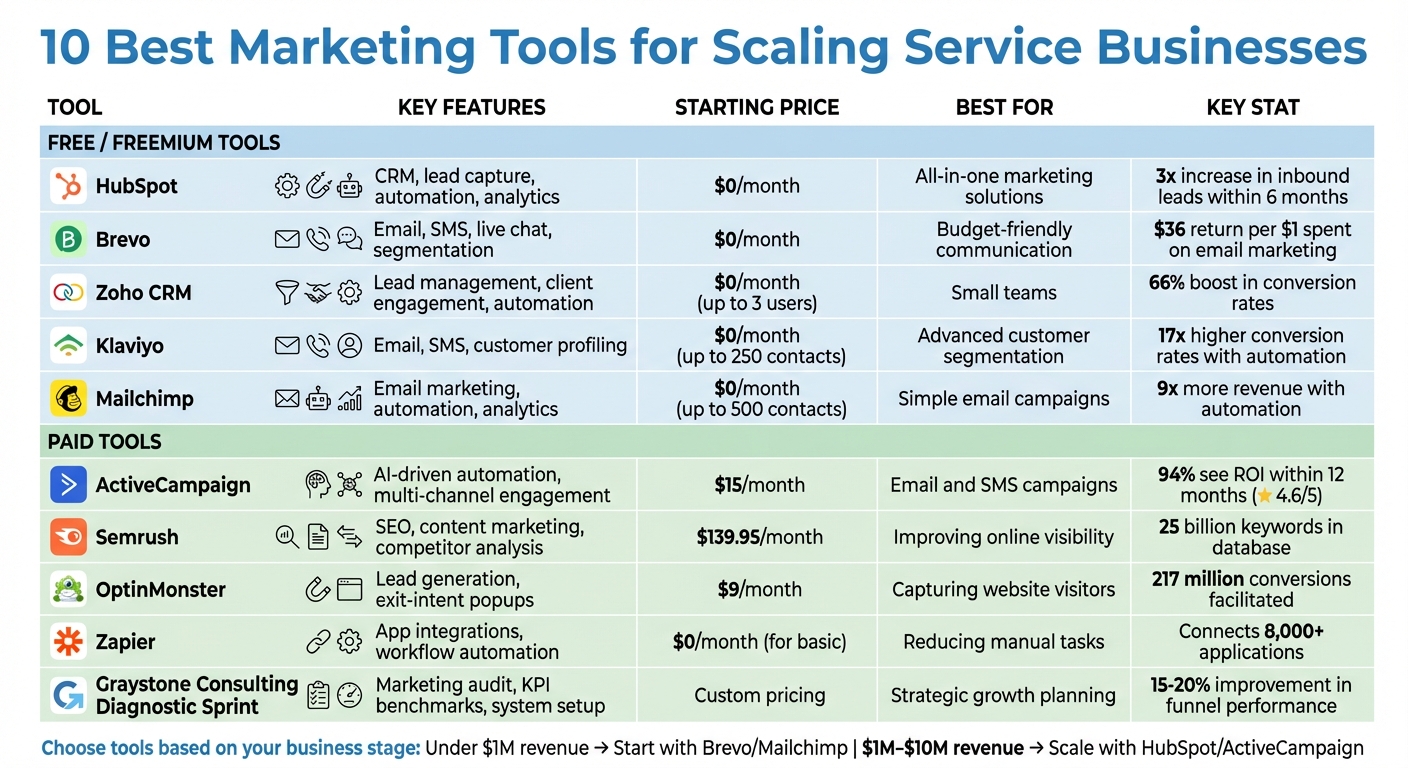
Quick Comparison Table
| Tool | Key Features | Starting Price | Best For |
|---|---|---|---|
| HubSpot | CRM, lead capture, automation, analytics | $0/month | All-in-one marketing solutions |
| ActiveCampaign | AI-driven automation, multi-channel engagement | $15/month | Email and SMS campaigns |
| Brevo | Email, SMS, live chat, segmentation | $0/month | Budget-friendly communication |
| Zoho CRM | Lead management, client engagement, automation | $0/month | Small teams |
| Klaviyo | Email, SMS, customer profiling | $0/month | Advanced customer segmentation |
| Semrush | SEO, content marketing, competitor analysis | $139.95/month | Improving online visibility |
| Mailchimp | Email marketing, automation, analytics | $0/month | Simple email campaigns |
| OptinMonster | Lead generation, exit-intent popups | $9/month | Capturing website visitors |
| Zapier | App integrations, workflow automation | $0/month | Reducing manual tasks |
| Graystone Consulting | Marketing audit, KPI benchmarks, system setup | Custom pricing | Strategic growth planning |
Each tool offers unique features to help service businesses grow efficiently. Choose the one that aligns with your current needs and budget.
10 Best Marketing Tools for Service Businesses: Features and Pricing Comparison
50 Essential Digital Marketing Tools (in Under 26 Minutes)
1. HubSpot
HubSpot is an all-in-one marketing platform that combines lead capture, AI-powered engagement, and customer journey tracking into a single CRM. It simplifies marketing by centralizing tools like adaptable forms, AI-driven assistants, and detailed analytics, making it easier to manage and grow your business.
Lead Generation Capabilities
HubSpot excels at turning website visitors into leads through smart forms that adjust to user behavior and dynamic calls-to-action. One standout feature is the Breeze Customer Agent – an AI assistant that interacts with visitors in real time, directing them to relevant resources and capturing their interest before they leave. Using intent-based targeting, HubSpot identifies potential buyers based on their demographics and behavior, ensuring your efforts focus on the most promising leads. Businesses using HubSpot often see a 3x increase in inbound leads within six months, with 83% of users reporting higher conversion rates.
Automation for Scaling Processes
HubSpot’s visual workflow board makes automating your processes straightforward. You can easily set up trigger-based email sequences, such as kickback emails that send immediately after a form submission, or drip campaigns that adjust based on user behavior.
"We set up our sales process without having to hire a CRM engineer. We could set up new fields, permissions, sequences, and reports without adding to our overhead".
The Marketing Studio brings campaign planning and execution into one AI-powered workspace, while a unified social inbox gathers conversations from all platforms in one place. All these tools feed into HubSpot’s analytics, ensuring every action contributes to measurable results.
Performance Tracking and Analytics
HubSpot’s multi-touch revenue attribution tool shows you which marketing efforts directly generate revenue. The Pathfinder tool dives into customer journey data, helping you pinpoint when visitors are most likely to convert so you can focus your efforts at the right moments. Users report a 167% increase in website traffic within six months and a 55% boost in deals closed after one year.
"HubSpot gives us a holistic understanding of our users’ actions across our website, emails, and social pages, connecting the dots without having to rely on separate analytics tools for each channel".
This level of tracking not only enhances client outcomes but also supports predictable revenue growth, making it a go-to choice for scaling service businesses.
HubSpot offers pricing to fit a variety of needs:
- Free Plan: $0/month, includes lead capture forms, email automation, and live chat.
- Starter Plan: $15–$20/month, includes custom CTAs and removes HubSpot branding.
- Professional Plan: $890/month, adds content personalization and AI agents.
- Enterprise Plan: $3,600/month, features advanced revenue attribution and customer journey mapping.
2. ActiveCampaign
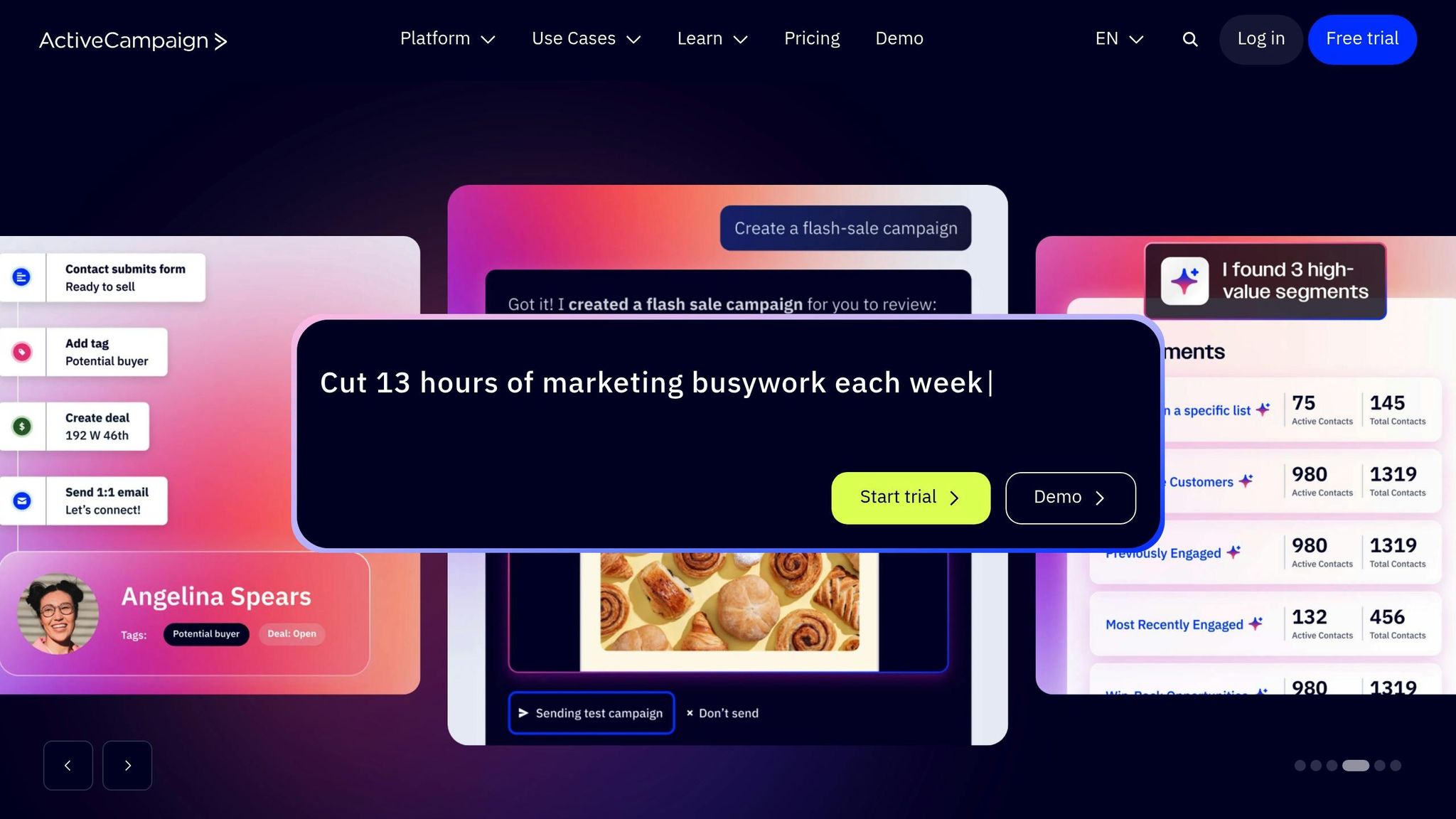
ActiveCampaign simplifies strategy, execution, and optimization with the help of AI, enabling businesses to set clear objectives. Like other high-level tools, it transforms how leads are managed and how client interactions are handled, driving business growth. Instead of manually creating intricate workflows, you simply define your goals, and the platform’s AI takes care of the rest. This makes it easier for service businesses to expand without increasing their team size.
Lead Generation Capabilities
ActiveCampaign helps capture leads through custom landing pages, sign-up forms, and pop-ups seamlessly integrated into its CRM. Its lead scoring feature evaluates prospects based on their engagement and behavior, ensuring your sales team focuses on the most promising opportunities. AI-suggested audience segments help uncover overlooked groups, while the Predictive Sending feature adjusts message timing for each lead, boosting click-through rates by an average of 17%. For example, in 2023, Morrow Audio used ActiveCampaign’s automation to recover 26% of abandoned carts, resulting in $30,000 in recovered revenue – 3.7 times higher than the industry average.
Client Retention and Engagement Features
The platform keeps customers engaged through email, SMS, and WhatsApp, leveraging automated win-back campaigns and sentiment analysis to gauge customer satisfaction. This multi-channel approach ensures you’re reaching clients on the platforms they prefer. One user shared that they generated over $76,000 from just two emails by utilizing ActiveCampaign’s forms, tagging, and automation features.
Automation for Scaling Processes
With over 800 pre-built automation recipes and an AI Campaign Builder, ActiveCampaign makes creating email sequences quick and efficient – cutting campaign creation time by threefold. In 2025, Ian Faison, Co-Founder of Caspian Studios, shared that using ActiveCampaign’s automation saved "hundreds of hours" that would have otherwise been spent rebuilding workflows for new podcast launches.
Performance Tracking and Analytics
ActiveCampaign’s Business Goals agent tracks progress toward specific objectives and offers actionable recommendations based on real-time data. Its integrated CRM reporting combines sales and marketing data, providing a comprehensive view of the customer journey. Impressively, 94% of users report seeing a return on investment within 12 months, with 68% achieving ROI in just six months. The platform also boasts a 4.6/5 rating on G2, based on over 7,200 reviews. By merging sales and marketing insights, ActiveCampaign helps service businesses scale efficiently, reinforcing its position as a tool for driving growth.
Pricing starts at $15 per month, with tiered plans that adjust based on contact volume and features. A 14-day free trial is also available, and no credit card is required to get started.
3. Brevo
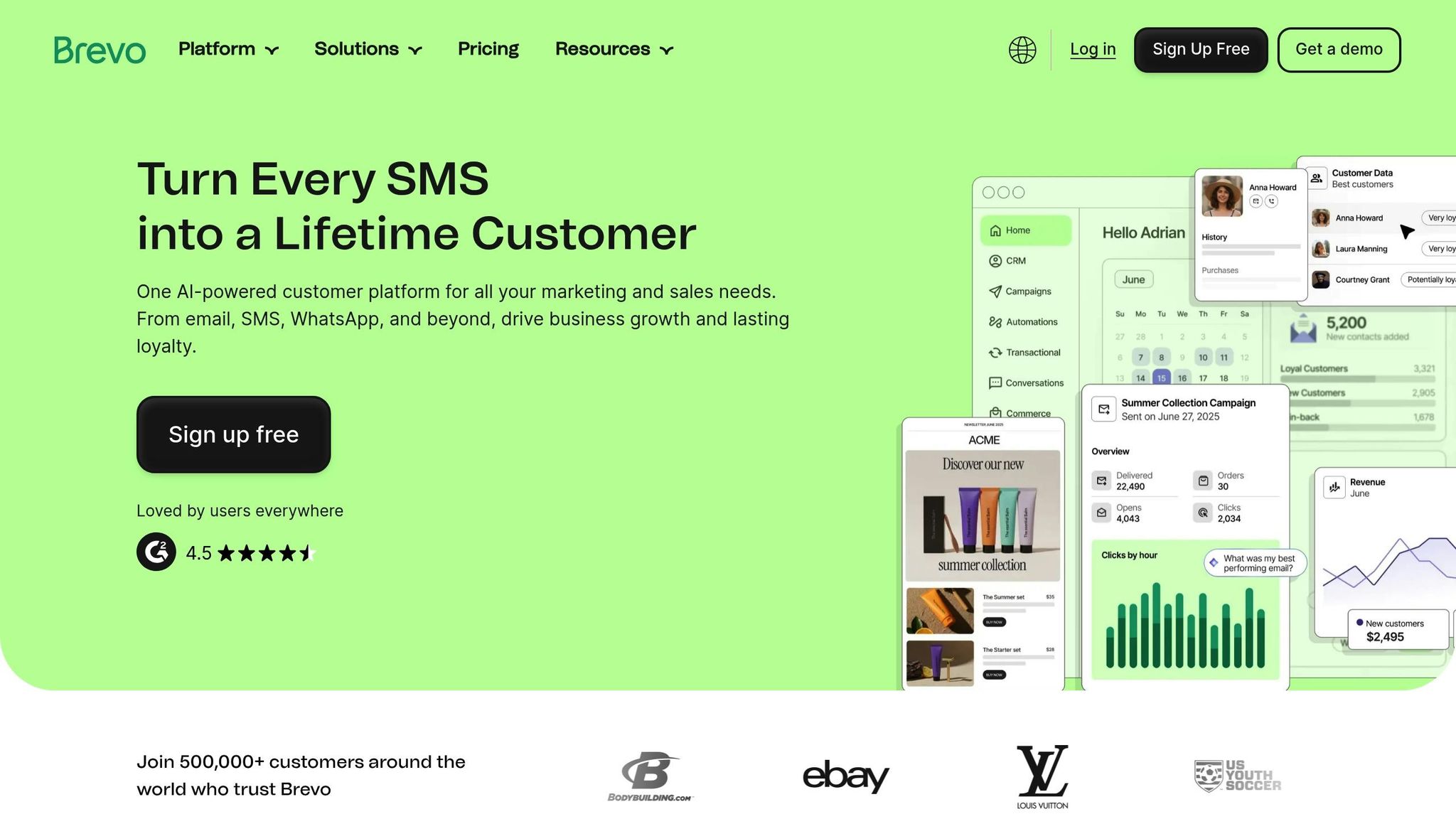
Brevo combines email, SMS, WhatsApp, and live chat into a single platform, making it easier for service businesses to manage communications with leads and clients. By centralizing these channels, Brevo helps growing businesses streamline their operations and scale efficiently. Its integrated CRM tracks all interactions, giving a clear picture of the customer journey. Plus, Brevo’s free plan is quite generous, offering up to 300 emails per day, unlimited contacts, and advanced segmentation tools.
Lead Generation Capabilities
Brevo simplifies lead generation with tools like customizable sign-up forms, landing page templates, and a Meetings feature for creating branded booking pages for consultations or demos. It also integrates with Facebook ads and retargeting tools to attract new visitors and re-engage existing ones. The drag-and-drop editor and pre-designed templates make it easy to create polished campaigns without needing coding skills. On top of that, Brevo’s email marketing can deliver impressive returns – around $36 for every $1 spent.
But Brevo doesn’t stop at just acquiring leads; it also focuses on building stronger client relationships.
Client Retention and Engagement Features
Keeping clients engaged is simple with Brevo’s multi-channel approach, covering email, SMS, WhatsApp, and live chat. Personalization tools allow you to use details like a client’s first name, birthday, or last service date to create tailored content that builds trust. For instance, Videdressing, a fashion retail company, boosted its email click rates by 15% by using Brevo’s CRM data for personalized campaigns. You can also automate key touchpoints, such as anniversary emails or “We Miss You” messages triggered by inactivity.
Automation for Scaling Processes
Brevo’s visual workflow builder takes the hassle out of managing repetitive tasks. You can automate welcome series, onboarding emails, and transactional messages like appointment confirmations or receipts. Its AI-powered send-time optimization ensures emails land in inboxes when recipients are most likely to engage. On average, businesses see a return of $5.44 for every dollar spent on Brevo’s marketing automation.
Performance Tracking and Analytics
Brevo provides real-time stats and email heatmaps to show which parts of your campaigns are driving clicks, helping you fine-tune your designs for better results. Sales reports track important metrics like revenue, conversion rates, and win/loss rates, highlighting the campaigns with the best ROI. To ensure high deliverability, Brevo automatically removes unsubscribed or bounced contacts and supports authentication protocols like DKIM, SPF, and DMARC. This is crucial, as nearly 20% of marketing emails fail to reach inboxes due to deliverability issues.
Pricing starts at $0 per month for the free plan, $9 per month for the Starter plan (includes 5,000 emails with no daily limit), and $18 per month for the Business plan (adds marketing automation and A/B testing).
4. Zoho CRM
Zoho CRM combines lead management, client engagement, and automation into one platform, trusted by over 300,000 businesses globally. It’s built to help service-oriented businesses grow while maintaining the personal touch that keeps clients loyal. With features like drag-and-drop web-to-lead forms that directly capture visitor data, and a mobile card scanner app for digitizing business cards on the go, Zoho CRM ensures your team stays efficient and connected. Plus, its SalesSignals feature alerts you in real time when prospects engage with your brand on social media. Let’s dive into what makes Zoho CRM stand out:
Lead Generation Capabilities
Zoho CRM simplifies lead capture with no-code webforms that feed directly into your sales pipeline. It integrates seamlessly with Google Ads, allowing you to track which keywords and campaigns are driving conversions. Automated lead scoring assigns points based on engagement – like email opens or website visits – helping your team prioritize high-intent prospects. For small businesses, this translates to an average 66% boost in conversion rates.
Client Retention and Engagement Features
Zoho CRM consolidates all client interactions – emails, social media posts, and more – into a single, unified timeline. Carlos Perez, CFO of Southern Cross Protection, highlights its value:
"Zoho has become our central data repository and source of truth of our data".
The platform’s RFM (Recency, Frequency, Monetary) segmentation tool identifies your most valuable clients, enabling you to design loyalty programs and re-engagement strategies that resonate. Businesses using CRM software like Zoho report an average 11% increase in customer retention.
Automation for Scaling Processes
Zoho’s Blueprint feature lets you visually map your sales process using an intuitive drag-and-drop interface, ensuring team alignment. Thomas John, Managing Director of Agappe, shared that Zoho CRM helped his company achieve an 80% productivity boost in just one year by centralizing all business information. Additionally, the Cadences tool automates follow-up sequences based on lead responses, making nurturing effortless. Marketing automation through Zoho CRM has been shown to improve sales productivity by 14.5%, with 77% of marketers reporting better conversion rates.
Performance Tracking and Analytics
Zoho CRM offers robust performance tracking, helping you monitor marketing attribution across channels to identify what’s driving revenue. Its Google Ads integration ties ad spend to sales outcomes, while Zia, Zoho’s AI assistant, predicts results and offers suggestions to improve email performance. Pricing starts at $0 per month for the free edition (up to three users). For broader access, Zoho One is available at $37 per employee per month (billed annually), granting entry to over 45 integrated business applications.
5. Klaviyo
Klaviyo brings together email, SMS, and mobile push notifications into one streamlined platform. By integrating data from over 350 sources, it creates unified customer profiles that track behavior across various touchpoints, from website visits to purchase history. Katherine Cabe, Senior Director of Retention at AS Beauty Group, highlights its importance:
"Having one unified customer profile, where everything about a customer is in the same place – it’s huge."
For service-based businesses, this means instant access to client booking history, preferences, and readiness, all displayed on a single dashboard. This unified view allows for more precise and effective engagement strategies.
Tools for Client Retention and Engagement
With its comprehensive data, Klaviyo supports client retention by automatically segmenting customers through RFM (Recency, Frequency, Monetary) analysis. This segmentation is based on their interaction patterns and spending habits. For instance, Svenfish, a seafood retailer, used this feature to re-engage high-value customers who hadn’t made a purchase in over three months. Their targeted discount campaigns now drive 70% of their e-commerce revenue. Additionally, Klaviyo’s AI predicts customer behavior, like their next order date or risk of churn, enabling businesses to take action before losing clients.
Automation to Streamline Marketing
Klaviyo also simplifies marketing efforts with automation tools that scale effortlessly. Its AI-driven features can create on-brand campaigns and customer journey flows from simple instructions. For example, Laura Geller Beauty ran a 30-day test in Spring 2024, which led to a 3.9x increase in quarterly SMS revenue. The platform supports automated workflows like welcome series, abandoned cart reminders, and post-purchase follow-ups, which can deliver conversion rates 17x higher than manual campaigns.
Analytics and Performance Insights
Klaviyo’s predictive analytics go beyond basic reporting, offering insights into customer lifetime value and comparing performance against 100 similar businesses. The apparel brand 2(X)IST replaced manual tracking with Klaviyo’s automated RFM segments. By setting up targeted workflows that offered personalized discounts to customers at risk of churning, they generated $15,200 in extra revenue within one quarter.
Pricing is accessible, starting at $0 per month for up to 250 contacts (including 150 SMS credits). The Email Plan begins at $20 per month for 251–500 contacts, and the SMS Plan starts at $15 per month for up to 1,250 credits.
6. Semrush

Semrush brings together SEO, content marketing, and competitive intelligence under one roof, tracking over 808 million web domains and 43 trillion backlinks. With a database of over 25 billion keywords spanning 121 countries, it helps service-based businesses zero in on what their potential customers are searching for. For businesses aiming to enhance their online visibility and outperform competitors, this tool is a game-changer. Trusted by 30% of Fortune 500 companies and used by 10 million digital marketing professionals globally, Semrush has cemented its place in the industry.
Lead Generation Capabilities
Semrush offers tools that make identifying and targeting high-value search terms a breeze. The Keyword Magic Tool analyzes key metrics like monthly search volume, keyword difficulty, search intent, and even provides a Personalized Keyword Difficulty score to help businesses understand how they might rank for specific terms. On the backlinking front, the Link Building Tool simplifies outreach by suggesting potential domains for partnerships and tracking personalized emails to secure authoritative backlinks.
Teddy Levarda, owner of Morningside Acupuncture, shared how Semrush transformed his local search presence in New York City:
"If I’m not in the top three results on Google Maps, New Yorkers don’t know I exist. I use Semrush to improve that locally, and it’s been remarkable."
The Market Explorer dives into competitors’ traffic sources – whether it’s from organic search, paid ads, or social media – and provides detailed audience demographics to refine targeting strategies. Meanwhile, the Media Monitoring app identifies unlinked mentions of your brand, giving you the opportunity to reach out and turn them into backlinks.
Semrush doesn’t just stop at insights; it also makes scaling marketing efforts easier with automation.
Automation for Scaling Processes
Repetitive tasks can bog down any marketing operation, but Semrush’s automation tools help lighten the load. The Social Poster tool lets users schedule and post content across platforms like Facebook, Instagram, LinkedIn, Pinterest, and X – all from a single dashboard. It even supports bulk scheduling for up to 100 posts via CSV uploads. For content creation, ContentShake AI assists with brainstorming, writing, and repurposing text. On the technical side, the Site Audit tool scans for over 140 website issues, such as broken links and slow loading speeds, ensuring your site remains optimized for capturing leads. Additionally, the AI Automated Data Collector pulls marketing data from more than 50 platforms into Google Sheets on a set schedule, eliminating the need for manual reporting.
With these tools in place, businesses can focus on strategy while Semrush handles the heavy lifting.
Performance Tracking and Analytics
When it comes to tracking performance, Semrush delivers. The Position Tracking tool monitors daily keyword rankings and average positions across specific locations. For example, Arkadium, a gaming company, saw a 230% boost in organic traffic in 2019 after fine-tuning their SEO strategy with Semrush. Eric Bogard, their VP of Marketing, credited the tool’s insights for helping them achieve record-breaking website traffic. The Site Audit tool further supports optimization efforts by providing a "Site Health" score and categorizing issues into Errors, Warnings, and Notices, with Errors flagged as top priority.
Brian Dean, founder of Backlinko, praised the platform:
"When it comes to pure value, Semrush wins. That’s mostly because you get a complete SEO and Google Ads suite for the same monthly price."
For social media, the Social Tracker compares growth and engagement metrics against competitors, while the Media Monitoring tool tracks online mentions and assigns sentiment scores to gauge brand reputation. Integration with Google Analytics and Google Search Console ties it all together, offering a comprehensive view of website traffic, user behavior, and indexing issues.
Semrush pricing starts at $139.95 per month for the Pro Plan, $249.95 per month for the Guru Plan, and $499.95 per month for the Business Plan.
sbb-itb-ad881f4
7. Mailchimp
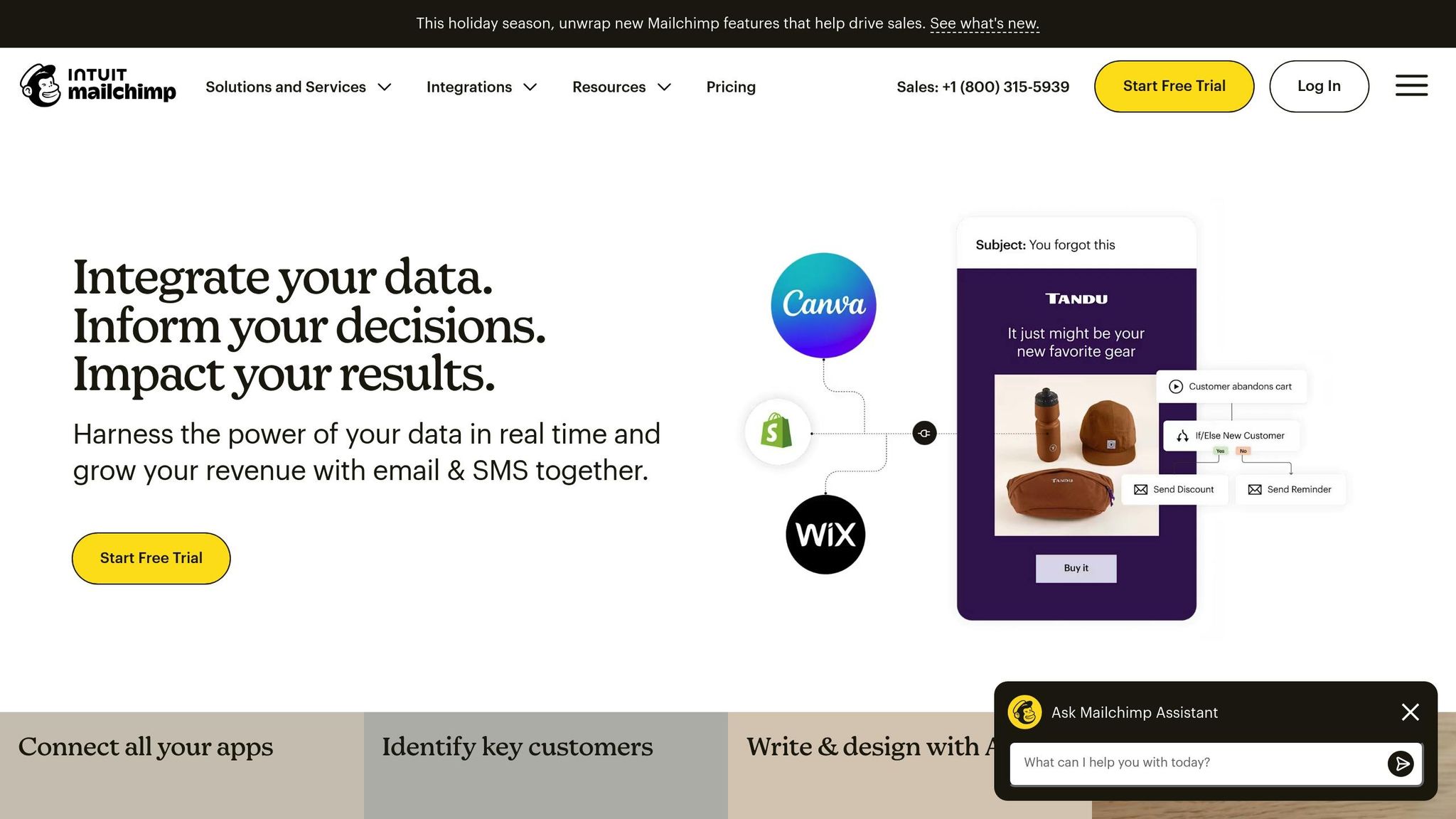
Mailchimp is a popular platform for email marketing and automation, designed to help businesses capture leads, automate outreach, and monitor performance effectively. It provides customizable forms and landing pages, making it easy to collect lead data right away. For businesses expanding their reach across various platforms, Mailchimp integrates seamlessly with Meta, TikTok, Google Ads, Snapchat, and LinkedIn. This allows businesses to engage and nurture leads as soon as they interact on social media. These integrations make it a powerful tool for scaling marketing efforts across major digital channels.
On top of its lead capture capabilities, Mailchimp simplifies operations with its advanced automation tools.
Automation for Scaling Processes
Mailchimp’s automation features let users design multi-step customer journeys that respond to real-time actions. With more than 60 pre-built automation templates – covering welcome emails, cart recovery, and re-engagement campaigns – businesses can launch complex campaigns without starting from scratch. These tools have delivered impressive results, with users reporting up to 9x more revenue and a 127% boost in click rates. So far, over 1.5 million automations have been created using Mailchimp’s flow tools.
Louise Lau, Performance Marketing Manager at Shapeways, shared her experience using Mailchimp in combination with Zapier to segment audiences and automate workflows. This approach led to a 283% increase in open rates and a 525% rise in click-through rates:
"The Mailchimp + Zapier integration allows us to save time and also allows us to accurately segment the audience that we wish to target and just makes everything seamless."
Mailchimp’s automation capabilities aren’t limited to email. It also supports SMS marketing, social media scheduling for platforms like Facebook, Instagram, and Twitter, and even automated direct mail postcards. With integrations for over 300 apps – including Shopify, Salesforce, QuickBooks, and Zapier – businesses can sync data and automate workflows across platforms without manual effort.
Beyond automation, Mailchimp provides robust tools for performance tracking.
Performance Tracking and Analytics
Mailchimp’s dashboards offer detailed insights into crucial metrics like open rates, bounce rates, click-through rates, and unsubscribes. Businesses can also measure the return on investment for ads and landing pages by tracking views, clicks, and customer acquisitions. The platform’s Smart Recommendations feature leverages data science to suggest improvements for visuals, copy, and layouts to enhance engagement. Additionally, by enabling Google Analytics link tracking, businesses can see exactly how email campaigns are driving traffic and conversions on their websites.
Mailchimp offers flexible pricing options, starting with a Free plan at $0 per month for up to 500 contacts. Paid plans include the Essentials plan at $13 per month, the Standard plan at $17 per month, and the Premium plan at $299 per month.
8. OptinMonster
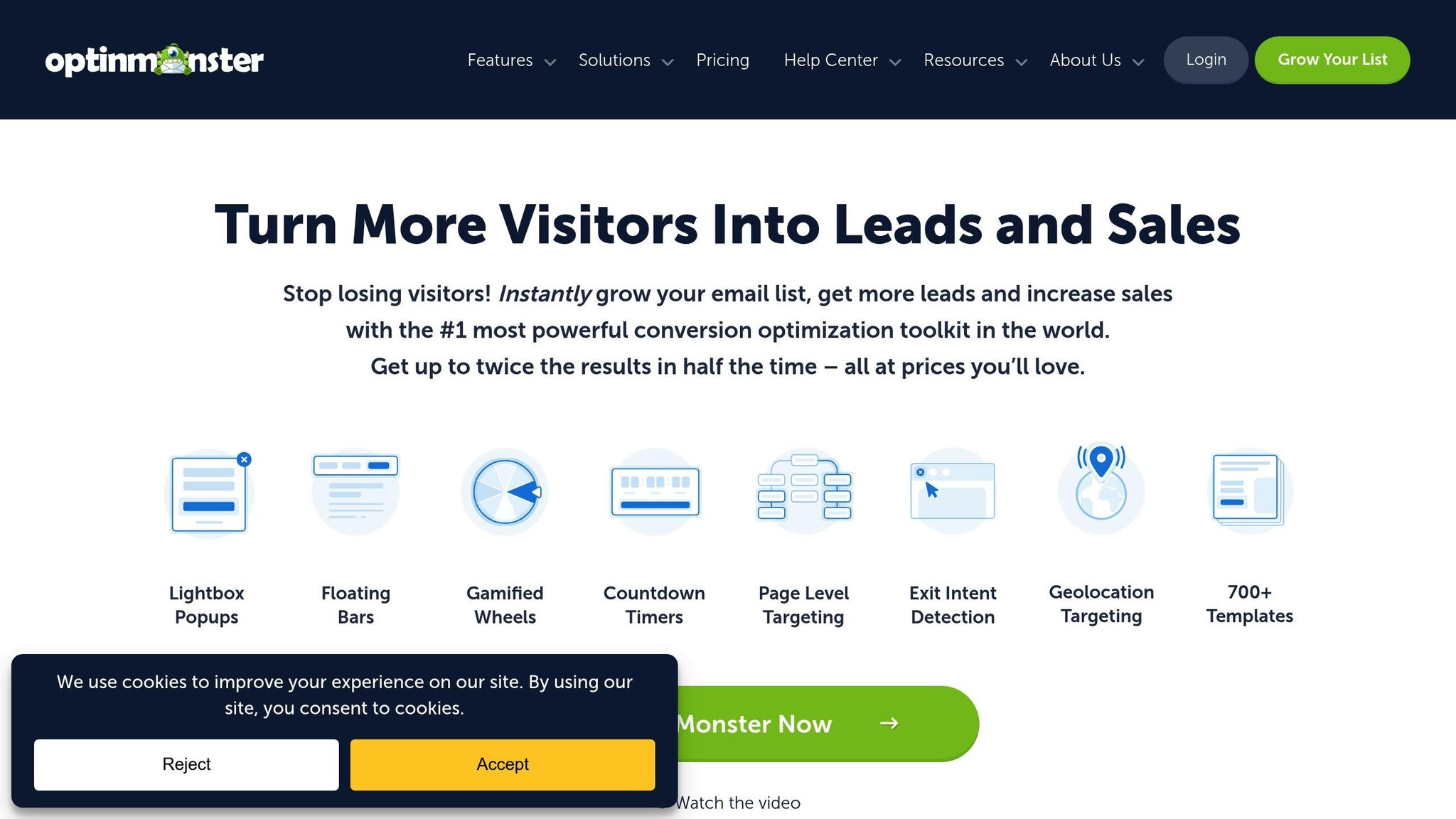
OptinMonster is a powerful lead generation tool designed to help service businesses capture potential customers before they leave their website. Trusted by over 1 million websites, it has facilitated 217 million conversions and optimizes over 6 billion visitor sessions each month, turning traffic into valuable leads.
Lead Generation Capabilities
OptinMonster is built to transform brief website visits into meaningful leads. It offers nine different campaign types, including lightbox popups, floating bars, fullscreen welcome mats, slide-ins, and content lockers. These options allow businesses to engage visitors at various points on their website. One standout feature is its Exit-Intent® Technology, which detects when a visitor is about to leave and displays a targeted message – a crucial tool for capturing leads that might otherwise be lost.
Michael Stelzner, founder of Social Media Examiner, highlighted the effectiveness of this technology. Over seven months, he added more than 95,654 names to his email list using OptinMonster’s Exit-Intent™ feature. He shared:
"In only 7 months, we added more than 95,654 names to our email list using OptinMonster’s Exit Intent™ technology. We strongly recommend it!"
For businesses offering downloadable resources like whitepapers or guides, the Content Locker feature is particularly useful. It requires visitors to provide an email address to access premium content. Whole Whale, a digital agency, used this feature to gate high-value resources, achieving a 62% increase in conversions and doubling email sign-ups.
OptinMonster also excels in behavioral targeting, using advanced rules such as page-level, geolocation, and referrer targeting to ensure campaigns are relevant to each visitor. Additionally, its AdBlock Detection feature prompts users to disable their ad blockers, with about 77% complying when asked politely.
Automation for Scaling Processes
OptinMonster uses real-time behavior automation to create personalized campaigns based on user activity, cookies, and location. Its OnSite Retargeting® system customizes offers for new visitors, returning users, and existing customers, reducing popup fatigue while boosting engagement.
The platform integrates seamlessly with over 100 email marketing services and CRMs, such as HubSpot, Mailchimp, and ActiveCampaign. This ensures that captured leads flow directly into your existing workflows. For example, Cosmetic Capital increased their leads by 300% with a floating bar campaign, while MedStar saw a 500% boost in conversions using tailored targeting and trigger features.
Performance Tracking and Analytics
OptinMonster doesn’t just help you capture leads – it also provides detailed insights into campaign performance. Its dashboard tracks key metrics like total visitors, conversions, conversion rates, and revenue attribution. The built-in A/B testing tool allows businesses to experiment with different headlines, designs, and triggers to determine what works best. For even deeper insights, users can integrate OptinMonster with Google Analytics to monitor unique conversion goals and event-level data.
Pricing starts at $9 per month (billed annually) for the Basic plan, which covers one site and up to 2,500 pageviews. Additional plans include the Plus plan at $19 per month, the Pro plan at $29 per month, and the Growth plan at $49 per month. All plans come with a 14-day money-back guarantee.
9. Zapier
Zapier connects over 8,000 applications, creating a streamlined automation system for businesses. Used by more than 3.4 million companies globally, it has facilitated over 25 million automated workflows – known as "Zaps" – to reduce repetitive tasks and manual data entry. The platform boasts a 99.99% reliability rate for executing critical processes.
Automation for Scaling Processes
Zapier takes the hassle out of manual data entry, enabling smoother workflows for tasks like lead management. For instance, when someone fills out a form on Facebook Lead Ads or LinkedIn, Zapier automatically collects the data, enhances and scores the lead based on your criteria, and sends it directly to your CRM. This eliminates the need for manual input. Its advanced features, like multi-step workflows and logic branches called "Paths", allow businesses to prioritize high-value leads by assigning them to senior sales reps, while others are funneled into nurturing sequences.
The platform’s impact is evident in real-world examples. Arden Insurance Services saved 34,000 work hours annually, translating to nearly $500,000 in savings, according to Operations Manager Tyler Diogo. Similarly, Vendasta reclaimed $1 million in potential revenue by cutting out 282 days of manual administrative work each year. Marketing Operations Specialist Jacob Sirrs noted:
"Because of automation, we’ve seen about a $1 million increase in potential revenue. Our reps can now focus purely on closing deals – not admin."
Even smaller teams have seen impressive results. Contractor Appointments automated 80–90% of their lead processing, leading to a $300,000 boost in annual revenue. Slate Magazine, on the other hand, scaled to over 2,000 new leads per month while saving more than 100 hours of manual work. Andrew Harding, VP of Marketing and Content Partnerships, shared:
"What used to be overwhelming is now scalable. With Zapier, I don’t have to choose between doing good work and doing a lot of it."
These efficiencies not only save time but also enhance performance tracking.
Performance Tracking and Analytics
Zapier provides powerful tools for monitoring marketing operations. Features like audit logs, real-time alerts, and automated reporting dashboards offer a clear view of performance. The platform also syncs conversion events with advertising platforms like Google Ads, Facebook Lead Ads, and LinkedIn Ads, improving attribution accuracy and optimizing ad spending. Additionally, businesses can use Zapier Tables to create live, auto-updating databases that centralize lead tracking from multiple channels.
Toyota of Orlando utilized these capabilities to manage over 30,000 lead records while saving more than 20 hours per week. Spencer Siviglia, Director of Operations, highlighted:
"With Agents, I’m getting insights I didn’t even know to look for. They flag when something’s off, answer questions in plain language, and save me hours every week."
Zapier’s pricing starts with a free plan for basic two-step workflows. Professional plans, which include advanced multi-step Zaps, begin at $19.99 per month (billed annually). For larger organizations, enterprise plans offer unlimited users, enhanced security features like SAML-based SSO, and dedicated technical account management.
10. Graystone Consulting Diagnostic Sprint
The Diagnostic Sprint is a comprehensive audit designed to uncover and fix inefficiencies in marketing strategies. Created by Will Gray, Graystone Consulting focuses on helping founder-led businesses with revenues between $1M and $10M build scalable marketing systems. This process sets key performance metric (KPI) benchmarks, spots revenue gaps, and creates a clear roadmap for growth. It serves as the starting point for accurate performance tracking and streamlined automation.
Performance Tracking and Analytics
This Sprint moves businesses from relying on guesswork to making decisions based on solid data. By establishing KPI benchmarks across the marketing funnel, it identifies what’s working and where resources are being wasted. Metrics like conversion rates, attribution, and funnel performance are analyzed to pinpoint bottlenecks. Self-service access to this data allows teams to make real-time adjustments, resulting in a focused growth strategy. These insights empower service-based businesses in growth stages to allocate resources effectively and maximize returns.
Automation for Scaling Processes
Using the insights from the audit, Graystone Consulting implements automation to drive consistent growth. After the diagnostic phase, they offer Growth System Installation services, including CRM setup, automation workflows, and KPI dashboards. These tools connect your ad platforms to your CRM, simplifying lead management and eliminating manual data entry. Designed to scale with your business, this system reduces operational overhead. Plus, it comes with a guarantee of a 15–20% improvement in funnel performance, ensuring measurable gains in conversion rates.
For businesses seeking ongoing support, the Leadership Retainer provides access to fractional CMO services. This includes regular strategy sessions and ongoing KPI management, ensuring that the systems developed during the Diagnostic Sprint continue to adapt and grow alongside your business.
Feature and Pricing Comparison
Brevo brings together email, SMS, and chat functionalities in a way that’s easy on the budget. Semrush, on the other hand, shines in the realm of organic search, offering tools like keyword research, site audits, and competitor analysis. Meanwhile, Graystone Consulting’s Diagnostic Sprint takes a different approach, providing a strategic audit to pinpoint inefficiencies and craft a growth-focused plan.
Here’s a quick look at their pricing:
- Brevo: Starts with a robust free plan, with paid options beginning at $25 per month for scalable solutions.
- Semrush: Costs $129.95 per month for monthly billing or $108.33 per month with an annual plan. A 7-day free trial is also available.
- Diagnostic Sprint: Pricing isn’t listed publicly since the service is tailored to meet the unique needs of each business.
Brevo and Semrush are execution-focused tools, ideal for managing campaigns and improving SEO. In contrast, the Diagnostic Sprint zeroes in on identifying key marketing opportunities, setting performance benchmarks, and mapping out your funnel. This is especially useful for service businesses earning between $1 million and $10 million annually, where it’s not always clear which marketing efforts are delivering the best returns. For context, email marketing can yield an average return of $44 for every $1 spent, and securing the top spot on Google can capture around 33% of clicks, compared to just 9% for third place.
Both Brevo and Semrush boast ratings of 4 stars or higher on G2 and Capterra. Businesses leveraging the Diagnostic Sprint and its follow-up Growth System Installation often see a 15–20% boost in funnel performance. This comparison underscores the importance of selecting tools that balance immediate action with long-term strategic planning.
Conclusion
A well-rounded marketing system weaves together tools that handle everything from capturing leads to retaining customers. For instance, OptinMonster helps you grab visitors’ attention right away, while Zapier seamlessly transfers that data into your CRM, such as HubSpot or Zoho. Then, platforms like ActiveCampaign or Brevo step in to nurture those leads with tailored emails and SMS messages until they’re ready to convert. Recent stats show that 63% of marketers automate their email marketing, with 49% noting time savings and 45% reporting greater efficiency.
The tools you choose should align with where your business is right now. If you’re in the early stages with revenue under $1 million, affordable options like Brevo (starting at $8/month) or Mailchimp ($13/month) can cover your multi-channel outreach needs. Once your revenue grows past $1 million and heads toward $10 million, you’ll likely need more sophisticated solutions. At this stage, HubSpot ($800/month) or ActiveCampaign ($15/month) offer the deeper integrations and advanced workflows necessary for scaling. This approach ties back to the earlier discussion on combining lead capture, CRM, and email marketing for sustainable growth. Start small – introduce tools like Zapier to streamline repetitive tasks like welcome emails or appointment reminders.
Centralizing your data is the glue that binds your CRM, email campaigns, lead capture, and automation into a single, revenue-focused system. This not only saves time but also boosts your bottom line.
"Running marketing without automation is like pouring water into a leaky bucket – you work hard to attract visitors, but too many slip away because you can’t follow up at the right time." – OptinMonster
To achieve the best results, these tools need to be part of a cohesive strategy. When properly integrated, they can deliver incredible value. That’s where Graystone Consulting’s Diagnostic Sprint comes in – it helps you identify which marketing activities yield the best results and maps out a funnel that aligns your tools with your revenue objectives. Considering that 75% of professionals say automation simplifies customer journey mapping, the real question isn’t whether to automate – it’s how to do it in a way that suits your business’s size, growth stage, and unique needs.
FAQs
What should I consider when selecting a marketing tool for my service business?
When selecting a marketing tool for your service business, it’s important to focus on how well it meets your specific needs. Look for features that support lead generation, like landing page builders or ad integrations, to help you attract new clients. For client retention, tools offering automated follow-ups, reminders, or loyalty programs can make a big difference in maintaining strong relationships with your customers.
Tools that automate repetitive tasks – such as email campaigns or scheduling social media posts – are also worth considering. They can save you valuable time, allowing you to concentrate on delivering excellent services. Don’t overlook analytics capabilities either; dashboards that track ROI or customer lifecycle metrics can provide insights to fine-tune your strategies.
Make sure the tool’s pricing aligns with your budget and offers room to grow as your business expands. Compatibility with your existing software, user-friendliness, and responsive customer support are key factors to evaluate as well. Lastly, prioritize data security to safeguard your clients’ sensitive information. By keeping these factors in mind, you’ll be better equipped to choose a tool that simplifies your marketing efforts and evolves alongside your business.
How can automation tools like Zapier help streamline my service business?
Zapier simplifies the way your business operates by taking over repetitive tasks through automation. This means your team can dedicate their energy to more strategic and impactful work. By linking the apps you rely on, Zapier creates workflows – known as "Zaps" – that handle tasks like syncing new leads, updating CRM records, or sending notifications without any manual effort.
This not only saves time but also reduces the chance of human error. With Zapier in place, your processes run seamlessly, keeping your team more productive and efficient.
How can a CRM system help service businesses grow effectively?
A CRM system can transform the way service businesses operate, especially when growth is the goal. By serving as a centralized hub for all client interactions, it provides a complete snapshot of each customer. This means you can easily track communication, preferences, and history, making it simpler to deliver a tailored and meaningful experience.
Key features like automated lead capture, follow-up reminders, and workflow management help streamline daily tasks and save valuable time. It also plays a crucial role in boosting client retention by ensuring consistent communication and uncovering opportunities for upselling or cross-selling. In short, a CRM not only simplifies your processes but also helps drive revenue by keeping customers happy and engaged.



0 Comments