





Testing and scaling are two sides of the same coin when it comes to tailored consulting solutions for growth. Here’s the bottom line:
- Testing helps you experiment and learn what works. It’s about reducing uncertainty, even if 67–90% of tests fail. Allocate 10–15% of your marketing budget to testing.
- Scaling is where you put proven strategies to work. Gradual budget increases (10–30% every few days) ensure campaigns stay profitable while growing. Focus on key metrics like ROAS and CPA.
The key is balance. Set aside 70–80% of your budget for scaling successful campaigns and 20–30% for testing and new opportunities. This disciplined approach ensures steady growth without unnecessary risks.
Think of testing as your safety net and scaling as your growth engine. Both are essential for long-term success, especially in today’s competitive market.
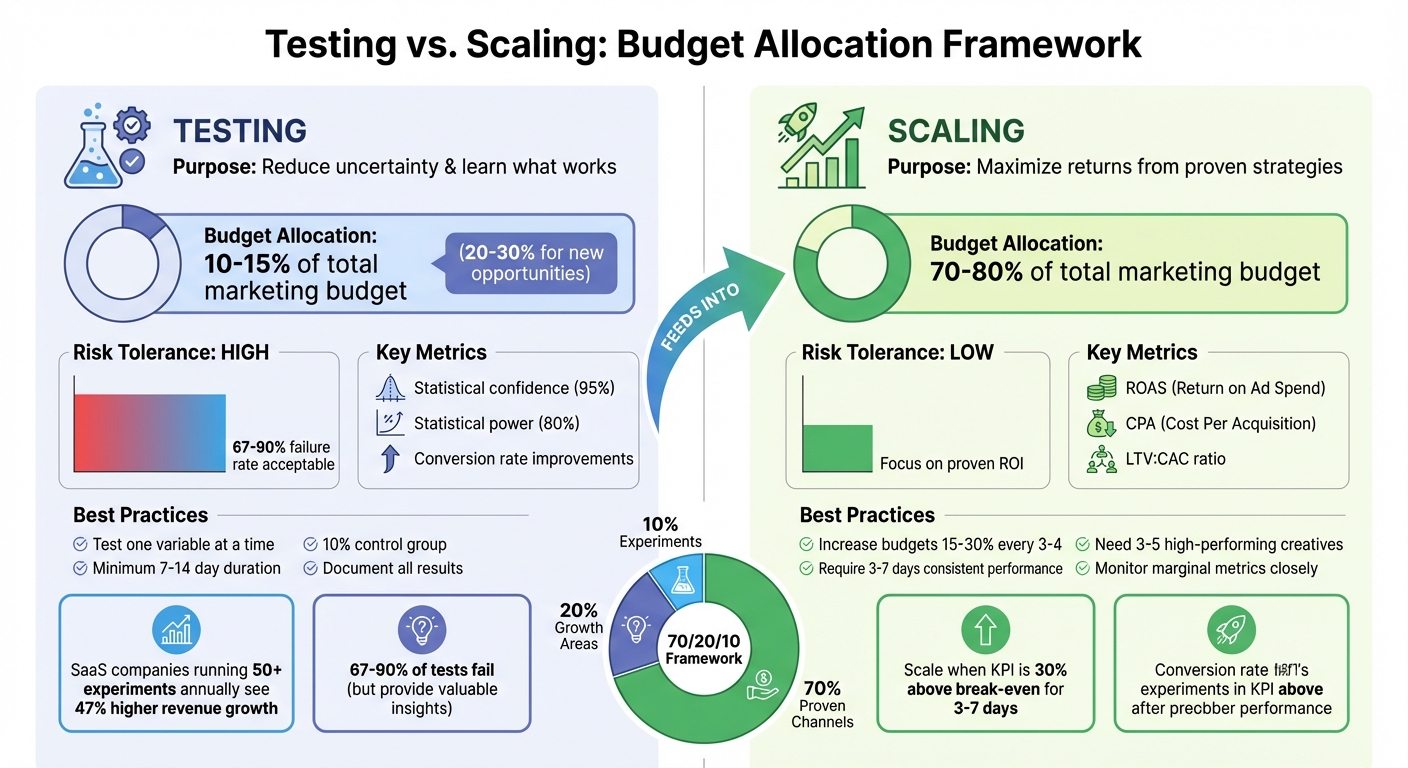
Testing vs Scaling Budget Allocation Framework
Understanding Testing: Purpose, Budget, and Best Practices
Why Testing Matters
Testing brings a structured, evidence-based approach to marketing, helping you move beyond guesswork to uncover what genuinely drives results. It’s a way to confirm assumptions before committing your entire budget.
Here’s a compelling stat: SaaS companies in their growth phase that run 50+ experiments annually see 47% higher revenue growth and 38% better customer retention compared to those running fewer than 10 tests. Even with a high failure rate of 67–90%, testing reduces risk and provides critical insights.
Testing also uncovers opportunities that a "set-it-and-forget-it" strategy would miss. For example, experimentation can reveal untapped potential in new channels, audiences, or messaging. With privacy changes phasing out third-party cookies, testing for incrementality – the actual lift your marketing efforts generate – has become one of the only reliable ways to measure ROI.
This systematic approach not only sharpens your marketing strategy but also helps you allocate budgets more effectively, based on your business stage.
How Much to Spend on Testing
The general rule of thumb is to allocate 10–15% of your total marketing budget specifically for testing. For instance, if you’re a B2C company where marketing typically accounts for about 21.1% of the overall budget, this means setting aside a dedicated portion rather than relying on leftover funds.
Your spending should also align with your business stage. If you’re still fine-tuning your product–market fit, consider allocating up to 20% of your marketing budget. For more established businesses, 5% may suffice.
Beyond percentages, calculate the minimum viable investment for each test based on your conversion metrics. If your budget is tight, focus on higher-funnel actions like "add to cart" rather than "purchase" to achieve statistical significance more quickly. Most tests aim for 80% statistical power and 95% confidence to ensure results are meaningful and not just random noise.
Best Practices for Testing
Focus on one variable at a time. Whether it’s the subject line, image, or audience, avoid testing multiple elements simultaneously. This way, you can clearly identify what’s driving the change.
Start with your best-performing campaigns as benchmarks. Always include a control group (typically 10% of your audience) and define clear hypotheses with specific sample sizes and test durations. For accurate results, establish your minimum sample size, required confidence level, and test duration – usually at least 7–14 days. Resist the urge to check results too early, as this can lead to false positives and poor decisions.
"The value of the test is not in the number of additional customers that you got… The value of the test is in making more informed decisions in the future." – Marti Sanchez, Recast
Document every test – successes and failures alike – in a shared repository. This habit builds institutional knowledge and helps your team avoid repeating costly mistakes. With a disciplined approach, you can ensure your testing efforts are both insightful and cost-effective.
sbb-itb-ad881f4
Scaling Proven Strategies: When and How
When to Scale: Identifying Ready Strategies
Scaling isn’t about guessing – it’s about timing, backed by data. A strategy is ready to scale once it moves past the learning phase, which typically requires around 50 optimization events or conversions per week. Look for 3–7 days of consistent performance where your primary KPI (like ROAS or CPA) is at least 30% above break-even levels.
"The right moment to scale isn’t a guess. It’s a decision based on performance signals, budget efficiency, and a clear growth strategy." – LeadEnforce
Another critical factor? Creative readiness. You’ll need 3–5 high-performing creatives to avoid ad fatigue as your spend increases. A single successful ad can quickly lose effectiveness at higher budgets, especially if frequency rises above 2–3, often resulting in performance drops.
Budget Strategies for Scaling
Once you’ve confirmed readiness, scale gradually. Increase daily budgets by 15–30% every 3–4 days. If ROAS starts to dip, reduce budgets by 10–20% to stabilize performance.
For high-value campaigns, consider the "Slow Burn" approach – raising budgets by just 1% daily. This method helps pinpoint the ideal spend level without compromising performance. As Jon Loomer, founder of Jon Loomer Digital, puts it:
"With Slow Burn, we want to find the sweet spot where you’re spending the most you possibly can while getting great results"
A balanced budget allocation is also key. Allocate 70–80% of your budget to proven winners and 20–30% to testing. This approach ensures you’re maximizing returns while keeping room for future growth. For example, in March 2025, a DTC skincare brand scaled its monthly ad spend from $100,000 to $500,000 while maintaining a 3.5x ROAS by following this structured method.
Horizontal scaling is another effective tactic. Duplicate winning ad sets to target new audiences, such as expanding from a 1% to a 3–5% lookalike audience or exploring new regions. This helps spread risk and avoids frequency spikes. Additionally, Campaign Budget Optimization (CBO) often outperforms Ad Set Budget Optimization (ABO) by dynamically shifting spend to the best-performing segments.
No matter the strategy, close monitoring is essential to ensure scaling efforts remain profitable.
Monitoring Performance During Scaling
To track progress, focus on marginal metrics like CPA and ROAS (MROAS) rather than just overall account averages. If additional spending delivers weaker results than before, you may have hit your performance ceiling.
Automated guardrails can help manage risks. For instance, pause ads if they spend 0.75–1.0× the target CPA without generating a conversion. Similarly, if ad frequency exceeds 3.0, pause and expand your audience before increasing budgets further. These measures prevent overspending on campaigns that aren’t delivering.
Real-world examples highlight the importance of these tactics. In early 2025, an apparel brand saw declining ROAS but turned things around by shifting budgets to broader audiences and refreshing ad creatives. They also introduced post-purchase upsells and increased average order values, boosting monthly revenue by 40% while maintaining profit margins. Meanwhile, a high-end furniture brand improved its ROAS by 25%, even with a 50% increase in Google Ads spend, by cutting underperforming segments and reallocating funds to high-intent keywords in Shopping ads.
If a campaign is marked as "Limited by Budget" but maintains a stable CPA, this signals a chance to increase the budget by 10–20%. Monitor performance for 48 hours before making further adjustments. The goal isn’t just to spend more – it’s to find the maximum budget at which your campaign remains profitable.
At Graystone Consulting, we use data-driven insights and adaptable budgeting models to help businesses fine-tune their scaling strategies and achieve the best ROI.
Next, we’ll dive into common pitfalls to watch for when testing and scaling.
Key Differences Between Testing and Scaling
Comparison of Budget, Risk, and Metrics
Understanding the distinction between testing and scaling is essential, as their purposes and strategies differ significantly.
Testing is all about reducing uncertainty. Instead of chasing immediate profits, the focus is on gaining insights and learning what works. Scaling, on the other hand, is about capitalizing on those insights to maximize returns from already-validated strategies.
When it comes to budgets, testing is more flexible. These funds are dedicated to experimentation and aren’t tied to strict ROAS (Return on Ad Spend) standards. Scaling budgets, however, grow incrementally – typically by 10–20% at a time – based on performance. Fun fact: many PPC issues can be resolved with basic math and quick budget adjustments. Sometimes, moving money around is all it takes to improve account performance, no matter the size.
Risk tolerance also shifts dramatically. Testing allows for a higher failure rate – up to 30% – because the goal is to figure out what works. Scaling, however, is all about playing it safe with proven strategies. While testing emphasizes rapid iterations and experimentation, scaling focuses on steady, measured adjustments informed by campaign performance.
Even the success metrics differ. Testing prioritizes statistical confidence and conversion rate improvements, while scaling zeroes in on profitability indicators like ROAS, CPA (Cost Per Acquisition), and LTV:CAC (Lifetime Value to Customer Acquisition Cost) ratios.
Here’s a quick breakdown of how testing and scaling compare across key aspects:
| Aspect | Testing | Scaling |
|---|---|---|
| Budget Allocation | 10–15% of total spend | Performance-based, incremental increases |
| Risk Tolerance | Higher (30% failure rate acceptable) | Lower (focus on proven ROI) |
| Success Metrics | Statistical confidence, conversion lift | ROAS, CPA, LTV:CAC ratios |
| Timeline | Rapid iterations | Ongoing adjustments based on performance |
| Audience Approach | Controlled experiments with isolated variables | Focused on proven, high-intent segments |
how i test & scale products with facebook ads in 2025. (full tutorial)
Common Mistakes in Testing and Scaling
Avoiding common missteps during testing and scaling can help protect your budget and set the stage for long-term success.
Scaling Too Quickly Without Enough Testing
Rushing into scaling without thoroughly testing your strategy is a surefire way to drain your budget. Statistics show that between 80% and 90% of startups fail during the scale-up phase. Why? They often miscalculate market demand or attempt to grow before locking in a repeatable model. The red flags are easy to spot: shrinking profit margins as revenue rises, operational chaos overwhelming your team, and a sharp drop in ROAS (Return on Ad Spend) after increasing your budget. On top of that, aggressive budget increases can reset campaign learning phases, wiping out the progress you’ve made in optimization.
To avoid this, scale cautiously. Only increase budgets by 20–25% every 24–48 hours once your campaigns show consistent performance. Focus on ad sets that have been both stable and profitable for at least 5–7 consecutive days. Instead of pouring more money into a single winning ad set (known as vertical scaling), duplicate it into new audiences – like different Lookalike percentages or interest groups – to distribute risk. This measured approach helps ensure growth without unnecessary setbacks.
Now, let’s look at why underfunding tests can be just as damaging.
Underfunding Tests
Testing often gets treated as an afterthought, with businesses assigning it whatever scraps of the budget are left after product development and marketing plans. The result? Experiments that are too small or too short to yield actionable insights, leaving teams guessing instead of optimizing.
Some marketers shy away from testing because they fear losing money on failed experiments. But here’s the reality: testing is one of the best ways to reduce uncertainty and make smarter decisions. Properly funded tests deliver clear, actionable results that can guide your strategy and fuel growth.
To make testing a priority, dedicate 5–20% of your total budget specifically for experimentation. Add a 10–15% contingency buffer to account for any unexpected challenges. Before launching a test, ask yourself, "If the results are great or terrible, what will we actually do with them?" If the answer is "nothing", skip the test altogether. This deliberate approach ensures your testing efforts contribute directly to sustainable growth.
Missing Clear KPIs
Even with proper budgeting and testing, success hinges on having clear performance metrics. Without them, it’s impossible to gauge whether your efforts are paying off. Teams often struggle when they can’t agree on what success looks like or when they focus on vanity metrics instead of meaningful outcomes.
Before spending a dime on testing or scaling, define key metrics like break-even ROAS and target CPA (Cost Per Acquisition). These numbers act as decision-making guardrails: if your performance crosses these thresholds, you’ll know whether to pause, adjust, or double down on your efforts. For scaling campaigns, focus on metrics like ROAS, CPA, and the LTV:CAC (Lifetime Value to Customer Acquisition Cost) ratio. For testing, prioritize statistical confidence and improvements in conversion rates.
To remove emotion from the equation, set up automated rules. For instance, configure your platform to automatically increase budgets by 15% only when CPA stays below your target and the ad set hits a minimum spend threshold. Letting your KPIs guide your decisions eliminates guesswork and keeps your strategy grounded in data. These steps ensure your campaigns stay on track for sustainable growth.
Building a Dynamic Budget Allocation Model
To stay ahead in the fast-paced world of marketing, it’s crucial to adopt a flexible approach to budgeting. Many top marketers have moved away from rigid annual budgets, opting instead for quarterly reforecasts. This rolling 90-day strategy enhances budget accuracy by 15%. It’s a smart move in a landscape where yesterday’s winning strategy might not work today.
Shifting Budgets Based on Performance
A great starting point is the 70/20/10 framework: dedicate 70% of your budget to reliable, high-performing channels, 20% to promising growth areas, and 10% to experimental testing. However, the real trick is to make every channel requalify for its share of the budget each quarter. Why? Because what worked before might not work again as market conditions evolve.
To keep things efficient, set up pre-approved triggers for reallocating funds before campaigns even begin. For instance, if a test fails to meet two consecutive performance benchmarks, redirect that budget to channels delivering stronger results. Companies using this kind of multi-layered measurement approach report 15–20% better budget efficiency compared to those relying on single-source attribution.
It’s also important to track the marginal KPI, which measures the cost of acquiring the next customer at current spending levels. This helps identify when a channel is hitting diminishing returns. For example, if Customer Acquisition Cost (CAC) rises while Return on Ad Spend (ROAS) plateaus, it might be time to shift about 15% of the budget from bottom-funnel conversions to top-funnel awareness. This ensures a steady flow of new customers while maintaining overall efficiency.
Quarterly Reviews for Budget Optimization
Breaking your 90-day cycle into three phases can help fine-tune your spending. In the first month, use Zero-Based Budgeting to set clear forecasts without carrying over previous allocations. In the second month, adjust based on real-time performance data. Finally, in the third month, conduct a full ROI review and post-mortem to assess what worked and what didn’t.
Pay special attention to your "innovation lab" – the 10% of your budget reserved for experiments. If a test doesn’t show meaningful results within 30 days, reallocate those funds immediately. Also, keep an eye out for frequency fatigue; exceeding impression limits can drive up CAC by as much as 35%.
At Graystone Consulting, we’ve woven these strategies into our marketing systems to ensure every dollar is working hard. By balancing testing with scaling, we help businesses achieve sustainable growth while staying adaptable in an ever-changing market.
Conclusion
Testing lays the groundwork for confident scaling, while scaling turns validated insights into measurable growth. Every experiment helps reduce uncertainty and ensures your budget is spent wisely. This constant back-and-forth between testing and scaling forms the backbone of the agile marketing strategies mentioned earlier.
Companies that prioritize ongoing experimentation see better outcomes. For instance, growth-stage SaaS companies running over 50 experiments a year report 47% higher revenue growth and 38% better customer retention compared to those running fewer than 10 tests. As Win Dean-Salyards from Heinz Marketing aptly says:
"The goal isn’t to run perfect tests. It’s to run informative ones"
For founder-led businesses, balancing careful testing with strategic scaling isn’t just helpful – it’s essential for sustained success. This means managing your marketing budget with flexibility, using quarterly reviews and data-driven adjustments. As Marti Sanchez from Recast puts it:
"The value of the test is not in the number of additional customers that you got… The value of the test is in making more informed decisions in the future"
Even a failed experiment can save you from scaling an underperforming campaign that could have drained your resources.
This balanced approach is central to the scalable marketing systems we develop at Graystone Consulting. By aligning testing with execution, every dollar spent becomes an investment in smarter, more sustainable growth. Looking ahead, the brands that thrive in 2026 won’t necessarily be the ones with the deepest pockets – they’ll be the ones that treat each dollar as an opportunity to learn and grow.
FAQs
How can I tell if a strategy is ready to scale?
To figure out if a strategy is ready to scale, start by defining specific benchmarks during the testing phase. These could include KPIs, target conversion rates, or cost-efficiency goals. Once these benchmarks are consistently achieved, it’s time to dive deeper into the strategy’s overall performance. Look for strong, repeatable results, effective use of budget, and clear signs of growth potential.
Scaling should only happen when the strategy demonstrates consistent success across a large enough sample size. This ensures the results aren’t just lucky flukes. By sticking to measurable outcomes and steady performance, you can confidently invest resources to scale and make a bigger impact.
How can I effectively test strategies with a limited budget?
Testing strategies on a limited budget calls for a sharp focus and smart use of data to get the most out of every dollar. Start by setting clear and specific goals for each test. For example, you might want to assess how a single ad creative performs or see how a particular audience segment responds. Narrowing your focus like this helps you avoid spreading your resources too thin.
Leverage any historical data you have to make informed decisions right from the start. This can cut down on guesswork and ensure your initial steps are more calculated. Once testing begins, scale your budget gradually – think small increases of around 10-20% – based on how well your campaigns perform. This approach minimizes risk and gives you room to adjust in real time.
Using structured techniques like A/B testing is a great way to collect actionable insights. These methods ensure that every dollar spent not only drives results but also teaches you something valuable. The ultimate goal is to focus on measurable outcomes, adjust based on data, and stay adaptable to make the most of your budget.
How should I allocate my budget between testing new strategies and scaling proven ones?
Balancing your budget between testing and scaling takes careful planning to get the best results without overspending. Start by allocating a specific portion of your budget for testing new strategies. This approach allows you to gather meaningful data while keeping financial risks in check. The key is to set aside enough to spot trends and opportunities without overextending your resources.
Once you’ve pinpointed strategies that work, shift gears toward scaling them. Use performance metrics like CPA (cost per acquisition) or ROAS (return on ad spend) to guide your decisions. Automating budget adjustments can help you focus on high-performing campaigns while pausing those that aren’t delivering results. This ensures your spending stays efficient and aligned with your goals.
By splitting your focus between trying new ideas and doubling down on proven strategies, you can build a marketing plan that’s both data-driven and designed to fuel growth while maximizing your return on investment.



0 Comments