





Struggling with chaotic marketing efforts? Here’s the solution: Fractional CMOs transform scattered tactics into structured, reliable systems that drive growth. They don’t just manage marketing – they build frameworks that ensure every part of your strategy works together seamlessly.
Key Insights:
- What they do: Fractional CMOs design systems, not just campaigns. They focus on governance, accountability, and data to create a self-sustaining marketing engine.
- Why it matters: Without a unified system, businesses waste resources, miss leads, and face unpredictable growth.
- Proven results: Companies using these systems report higher revenue growth, streamlined operations, and reduced costs.
5 Steps to Scalable Marketing:
- Audit: Identify revenue leaks and inefficiencies.
- Build Infrastructure: Connect tools like CRMs and automate processes.
- Align Teams: Ensure sales, marketing, and customer success work toward shared goals.
- Test & Optimize: Use data-driven experiments to refine strategies.
- Document: Create playbooks and SOPs for consistency and long-term success.
Fractional CMOs don’t just fix immediate problems – they leave behind a system your team can run independently, ensuring lasting growth.
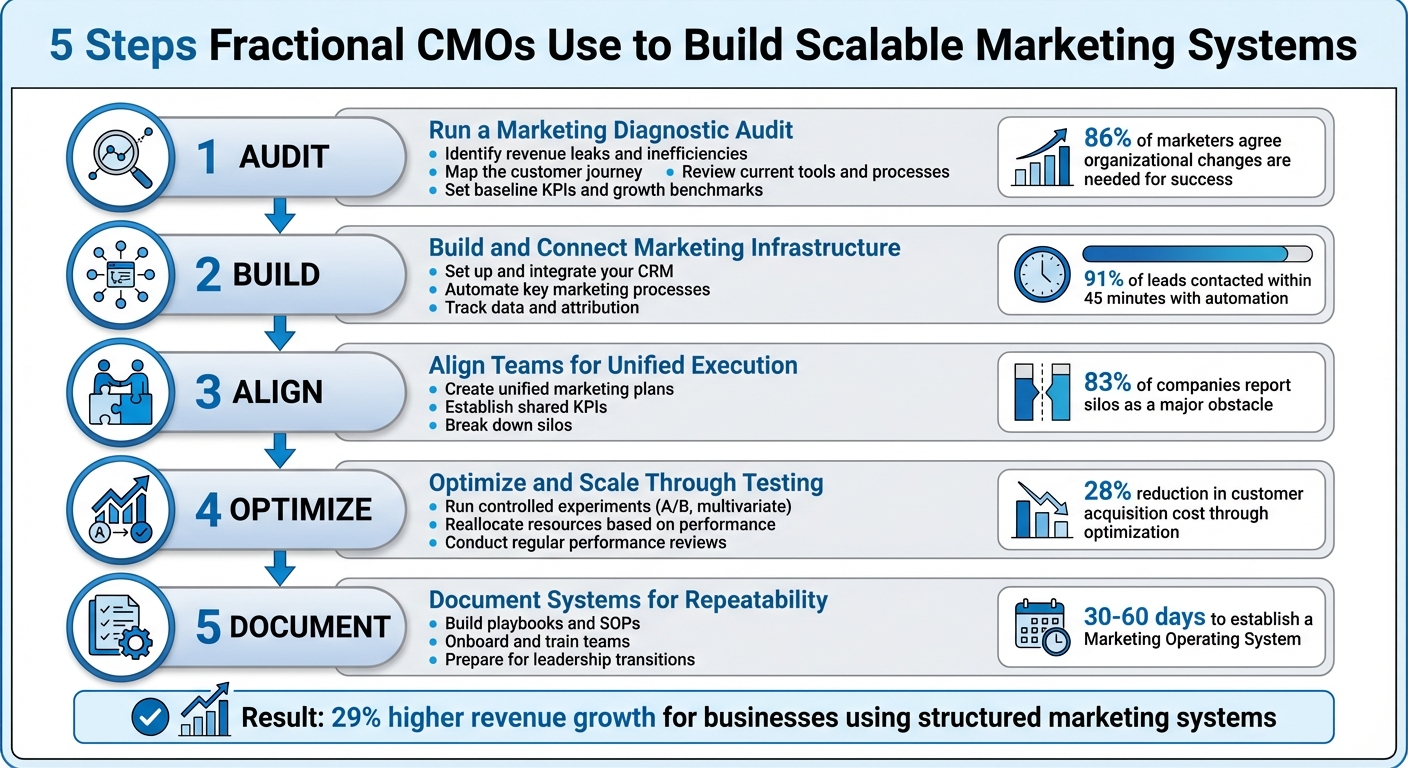
5-Step Framework for Building Scalable Marketing Systems
Fractional CMO Strategy: How to Scale Without Getting Overwhelmed
sbb-itb-ad881f4
Step 1: Run a Marketing Diagnostic Audit
Fractional CMOs start by identifying where revenue is slipping through the cracks with tailored consulting solutions. This isn’t just about collecting data – it’s about finding the root causes of these leaks. They look for disconnects in strategy, leadership bottlenecks, and gaps in team accountability throughout the customer journey.
The process goes beyond surface-level analysis. It evaluates how leadership operates in practice, rather than how it’s outlined on paper. Without being influenced by internal politics, Fractional CMOs can uncover where teamwork breaks down and decisions get delayed. This kind of clarity is crucial, especially considering that 86% of marketers agree organizational changes are needed to achieve lasting success.
From there, they map the customer journey, evaluate existing tools, and establish baseline metrics. This comprehensive approach ensures that revenue leaks are identified and addressed quickly.
Map the Customer Journey
One of the biggest sources of revenue loss happens during transitions between marketing, sales, and customer success teams. By mapping out every stage of the customer journey – from the first interaction on the website to closing a deal – Fractional CMOs can identify exactly where potential customers drop off and why.
The numbers are eye-opening: companies that skip formal journey mapping miss out on 15–20% of potential revenue growth because they fail to capture conversion and upselling opportunities. On the other hand, businesses with structured journey management programs see customer retention rates of 55%, compared to just 21% for those without. Fractional CMOs take it a step further by defining exit and advancement criteria for every stage of the journey. They also work closely with sales teams to uncover common pain points and assign clear ownership for each critical touchpoint, ensuring no lead falls through the cracks.
Review Current Tools and Processes
The next step is an infrastructure audit to determine whether the company’s tools and workflows are equipped to support growth. Many businesses discover that their CRM systems, automation platforms, and processes are either underused or poorly aligned with their goals. Fractional CMOs focus on the "marketing foundation" – the systems that should seamlessly connect data across channels but often fail to do so.
This audit includes mapping CRM fields to the customer journey, ensuring that every stage is properly tracked with specific data points and reports. When the data pipeline is broken – leaving marketing in the dark about what happens after a lead enters the sales funnel – it’s nearly impossible to attribute success accurately. The audit also identifies areas where teams waste time on manual tasks that could easily be automated, highlighting opportunities to streamline operations.
These insights guide the necessary system upgrades to support scalability. Once infrastructure gaps are clear, the focus shifts to establishing measurable goals.
Set Baseline KPIs and Growth Benchmarks
Without starting metrics, tracking progress is impossible. Fractional CMOs establish baseline key performance indicators (KPIs) such as Customer Acquisition Cost (CAC), Marketing ROI (ROMI), funnel conversion rates, and Customer Lifetime Value (CLV). Interestingly, only 23% of marketers feel confident in their ability to track the right KPIs. This diagnostic process helps zero in on the metrics that matter most for the company’s specific growth stage.
For example, early-stage businesses with $1M–$3M in revenue might focus on foundational priorities like refining their messaging and defining their Ideal Customer Profile (ICP). In contrast, companies in the $3M–$10M range often prioritize metrics like pipeline velocity and funnel conversion rates.
The baseline also includes operational benchmarks, such as comparing actual revenue to forecasts and calculating profit per employee. These insights reveal inefficiencies that go beyond marketing, setting the stage for measurable improvements. By establishing this "before" snapshot, companies can objectively assess the impact of new strategies and systems.
Step 2: Build and Connect Marketing Infrastructure
After identifying revenue leaks through a diagnostic audit, the next step is to create the technical framework that transforms those insights into actionable solutions. This infrastructure ensures smooth data flow – from the first website visit to closing a deal – laying the groundwork for consistent growth.
"The difference between that $120K waste and this $121K investment: ownership. They control every system. If I get hit by a bus tomorrow, their HubSpot workflows don’t stop working." – Art Nikashin, Marketing Systems Architect
Set Up and Integrate Your CRM
Your CRM should align with your business goals, connecting every touchpoint to measurable growth. But setting up a CRM isn’t just about strategy – it’s about execution. Surprisingly, 60% of fractional CMOs have never actually built a CRM workflow or set up technical attribution themselves.
The process begins by observing real sales workflows to ensure the CRM mirrors actual operations. For example, in 2024, a California law firm collaborated with Art Nikashin to design custom HubSpot pipelines that replicated their intake process, covering everything from consultations to case signings. They also integrated CallRail for multi-number attribution, allowing them to track every phone call back to its marketing source. Over a year, this setup helped the firm sign 219 cases, generate $17M in revenue, and cut their cost per case from $8,600 to $4,297.
To handle multi-source leads, CRMs require unique identifiers and deduplication logic. Integration with tools like CallRail, Zapier, and form builders such as Gravity Forms ensures no lead is overlooked. Businesses must also maintain full administrative access to platforms like HubSpot, Google Analytics, and CallRail to keep systems operational, even if a consultant leaves.
Building a CRM typically takes six to eight weeks, depending on the complexity of the system and the quality of the data. While not a quick fix, a well-built CRM becomes a long-term asset that grows in value over time.
Automate Key Marketing Processes
Speed matters when responding to leads. One SaaS company, for instance, spent $12,000 a month on strategy but left Typeform leads untouched. After revamping their system with Gravity Forms, Zapier, and Kit email sequences, their monthly recurring revenue jumped from $5,000 to $45,000 in just nine months.
Automation eliminates manual bottlenecks, ensuring processes run smoothly and efficiently. Key areas to automate include lead intake and routing, so every form submission reaches the right sales rep immediately. Studies show that automated routing can lead to 91% of leads being contacted within 45 minutes. Lead scoring and qualification are also crucial, enabling the CRM to prioritize high-value prospects based on their behavior and profile.
Automated follow-up sequences play a vital role in nurturing leads. For example, the California law firm implemented a seven-stage email automation sequence to engage prospects who weren’t ready to commit right away. These sequences used conditional logic to send the right message at the right time, keeping the firm top-of-mind with minimal effort.
Document and automate any repetitive process to save time and reduce errors. However, make sure all automation is built within accounts owned by the client, not on platforms controlled by consultants, to ensure businesses retain control of their systems.
Once automation is in place, the next step is ensuring every action is trackable.
Track Data and Attribution
Multi-channel attribution ties together data from different sources, allowing businesses to trace every lead back to its origin and understand which marketing efforts are driving results.
Hidden form fields are a simple yet effective way to capture UTM parameters. These fields automatically tag leads with their marketing source upon form submission, linking inquiries to specific campaigns. For businesses that rely on phone calls, tools like CallRail connect offline conversions to digital ad spend, closing the attribution gap.
Centralized dashboards take this a step further by linking ad spend directly to revenue. For example, the California law firm’s real-time reporting revealed that certain channels delivered an 18.6× return on investment over 12 months. This shifts the focus from vanity metrics like clicks and impressions to critical metrics such as Customer Acquisition Cost (CAC), Lifetime Value (LTV), and pipeline conversion rates.
Maintaining clean data is equally important. Automated workflows can handle duplicate entries and ensure consistency across platforms using tools like Zapier or built-in CRM deduplication features. To future-proof the system, businesses should document their setup with resources like a "System Map" PDF and training videos, enabling internal teams to manage the infrastructure even during leadership changes.
Invest in systems that ensure long-term operational stability and measurable results.
Step 3: Align Teams for Unified Execution
Once a solid marketing infrastructure is in place, the next step is ensuring that all teams are working toward the same goals. Without alignment, even the most advanced systems can falter – especially when departments operate in silos, duplicate efforts, or prioritize conflicting objectives.
Create Unified Marketing Plans
A fractional CMO takes high-level business objectives and translates them into actionable plans with clear responsibilities. This involves defining roles, setting timelines, and establishing success metrics. The process blends strategic direction from leadership with input from teams on the ground. For example, leadership might outline 3–5 key strategic goals, while teams from marketing, sales, and customer success propose specific initiatives to achieve them.
Take the case of a mid-sized B2B service provider. Between 2024 and 2025, they transitioned from working with disconnected vendors to an integrated fractional marketing team. Within three months, this unified team consolidated their strategy and launched a cohesive rebrand. The result? A 42% increase in qualified leads in the first quarter.
Leadership plays a critical role here. The fractional CMO must have decision-making authority over budgets and personnel, including the ability to replace underperforming agencies. This ensures accountability and keeps execution on track.
"A Fractional CMO who cannot fire a non-performing agency does not own the result; the agency owns the Fractional CMO." – Kamyar Shah, Founder, World Consulting Group
Establish Shared KPIs
Misalignment often stems from teams tracking different metrics. For instance, marketing might celebrate high website traffic, while sales remains frustrated with poor lead quality. A unified scorecard ensures everyone is focused on the same revenue-driven outcomes rather than isolated metrics.
Key shared metrics often include Customer Acquisition Cost (CAC), Lifetime Value (LTV), pipeline conversion rates, and marketing-sourced revenue. These shared KPIs help unify efforts. In fact, 77% of leaders identify silos as a top challenge to achieving strategic goals.
To further align teams, a fractional CMO creates Service Level Agreements (SLAs) between marketing and sales. These agreements define what qualifies as a Marketing Qualified Lead (MQL) versus a Sales Qualified Lead (SQL), set follow-up expectations, and enable processes like automated lead routing. When both teams are aligned, 91% of leads can be contacted within 45 minutes.
Break Down Silos
Silos are a common issue, with 83% of companies reporting them and 40% of marketers citing them as a major obstacle. Silos slow down execution and can lead to conflicting messages across teams.
Fractional CMOs play a key role in breaking down these barriers. Acting as a bridge between sales, product, and customer success, they facilitate cross-functional workshops to define the Ideal Customer Profile (ICP) and align messaging. This ensures everyone is on the same page. By embedding themselves in internal meetings – like daily check-ins and weekly planning sessions – they become an integral part of the team.
For example, in late 2024, a performing arts nonprofit partnered with a fractional CMO to optimize the launch of a summer concert series. The fractional CMO developed the strategy, while an agency executed social and paid media campaigns. This collaboration generated $97,500 in ticket sales from a $15,400 media spend, resulting in a 78% increase in Return on Ad Spend (ROAS).
CEO support is essential for success. When the CEO publicly endorses the fractional CMO during all-hands meetings, it grants the authority needed to lead both internal teams and external partners effectively.
With teams now aligned, the foundation is set for rigorous testing and scalable growth, paving the way for the next step: continuous testing and optimization.
Step 4: Optimize and Scale Through Testing
Once teams are aligned and infrastructure is connected, it’s time to focus on testing – driven by data, not guesswork. This step is all about applying the scientific method to refine marketing decisions. Each experiment should begin with a clear hypothesis, such as, “Changing the CTA button to green will increase clicks by 10%”. The goal is to control variables and measure real outcomes, ensuring decisions are based on evidence.
Run Controlled Experiments
To achieve meaningful results, experiments must follow strict statistical principles. Most marketing experiments aim for 80% statistical power to ensure reliable findings. This means tests need adequate sample sizes and shouldn’t be stopped too early, as doing so can lead to misleading results. Fractional CMOs typically use three main types of experiments:
- A/B Testing: Compare a "champion" version against a "challenger" to identify which performs better.
- Multivariate Testing: Test multiple variables at once to see how different combinations impact outcomes.
- Incrementality Tests: Withhold marketing from a specific group to measure the true lift of a campaign.
"The science of experimental design applied to marketing is about carefully selecting and controlling the variables that affect outcomes, designing the approach for sample size sufficiency, and tailoring the overall design to have enough power to read the phenomenon being observed."
– Nick Stoltz, Chief Strategy Officer, Measured
Avoid checking interim data frequently, as this can lead to false positives. Keep a central record of hypotheses, test variations, and results to avoid repeating failed experiments. Once experiments confirm what works, the focus should shift to optimizing resources.
Reallocate Resources Based on Performance
With insights from testing, budgets can be redirected to high-performing channels. For example, one company reduced its customer acquisition cost by 28% by reallocating 40% of its budget based on performance data. Fractional CMOs should have the authority to adjust budgets, messaging, or even replace underperforming campaigns.
"The Fractional CMO’s job is to build an experimentation framework where every campaign teaches you something, and every insight feeds the next decision."
– Matthew Deal, SaaS Fractional CMO
Conduct Regular Performance Reviews
Frequent performance reviews ensure marketing stays agile. Instead of relying on quarterly reports, these reviews allow for course corrections within days. Companies that adopt structured review processes often see impressive results – one case documented a 35% increase in Marketing Qualified Leads within just 90 days.
"The ‘Governance Cadence’ is the heartbeat of the Operating System. It transforms strategy from a quarterly presentation into a weekly discipline."
– Kamyar Shah, Fractional CMO
Reviews should prioritize a hierarchy of metrics to identify issues that demand immediate attention. For example, a sudden drop in pipeline velocity might call for executive action, while a small dip in lead volume may only require closer monitoring. Interestingly, 64% of marketing leaders are now leveraging flexible, on-demand talent for strategic projects, with companies using fractional CMOs reporting 29% faster revenue growth.
This ongoing cycle of testing, resource allocation, and review ensures systems are continuously refined. The next step is to document these optimized processes to maintain consistency and scalability, even during leadership transitions.
Step 5: Document Systems for Repeatability
Testing and refining your strategies only pay off if the lessons learned are preserved. Without proper documentation, every leadership change risks erasing progress and forcing teams to start from scratch. The solution? Build systems that capture what works and ensure they can run smoothly, even without constant oversight.
Build Playbooks and SOPs
A solid marketing playbook should cover five key areas: campaign planning workflows, lead management processes (like scoring and routing), technology stack documentation, reporting templates, and a centralized marketing calendar. These guides aren’t just about the "how" but also the "why" behind decisions, making them invaluable for continuity.
"You don’t rise to the level of your goals. You fall to the level of your systems."
– James Clear
Visual aids – like flowcharts, screenshots, and checklists – can make these documents easier to follow. Store them in digital, searchable platforms like Notion, Slite, or Monday.com to ensure updates happen in real time. Assigning ownership, often to a Marketing Operations Manager, is crucial. Without someone responsible for maintaining the playbook, it can quickly become outdated.
Once your playbooks are ready, the next step is to make them part of your team’s daily operations.
Onboard and Train Teams
Documented SOPs simplify onboarding by giving new hires step-by-step instructions they can follow without needing constant guidance. This ensures consistency across the team and reduces reliance on verbal explanations. Scheduling quarterly reviews of these documents helps keep them aligned with updated tools, roles, and business goals. Linking live templates and dashboards directly to the playbook, instead of duplicating information, keeps it streamlined and easy to navigate.
A well-trained team ensures that operations remain consistent, even during times of change.
Prepare for Leadership Transitions
Systematizing processes isn’t just about day-to-day efficiency – it’s also about preparing for leadership changes. Without documented systems, transitions can disrupt marketing execution and stall progress. A well-structured Marketing Operating System captures essential knowledge and turns it into repeatable processes, reducing the risk of setbacks.
Take this example: A B2B SaaS company with A B2B SaaS company with $12M in ARR brought in a Fractional CMO to overhaul their marketing.2M in ARR brought in a Fractional CMO to overhaul their marketing. The leader replaced a disorganized "black box" system with a structured Operating System over eight months. They implemented a weekly governance process, standardized CRM data, and renegotiated agency contracts to focus on performance. By the end of the engagement, the system was self-sustaining, allowing the company to hire a full-time Director to manage it. The result? A 40% growth in the following year.
"The actual product of the engagement is not the person; it is the governance structure, the decision cadence, the accountability protocols, and the data architecture they leave behind."
– Kamyar Shah, Founder, World Consulting Group
With proper guidance and ownership, most businesses can establish a Marketing Operating System in 30 to 60 days. The final phase of a fractional engagement should focus on wrapping up SOPs, playbooks, and dashboards, ensuring the marketing engine is fully operational and leaving behind a 12-month roadmap with clear milestones.
Conclusion: Building Growth with Fractional CMOs
Creating scalable marketing systems requires a thoughtful approach – from conducting audits that uncover revenue leaks to building infrastructure that integrates your CRM, automation, and attribution tools. The main shift lies in viewing marketing as a long-term asset, not just a series of short-term campaigns.
Key Takeaways for Founder-Led Businesses
Fractional CMOs rely on a five-step framework – audit, build, align, optimize, and document – to transform scattered marketing efforts into a system that drives sustainable growth. Each step tackles a specific challenge: audits identify where revenue is lost, infrastructure connects fragmented tools, alignment fosters collaboration across teams, testing reallocates resources to effective strategies, and documentation ensures continuity through leadership transitions. Businesses that adopt these structured systems experience 29% higher revenue growth on average compared to those relying on unstructured tactics.
"When you hire a role, you are renting effort. When you hire a Fractional CMO to install an Operating System, you are buying an asset."
– Kamyar Shah, Fractional CMO
These strategies pave the way for practical solutions and long-term success.
How Graystone Consulting Can Help
Graystone Consulting specializes in building scalable marketing systems tailored for founder-led and growth-stage businesses. Using the proven five-step framework, they create measurable, data-driven systems that deliver results.
Their process kicks off with a Diagnostic Sprint to map your go-to-market strategy, pinpoint funnel inefficiencies, and highlight ownership gaps. Next, they implement connected marketing infrastructure, including CRM setups, automation workflows, and KPI dashboards – backed by a 15–20% funnel lift guarantee. Through their Leadership Retainer, Graystone provides ongoing fractional CMO support with regular strategy sessions, ensuring your system evolves as your business grows. Their goal is to empower your team with sustainable systems, reducing reliance on external support while building lasting capabilities.
FAQs
When should I hire a fractional CMO?
When your business needs strategic marketing leadership but hiring a full-time executive doesn’t make financial sense, it’s time to consider a fractional CMO. This can be a game-changer if your marketing efforts have hit a plateau, you’re looking to scale quickly, or you’re navigating a growth phase that demands expert input. A fractional CMO can help you build scalable systems, fix revenue leaks, and implement data-driven strategies to support long-term growth – all without the hefty price tag of a full-time hire.
What tools do I need for a marketing system?
To set up an effective marketing system, you’ll need a handful of key tools:
- CRM and marketing automation platforms: These help manage your leads and automate campaigns, saving time and improving efficiency.
- Workflow automation tools: Ideal for handling repetitive tasks, so your team can focus on strategic work.
- Analytics tools: Crucial for tracking performance and understanding attribution, ensuring your efforts are on the right track.
- SEO and content marketing tools: Boosts your online presence, making it easier for potential customers to find you.
Graystone Consulting combines these tools with thorough audits and leadership strategies, building marketing systems that are scalable and driven by data.
How fast will I see revenue impact?
When businesses implement scalable marketing systems under the guidance of a fractional CMO, the financial impact often becomes evident within 12 months. During this time, many companies see a 3-5x return on investment, driven by enhanced marketing infrastructure, strategic direction, and systems designed to deliver measurable growth.



0 Comments