





Founder-led branding works because it builds trust through personal connection. Founders’ stories and voices resonate more than corporate logos, with LinkedIn founder accounts generating 561% more reach than company pages. But as companies grow, this strategy can become a bottleneck. Founders often struggle to scale their influence without slowing operations or creating inconsistencies in messaging.
Key takeaways:
- Challenges: Founders controlling every decision, inconsistent messaging, and difficulty scaling personal stories into systems.
- Solutions: Shift from founder-driven to system-driven branding by creating scalable processes, codifying the founder’s insights, and delegating effectively.
- Case Studies: Companies like Canva and Gumroad succeeded by embedding their founder’s vision into scalable frameworks while reducing dependency on the founder’s day-to-day involvement.
- Pro Tip: Fractional CMOs can help growth-stage companies bridge the gap between founder vision and operational execution.
The goal? Build systems that retain the founder’s voice but allow the brand to grow independently of one person.
Founder-Led Marketing Strategy: How to Scale Trust Without Becoming the Bottleneck
sbb-itb-ad881f4
Main Challenges When Scaling Founder-Led Brands
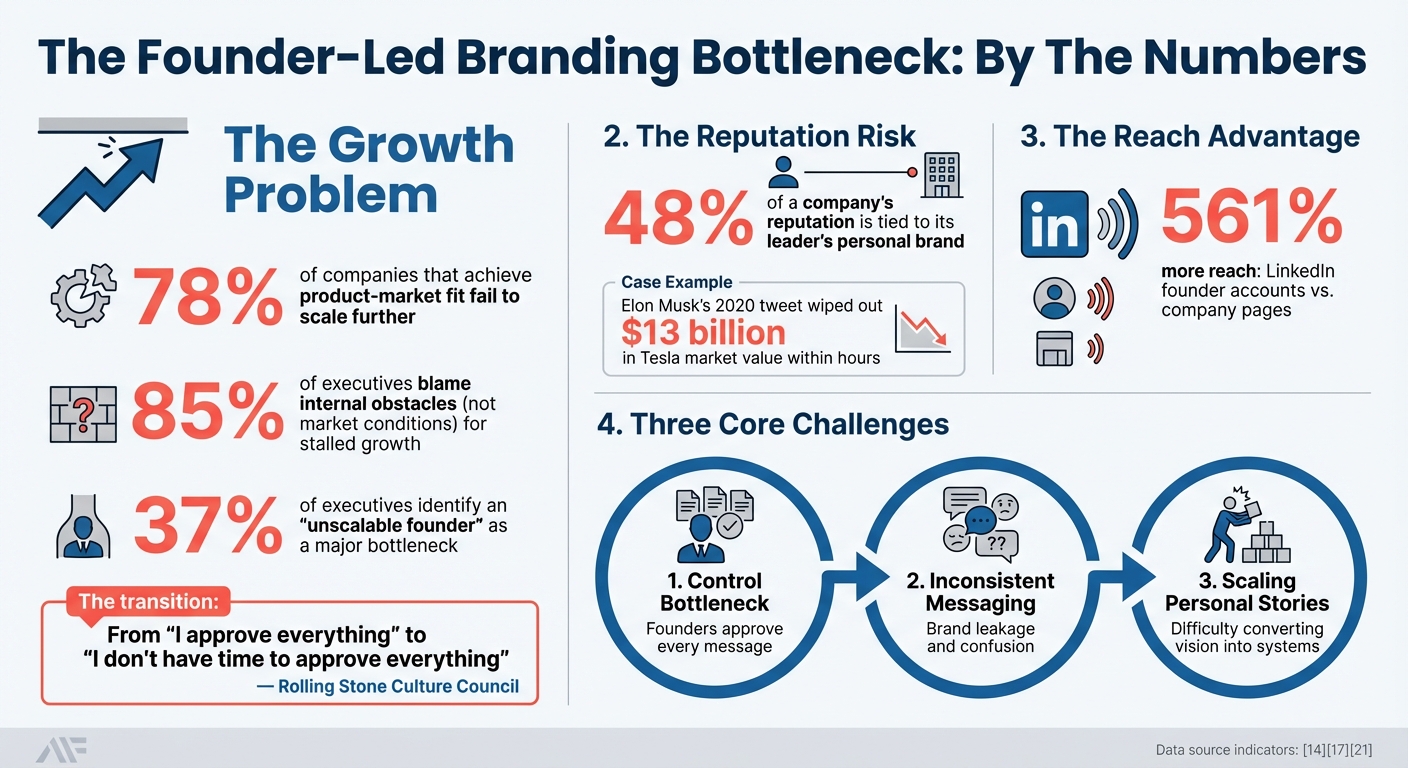
Founder-Led Branding Challenges: Key Statistics and Growth Bottlenecks
Scaling a founder-led brand comes with its own set of hurdles. The data paints a clear picture: 78% of companies that achieve product–market fit fail to scale further, and 85% of executives blame internal obstacles over market conditions for stalled growth. Among these, 37% of executives point to an "unscalable founder" as a major bottleneck.
The issue boils down to this: founders often become the choke point. When every decision – whether it’s approving marketing campaigns, replying to customer emails, or tweaking brand strategies – requires their input, the entire operation slows to a crawl. Important details like pricing strategies, feature rollouts, or onboarding processes often remain locked in the founder’s head, leaving teams unable to act independently. As the Rolling Stone Culture Council put it:
"The hardest transition in these companies is the shift from ‘I approve everything’ to ‘I don’t have time to approve everything’".
The Problem of Inconsistency
Another challenge is inconsistency in messaging. A founder’s personal brand often becomes so intertwined with the company that their mood or opinions can directly impact the business. Take Elon Musk, for example. In May 2020, his tweet stating, "Tesla stock price is too high", wiped out $13 billion in market value within hours. Research shows that 48% of a company’s reputation is tied to its leader’s personal brand. This means that any off-brand comment or misstep can have immediate consequences for the business.
Translating Personal Vision Into Scalable Systems
Founders also face difficulty in converting their personal stories and vision into systems that can scale. Marketing, often tied to the founder’s identity, becomes hard to delegate. This creates friction when new marketing leaders try to implement fractional CMO-led structured processes. The result? A growth ceiling where every campaign still hinges on the founder’s direct involvement, which limits scalability.
These challenges boil down to three main issues:
Founders Who Control Every Message
The need for founder approval on every single message – whether it’s a social media post, an email, or a customer response – is a common growth killer. This bottleneck slows decision-making and delays campaigns, stifling momentum. As Alexandria Ohlinger, a brand strategist, aptly said:
"Until you let go, you are the bottleneck, not the algorithm".
Even when tasks are delegated, they often creep back onto the founder’s plate over time, tethering the business to one person’s bandwidth. This not only delays progress but also prevents teams from building scalable systems.
Brand Messages That Don’t Align
A founder’s shifting opinions can lead to inconsistent brand messaging. This "brand leakage" creates confusion – customers might trust the founder but fail to connect with the company itself. While early-stage customers may appreciate an unfiltered, personal touch, larger enterprise clients expect professionalism and consistency. As the company grows, what once felt authentic can start to seem erratic, making it harder to close deals. This highlights the need for standardized brand narratives.
Turning Personal Stories Into Scalable Standards
One of the toughest transitions is transforming a founder’s unique experiences into clear, repeatable brand guidelines. Without these, the brand struggles when the founder steps away or focuses on other priorities.
A great example is Adam Holmgren, CEO of Fibbler. In January 2026, after landing his first 50 customers through his personal LinkedIn, growth hit a wall. To move forward, he codified his insights into tangible brand assets – like a pink lion mascot – that could stand on their own without his constant involvement. This shift from a founder-centric approach to a "founder-plus" strategy is often the key to building a brand that thrives independently of one person’s energy.
Case Studies: How Growth Companies Solved Branding Problems
Looking at past challenges, these case studies highlight how companies turned personal branding into scalable, system-driven success through tailored consulting strategies.
Canva: Melanie Perkins and the Power of a Personal Vision
Melanie Perkins faced over 100 rejections from venture capitalists across three years before finally securing seed funding. Instead of letting these setbacks define her, she turned them into a compelling story that resonated with creators worldwide.
While teaching design in Perth, Australia, Perkins noticed that overly complex design tools discouraged creativity. This sparked her mission to "democratize design". To bring her vision to life, she used what she called "Column B thinking" – imagining an ideal future and working backward to create a roadmap. This approach helped her team stay aligned with Canva’s values as the platform grew to serve more than 240 million monthly users across 190 countries.
Even as Canva reached a $26 billion valuation, Perkins stayed closely tied to the brand. She personally welcomed new employees during orientation and shared major milestones through her own social media posts rather than relying solely on traditional press.
Understanding the intimidation new users might feel when faced with a blank canvas, Perkins introduced creative solutions like a 23-second onboarding video and the "monkey challenge", a fun task designed to build confidence. This idea stemmed from her background in psychology. As she explained:
"We realized it wasn’t just the software that needed to be simple; we had to build people’s confidence. Every confusing button made users feel stupid."
- Melanie Perkins, CEO and Co-founder, Canva
These user-focused strategies led to 50,000 signups in Canva’s first month and supported eight years of profitability. Perkins also scaled her values through systems like programmatic SEO and localized experiences in over 100 languages, ensuring Canva’s message stayed consistent as it grew.
Now, let’s look at how Gumroad’s approach to transparency provided a different, yet equally effective, path to scaling a founder-led brand.
Gumroad: Sahil Lavingia’s Radical Transparency
While Canva leaned on a narrative-driven approach, Gumroad rebuilt trust through radical transparency during a critical moment. After raising $8 million in venture capital, Gumroad hit a major roadblock in 2015, failing to secure a Series B round. This forced Sahil Lavingia to lay off 75% of his team (15 employees).
Instead of hiding this failure, Lavingia embraced it openly. In 2019, he published an essay titled "Reflecting on My Failure to Build a Billion-Dollar Company," which struck a chord with readers, amassing over 1 million views. From there, he adopted a transparency-first model, publicly sharing monthly revenue, salaries, and other key business metrics. This openness reduced the need for traditional marketing and built trust among creators.
Lavingia also made Gumroad’s product roadmap public, allowing creators to vote on features and see their suggestions implemented quickly. By early 2026, Gumroad had achieved over $10 million in annual recurring revenue, with Lavingia as the sole full-time employee. By January 2025, the platform had enabled creators to collectively earn $200 million – all without a dedicated marketing budget.
As Lavingia succinctly put it:
"If you’re profitable, you can take unlimited shots on goal. If you’re not, you’re on a countdown to zero."
- Sahil Lavingia, Founder, Gumroad
These case studies show how embedding a founder’s core values into scalable systems can ensure a brand retains its essence, even as it grows.
How to Scale Founder-Led Branding
To scale a founder-led brand effectively, the key is to shift from relying on spur-of-the-moment creativity to building structured systems. In this setup, the founder provides strategic guidance while specialized teams handle tasks like editing, design, and distribution. This transition helps eliminate bottlenecks and sets the stage for a more efficient, scalable marketing approach.
Building Marketing Systems That Scale
Chris Walker demonstrated the power of a simple yet effective content system while building an 8-figure B2B company between 2021 and 2024. His strategy revolved around three core content pillars: 65% authority content (technical frameworks), 25% personal content (journey and lessons learned), and 10% sales content (product updates). This balance fosters trust before making a sales pitch and can be replicated across various platforms.
For example, a streamlined content creation process might look like this: spend two hours every quarter planning 12 topics, record twelve 5-minute videos, and then let the team handle transcription, editing, and scheduling for a 12-week content series. Peter Caputa, CEO of Databox, uses a similar approach with his "building in public" LinkedIn posts, generating around 100 free trial sign-ups each month.
The technical tools required for this don’t have to be expensive. A basic setup might include scheduling tools like Buffer or Hootsuite (costing $10–$50 per month) along with free or low-cost options like Google Docs and Loom. The secret isn’t in fancy tools – it’s in building consistent, repeatable processes rather than relying on one-off campaigns.
Using Fractional CMOs to Manage Brand Growth
A fractional CMO (Chief Marketing Officer) offers senior-level expertise to design and implement a go-to-market strategy at a fraction of the cost of a full-time hire. Companies that use fractional CMOs report 29% higher revenue growth. These professionals typically charge between $8,000 and $20,000 per month, which represents a 60–70% cost-saving compared to hiring a full-time CMO.
Unlike agencies that focus on deliverables like blog posts or ads, fractional CMOs concentrate on metrics that matter – revenue, pipeline quality, and customer acquisition costs. As Maansi Sanghi, founder of Envizon, puts it:
"Agencies run sprints. Fractional CMOs build tracks".
One example of this in action is Graystone Consulting, which specializes in creating scalable marketing systems for founder-led businesses. Their services include audits to identify revenue leaks, setting up integrated growth systems, and providing ongoing fractional CMO leadership. This approach is particularly effective for businesses in the $1M–$10M revenue range, ensuring data-driven, sustainable growth while keeping the founder’s vision at the core.
Connecting Founder Stories to Company Goals
In January 2026, Adam Holmgren, CEO of Fibbler, expanded his founder-led branding strategy by combining his personal LinkedIn activity with Thought Leader Ads and memorable brand elements, such as a pink lion mascot. This approach helped Fibbler successfully enter the U.S. market from its European base. Holmgren emphasizes that maintaining trust is crucial when tying a founder’s story to broader business goals.
To ensure founder narratives align with company objectives, the Founder Story Arc Framework provides a helpful guide. Every piece of content should address these four elements: the problem identified, the solution created, the mission behind it, and proof of its success (metrics). This method ensures that founder stories stay relevant to customer needs rather than veering into self-promotion.
Key Takeaways: Moving from Founder-Driven to System-Driven Branding
Shifting from founder-driven to system-driven branding isn’t about sidelining the founder – it’s about amplifying their influence in a scalable way. As Set2Close explains, "The founder’s journey is about transitioning from being the indispensable mover to being the visionary engineer who designs the machine that can move the world". This shift involves turning personal intuition into repeatable systems that a team can execute.
To start, focus on codifying what drives your decisions – your "Founder Operating System." This includes mental models and decision-making frameworks that guide your instincts. Create tools like a "Story Bank" to document origin stories and a "Voice Blueprint" to ensure consistent messaging.
Support this transition with a system built on three pillars:
- People: Hire and train a team that aligns with your vision.
- Process: Document the steps for key functions to ensure consistency.
- Accountability: Set clear metrics and performance checks to track progress.
Companies like Canva and Gumroad show how essential continuous refinement is. Treat your brand like a living platform by running monthly optimization sprints. Use these sprints to retire outdated messaging, clarify unclear guidelines, and adjust based on market feedback. Keep a decision log to document major strategic choices, ensuring your future decisions align with your brand’s overall structure.
For businesses in the $1M–$10M range, fractional CMO services, such as those offered by Graystone Consulting, can provide strategic leadership without the expense of a full-time CMO. This approach bridges the gap between a founder’s vision and effective operational execution.
FAQs
When does founder-led branding start to limit growth?
When a brand is heavily tied to its founder, growth can hit a wall if the founder becomes a bottleneck in decision-making. This often emerges as the business expands, and the founder’s hands-on approach starts to slow things down. For example, if every marketing decision needs the founder’s sign-off, it can lead to delays, lower team morale, and make scaling harder. To keep growing, it’s crucial to shift toward a more decentralized and structured approach, allowing teams to operate more independently.
How do you codify a founder’s voice without losing authenticity?
To truly capture a founder’s voice, start by digging into their core purpose, personality, and values. These elements should shape the brand’s narrative. Build the story around their genuine experiences and beliefs, ensuring that everything – messaging, visuals, and even decisions – feels aligned with who they are. Skip the overly polished approach; instead, lean into personal insights and perspectives. This creates a distinct, relatable identity that fosters trust and feels unmistakably human.
What should a fractional CMO own vs. the founder?
A fractional CMO takes charge of the big-picture marketing strategy. This includes shaping the brand’s identity, refining its positioning, crafting messaging, and setting up marketing systems that can grow with the company. They ensure all marketing efforts align with business goals while also managing the day-to-day execution.
Meanwhile, the founder stays focused on steering the company’s vision, upholding core values, and driving product innovation. Their role is to ensure the brand stays true to its mission and resonates with its audience.
This dynamic creates a clear division of responsibilities: the founder leads growth and innovation, while the fractional CMO ensures the brand’s marketing is consistent and scalable. Together, they build a solid foundation for long-term success.



0 Comments